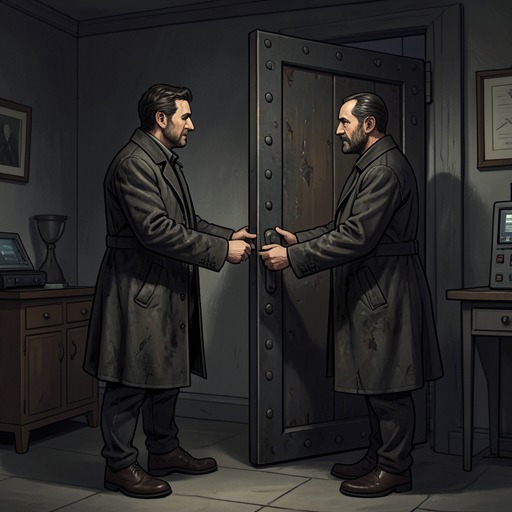
Apollo
Notes from UndergroundApollon is the Underground Man’s servant and a fixture of the secluded household in which the narrator tries to withdraw from other people. Over years of shared domestic life, his quiet, self-possessed manner becomes a daily provocation to the narrator, who tries to assert authority by withholding wages and finally orders Apollon to fetch a police officer. The episode turns a servant’s continued presence into a measure of the narrator’s dependence: in his private refuge, he cannot command the obedience he claims to expect.
Identity and Place in the Household
The narrator describes Apollon as a servant who has remained in his employment for seven years. He considers the man an integral part of his flat, not simply someone who performs household work: the room is his solitude, shell, and cave, and Apollon seems bound up with the space itself. The narrator says he could not live in furnished lodgings and could not bring himself to dismiss him, even though their relationship was persistently contentious.
Apollon’s importance is therefore both practical and symbolic. His presence belongs to the routines of a home the Underground Man presents as a retreat from mankind, but that retreat is not entirely under its owner’s control. The servant remains within it as a separate person whose habits and judgments the narrator cannot simply remove.
Manner and Everyday Conflict
The narrator portrays Apollon as an extreme pedant, vain about his appearance, and tyrannical in his conduct toward him. Apollon speaks little; when he looks at the narrator, the narrator reads his expression as firm, self-confident, and ironic. Even the way Apollon approaches his work is interpreted as an assertion of superiority: he appears, in the narrator’s account, to act as though doing the narrator a great favor, while doing little and considering himself under no obligation to do more.
These descriptions are filtered through the narrator’s resentment, but the recurring conflict they convey is concrete. Apollon’s slowness and self-possession unsettle a master who is acutely sensitive to signs of contempt. The narrator reports that he used to take the brushes from the passage secretly to clean them, afraid Apollon would notice; even the state of his clothes becomes part of this strained domestic self-consciousness. In this household, ordinary acts are charged with the possibility of being judged.
Wages as a Test of Authority
The narrator says that being even two or three days late with Apollon’s wages was impossible: Apollon would make such a fuss that the narrator would not know where to hide. The narrator’s fear of that reaction reveals how limited his authority is in practice. Though Apollon is his servant, the narrator feels answerable to the payment schedule and apprehensive about the confrontation that delay would bring.
At a time when he is already irritated with everyone, the narrator decides to withhold Apollon’s wages for a fortnight. He says he had been contemplating this for two years, intending to teach Apollon not to give himself airs and to demonstrate that the narrator could withhold payment if he chose. The plan makes the economic relation explicit: wages are not merely an obligation but the lever through which the narrator tries to reclaim status. Yet the need to hold back money to prove that he possesses power suggests how uncertain that power already feels.
The Confrontation and Apollon’s Resistance
During the later quarrel, the narrator loses his temper and calls after Apollon as the servant turns silently toward his own room. The narrator’s order is to stay and come back. He then goes behind Apollon’s screen and, trying to speak quietly and emphatically despite being breathless, commands him to fetch a police officer without delay.
Apollon does not respond with the alarm or deference the narrator appears to demand. He has settled at his table, put on his spectacles, and taken up sewing; hearing the order, he bursts into laughter. His response makes the narrator’s attempt to summon outside authority look less like effective command than a desperate performance. The servant’s composure and laughter leave the narrator unable to control either the exchange or the impression it creates.
Liza’s Arrival and Narrative Significance
The narrator inwardly blames Liza for the situation, although Apollon’s rudeness has already driven him beyond patience. After the narrator stands motionless with his head against the wall, Apollon returns with the news that a woman is asking for him and lets Liza in. He does not leave; instead, he watches the meeting with a sarcastic expression. The narrator orders him away in desperation, but Apollon’s continued presence means that this encounter, like the quarrel before it, takes place under the gaze of someone the narrator cannot dismiss or silence.
Apollon’s role in these scenes sharpens the contrast between the Underground Man’s imagined authority and his observed behavior. The narrator prepares carefully for public appearances, fears exposure through shabby clothes, and worries about how others see him; at home, too, he experiences himself as judged. Apollon is not shown offering a competing account of their relationship, so his character reaches the reader through the narrator’s hostile and self-exposing report. His silence, routines, and laughter nevertheless resist the narrator’s effort to make him a mere extension of the household. The servant remains present, and the narrator remains dependent on a relationship he experiences as intolerable.