Neva Street
Notes from UndergroundNevsky Prospect is a recurring setting in the Underground Man’s account of humiliation, resentment, and attempted self-assertion. He returns to its holiday crowds despite the distress they cause him, and ultimately uses a shoulder-to-shoulder collision with an officer there to enact, for himself, a moment of equality.
The Promenade and Its Crowds
On holidays, the Underground Man walks along the sunny side of Nevsky Prospect at about four in the afternoon. He describes these outings less as casual strolls than as repeated trials of humiliation: he keeps moving aside for generals, officers, and ladies, threading through the crowd while feeling that others have the right of way. Although he cannot explain why he goes, he says that he feels drawn there whenever he can.
The street’s everyday choreography gives rank a visible form. The Underground Man watches people make room for those of higher status, while experiencing his own repeated concessions as evidence that he is not on equal terms with others. What might be an ordinary public promenade becomes, in his account, an arena where social deference is enacted in each person’s movement.
The Officer and Repeated Resentment
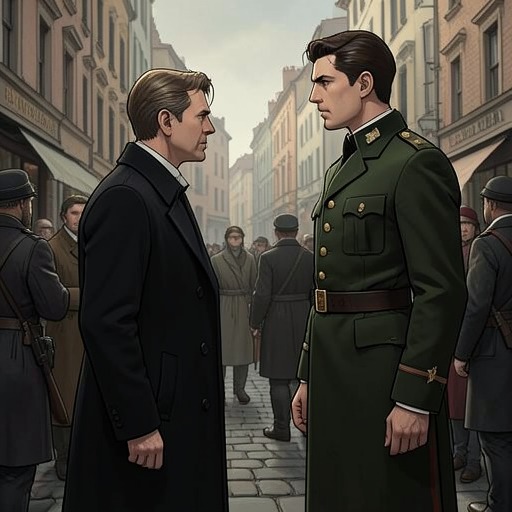
After his earlier affair with the officer, the Underground Man feels even more strongly drawn to the street, where he often sees him. The officer also makes way for generals and other high-ranking people, but walks straight toward people like the Underground Man, or even those better dressed than him, without turning aside. The contrast sharpens the narrator’s resentment: he sees the officer observing rank when it applies above him, yet disregarding people he considers beneath him.
The Underground Man’s grievance becomes an obsessive question of who must move first. He insists that no written rule requires him to yield and imagines a convention of mutual respect in which each person shifts halfway. The repeated encounter thus turns a minor social gesture into a contest over recognition, with the officer’s apparent indifference serving as the challenge the Underground Man cannot forget.
The Collision and Its Meaning
The Underground Man eventually goes to Nevsky Prospect intending to abandon his plan for confronting the officer. Three paces from him, however, he changes his mind, closes his eyes, and deliberately collides with him shoulder to shoulder. He says that he does not budge and passes on what he regards as perfectly equal terms. The officer does not look back and appears to ignore the collision; the Underground Man remains convinced that this indifference is only pretended.
The outcome is deliberately limited. The narrator acknowledges that he got the worst of the physical encounter, yet treats the act as a victory because he did not step aside. Nevsky Prospect gives the episode its force: the same public space where he has repeatedly yielded becomes the place where he performs the equality he has been demanding, even though the officer offers no acknowledgment of it.
Narrative Significance
The street episode makes the Underground Man’s social position legible through action rather than abstract argument. His account presents him as a clever, self-conscious figure who feels humiliated by circumstances he attributes to the laws of nature; on Nevsky Prospect, that sense of injury takes the concrete form of yielding or refusing to yield. The promenade’s repeated encounters also show how resentment can keep drawing him back to the scene that sustains it.
The episode belongs to the diary’s larger presentation of a character the author’s framing describes as imaginary yet representative of a living generation. Nevsky Prospect is therefore not merely a backdrop: it concentrates the conflict between the narrator’s acute awareness of social distinctions and his inability to secure recognition from another person. His shoulder-to-shoulder act briefly changes his own account of the encounter, but not the officer’s outward response.