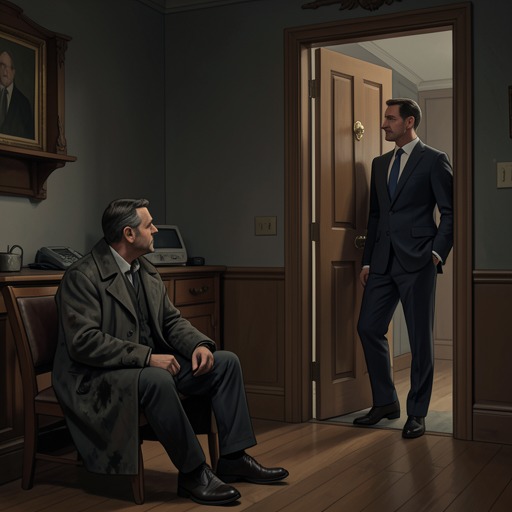
Zverkov
Notes from UndergroundZverkov is a former schoolmate whose farewell dinner becomes the focal point of the Underground Man’s struggle for recognition among his old classmates. The evidence presents him through the narrator’s retrospective, openly interested account rather than through an independent view of his character: he is described as socially favored and destined for a brilliant career, while the narrator’s repeated concern with his opinion reveals more about the narrator’s humiliation than about Zverkov’s own inner life.
Identity and Social Standing
Zverkov belongs to the Underground Man’s former school circle. At the dinner arranged for his departure, the narrator portrays him as a man from a good family, with considerable means, a promising career, and an engaging manner. The account also labels him a rake and a Lovelace, mixing admiration of his charm and social advantages with a disparaging judgment of his conduct. These descriptions are the narrator’s characterization, not an independently confirmed portrait.
Zverkov’s social position matters because the narrator sees the gathering as a public test of rank. He is so concerned with restoring his standing in Zverkov’s eyes that, the morning after the dinner, he treats the matter as his chief business and temporarily forgets Liza. Zverkov thus functions less as a developed speaking presence in the available evidence than as the imagined audience before whom the narrator hopes to recover his reputation.
The Farewell Dinner
The dinner is held at the Hotel de Paris as a farewell gathering for Zverkov. Simonov makes the arrangements and states that the cost will be twenty-one roubles for the other three participants. The Underground Man objects that including him would make the total twenty-eight roubles. His agitation at this calculation accompanies his unexpected decision to join the party, making the invitation itself a small contest over whether he will be counted as part of the group and on what terms.
The narrator later says that he arrived before the others and waited at the Hotel de Paris between five and six o’clock. He recalls drinking before the group arrived and uses his unfamiliarity with wine as an explanation for his behavior. The next morning, he apologizes particularly to Simonov and asks him to convey his explanations to everyone, especially Zverkov, whom he says he remembers having insulted as if in a dream. His apology is therefore also an attempt to manage how the evening will be understood by the man being celebrated.
Conflict and Displaced Revenge
The Underground Man’s account links his conduct toward Zverkov to an earlier insult at the dinner. He says that he had come intending to thrash an officer who had humiliated him, but failed to find the officer. Needing, as he presents it, to avenge the insult and recover his sense of self, he redirected his anger toward Liza, who had come to visit him. Zverkov is not identified as the officer; the distinction matters because the episode shows how the narrator’s grievance against one person spills over onto another, while the dinner’s social humiliation continues to govern his thoughts.
Zverkov’s importance in this conflict is consequently indirect but persistent. The narrator wants to repair his standing with him, recalls having insulted him, and makes him a central recipient of the apology he sends through Simonov. Yet the account supplies no reply from Zverkov and no confirmation that the apology changes their relationship. The effort to regain face is visible; its success is not.
Narrative Role and Limits of the Portrait
The book frames its underground diarist as an imaginary figure who nevertheless represents a recognizable generation and social type. Within that self-conscious account, Zverkov stands among the people whose apparent confidence and ease sharpen the narrator’s self-comparison. The narrator claims to be cleverer than those around him, yet his actions at the dinner and his subsequent concern about Zverkov’s judgment expose the gap between intellectual superiority as a claim and social authority as something he cannot secure.
The portrait is also shaped by the narrator’s larger method of explaining himself through argument, qualification, and reversal. He presents Zverkov as favored by family, money, career prospects, and charm, then makes his own wounded response the center of the episode. This imbalance limits what can be concluded about Zverkov as an individual, but clarifies his narrative function: he is the celebrated schoolmate whose apparent advantages become a measure against which the Underground Man stages his resentment, failed revenge, and attempt at social repair.