“blanker”
Noughts & CrossesThe expression “blanker” is a racial slur for Noughts whose force in Noughts & Crosses lies not only in open hostility but in its circulation: a parent uses it contemptuously, a crowd makes it a public slogan, and Sephy repeats it while trying to stop that crowd. Callum’s response makes the word’s harm unmistakable. It cannot be brushed aside as a passing insult; it becomes a remembered injury between friends and a measure of how prejudice can travel through speech, institutions, and intimate relationships.
Meaning and Social Use
The slur appears in a society structured by the inequality between Crosses and Noughts. In one conversation, Sephy hears her father denounce the Liberation Militia and call Noughts “blankers.” She is struck by the venom in his voice and by the fact that she has never heard him use the word before. Her immediate thought is personal rather than abstract: her friend Callum is a Nought, but he is not a blanker. The moment registers a conflict between the language of a powerful household and Sephy’s own attachment to someone that language degrades.
At the McGregor family home, the word is contested from another direction. Ryan uses it when dismissing Alex Luther, presenting the activist’s repeated imprisonment as evidence that peaceful attempts to change society do not work. Meggie objects: when Noughts use the same slur used against them by ignorant Crosses, they risk adopting the insult rather than undoing its force. Ryan counters with the claim that naming a slur for oneself can amount to claiming it. Their disagreement reveals that the word is not socially neutral even when a Nought says it: its use can signify defiance, but it can also reproduce the contempt embedded in the surrounding hierarchy.
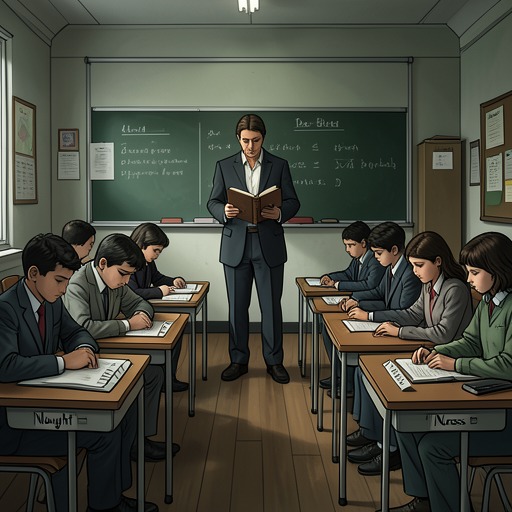
The expression also passes into institutional encounters. At Heathcroft, the headmaster dismisses Nought students’ difficulties by suggesting that they should go elsewhere if they find the school hard. At a hospital, staff require patient identity cards to be checked and registered before care is administered. These moments belong to the same wider world in which Noughts’ access to education and ordinary services is mediated by rules and authorities. The slur does not itself create each barrier, but its demeaning view of Noughts resonates with a system that repeatedly marks them as outsiders.
The School Protest and Sephy’s Intervention
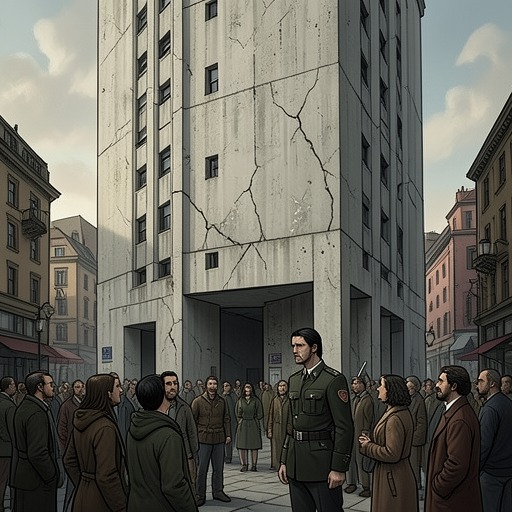
The most consequential public use of the expression comes at Heathcroft. As Sephy approaches the school, she hears a growing noise, turns the corner, and sees a large crowd outside. Protesters chant, “NO BLANKERS IN OUR SCHOOL. NO BLANKERS IN OUR SCHOOL.” Callum and three other Noughts are surrounded by police officers trying to push through to the entrance, while more officers attempt to hold the Cross crowd back. The slogan turns the slur into a collective demand for exclusion, directed at students seeking entry to the school.
Sephy tries to stop the crowd by shouting at them. She calls them animals, then calls them worse than animals and uses “blankers” against them. The noise dies down, but the intervention comes at a cost: Callum is there, staring at her with a strange expression. Sephy’s narration shows that she does not intend the insult for him and believes she is using it to make the crowd stop and help. Callum cannot receive the word apart from the public humiliation already surrounding him. The scene’s painful reversal is that Sephy tries to halt an attack by repeating the language of the attack, and the person she means to protect is wounded by it too.
The protest is followed by another public distortion. On television, Callum sees a report that describes the Nought students as meeting “some hostility.” He recalls that the police assigned to guard them allowed members of the crowd to poke, pinch, and punch them, and that his jacket was covered in spit. The report omits what happened to the students while softening the event into a euphemism. In that account, the crowd’s exclusionary chant is part of a larger pattern: the Noughts endure the encounter, while the media language minimizes it.
Personal Injury and Lasting Consequences
After the protest, Sephy tries to reduce the harm by telling Callum that it was just a word and invoking the saying that sticks and stones cannot hurt. Callum rejects that comparison. He tells her that a slap, punch, or stab would eventually stop hurting, but that he will never forget what she called him. The contrast is central to the expression’s meaning in the novel: spoken language can leave an injury that outlasts a physical blow because it fixes the speaker, the listener, and the surrounding prejudice into a single remembered moment.
Callum’s response turns the insult inward as well as outward. In his immediate thoughts, he repeats that he is not a blanker: being a Nought does not make him worth nothing, a waste of time and space, or a zero. The repetition answers the dehumanizing word by asserting his worth, but it also shows how forcefully the insult has entered his self-perception. What the crowd shouts as a political slogan becomes, for the person targeted, an assault on whether his life counts.
The quarrel remains part of the history between Callum and Sephy. Much later, when they confront one another, Sephy recognizes that Callum has hated her since she called him a blanker at Heathcroft. She also understands that he resents her for turning away at school and not being there when he needed her. Their hostility is therefore not reducible to one word alone: the slur marks the protest, while the abandonment she associates with it deepens the breach. In recalling the incident, Sephy also connects her drinking to the pain surrounding her relationship with Callum.
Naming, Power, and Narrative Significance
The book distributes the word across different speakers and settings rather than treating it as a single act of name-calling. It is voiced by a Cross parent, disputed within a Nought family, shouted by a school crowd, and used by Sephy in an effort to regain control of a threatening situation. Each use carries different circumstances, but the word’s repeated appearance exposes how readily the social hierarchy supplies a vocabulary for degrading Noughts—and how difficult it is to escape that vocabulary even when someone intends to oppose the prejudice behind it.
The protest scene gives that contradiction its sharpest form. The crowd uses the slur to demand that Nought students be barred from Heathcroft; Sephy repeats it to quiet the crowd; Callum hears the same degrading term from a friend he trusted. Her good intention does not cancel his experience, just as his pain does not erase the danger and disorder she was trying to stop. The scene refuses to make the word harmless because it is spoken in a moment of urgency or by someone who cares for him.
“Blanker” thus links public discrimination to private consequence. The chant identifies Noughts as people who do not belong at school; the inadequate television report blurs the hostility they endure; and Callum’s memory preserves the insult when the immediate scene has passed. Across these connected moments, the expression is both a tool of exclusion and a test of whether resistance can avoid repeating the language of the oppressor. Its deepest consequence is not merely that Sephy says the wrong word, but that the word becomes bound to a rupture between two people already living on opposite sides of a racial hierarchy.