Death penalty by hanging
Noughts & CrossesDeath by hanging is the state’s method of execution in the novel, imposed first on Ryan Callum McGregor and later on his son, Callum McGregor. It is more than a sentence named in court: the scaffold, prison crowd, trapdoor and lever make it a public ritual through which the state exercises lethal power, while the family’s repeated exposure to that power links a political conviction to a private catastrophe.
The Sentence and Its Context
Ryan’s sentence is announced at Hewmett Prison after he has been convicted of seven counts of murder and political terrorism. His appeal has been denied, and the formal announcement specifies hanging as the means by which the sentence will be carried out. The ceremony places Cross spectators in seats while Noughts stand; Callum is among them, and Persephone Hadley, arriving with her father, sees him there. The execution is thus presented not as an unseen administrative outcome but as a public event, observed across the racial divide that structures the novel’s society.
The events surrounding Ryan’s punishment establish that the death sentence is not the only form of state power in the story. When Jude is taken to hospital, the staff require his family’s identity cards and registration before medical care can be administered, citing a new government ruling. Elsewhere, the admission of Nought students to Heathcroft is met by a crowd chanting against their presence, while a television report minimizes the hostility the students face. At school, Mr Costa suggests that Noughts who find conditions difficult should go elsewhere, even as Mrs Paxton warns that they are being repeatedly targeted and may retaliate. These episodes do not describe the mechanics of hanging, but they place the punishment within a wider landscape in which institutions regulate access, public accounts obscure events, and Noughts encounter hostility in ordinary civic settings.
Ryan McGregor and the Prison Spectacle
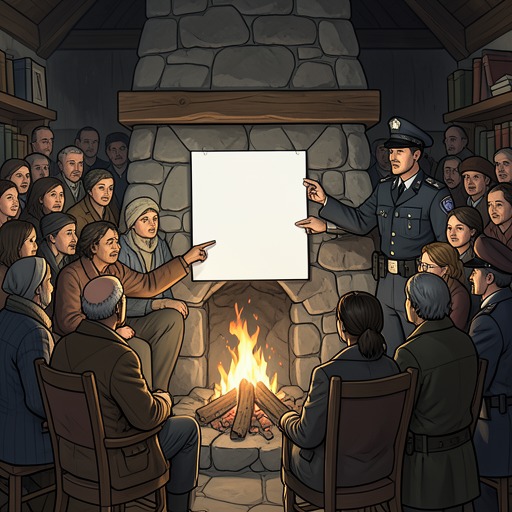
The account of Ryan’s execution begins with the preparations at Hewmett Prison. Nought visitors arrive dressed in black, largely silent, and are admitted through security after Callum’s father shows his identity card. In the courtyard, tiered seating occupies part of the space and a scaffold stands at the far end. Persephone initially does not understand why she has been brought there; the official announcement identifies the condemned prisoner and the charges, and only then does she grasp that Callum’s father is to be executed.
The scene also reveals how the punishment is experienced by those watching. The Noughts remain standing, some looking toward the scaffold and others crying; some look at the Crosses seated in front with visible hatred. Persephone’s eyes meet Callum’s, and the shock of seeing him after a long separation makes the encounter personal before the execution proceeds. The prison gathering therefore joins formal procedure to divided spectatorship: the state names a legal sentence, while the people assembled around it carry grief, anger and recognition.
Ryan does not die by hanging. A later news report says that he was killed while trying to escape from Hewmett Prison, electrocuted as he attempted to scale its electrified fence. He had been due to hang four days earlier, but the Home Office granted a last-minute reprieve. The report says his family is devastated and that officials have opened an inquiry. The reprieve changes the immediate method and timing of his death, but it does not restore his freedom or end the state’s custody of him; his death in the escape attempt replaces the execution that had been announced.
Callum’s Expected Execution
Callum’s own death sentence is framed through his certainty that the trial cannot save him. After his conviction, he reads press coverage from his prison cell and rejects the claim that Persephone is merely identifying with her kidnapper. He says he believes the verdict will stand because he is a Nought who fell in love with a Cross, and because Persephone is pregnant with his child and does not conceal it. In his view, the relationship and pregnancy make his case intolerable to the authorities; he says he knew he would hang before the jury was sworn in. His expectation turns the legal process into a sentence he regards as decided in advance.
On his last day, Callum states plainly that he does not want to die. As he is led from the prison cell, calls come from other cells along the corridor, but he keeps looking ahead because he has little time. Outside, a crowd has gathered, including many Crosses who have come to watch. He can see the scaffold and the noose, and later stands on the platform beside a closed trapdoor. The executioner, a blond-haired Nought in a black suit, stands behind the long lever that will open it. The mechanism makes the sentence immediate and material: the lever, platform and trapdoor reduce the state’s final act to a controlled procedure, while Callum remains conscious of his approaching death.
Execution and Narrative Significance
The trapdoor opens as Persephone calls out that she loves Callum. He falls, and the narration shifts to the rope creaking as his body swings. Persephone cannot know whether he heard her or whether his unfinished declaration of love reached her; the novel leaves that last exchange uncertain. The execution ends Callum’s life, but its final emotional meaning is withheld from the surviving witness. Her unanswered questions make the legal act’s irreversibility felt without supplying a comforting certainty about what passed between them in their last seconds.
The two executions occupy different outcomes under the same penal system. Ryan receives a reprieve from hanging but dies in an attempted escape; Callum is taken to the scaffold and executed. Their stories make the death penalty both a stated rule and a recurring family reality, with prison, public audiences and official announcements connecting the lives of father and son. Callum’s belief that his relationship with Persephone has made his conviction inevitable sharpens the racial dimension of the punishment, while the contrast between Ryan’s reprieve and Callum’s hanging shows how the threat can change form without releasing the family from state violence. The scaffold is therefore not only a place of execution but the culmination of a pattern in which legal authority and racial inequality converge on the McGregors.