Educational exclusion of Nought students
Noughts & CrossesEducational exclusion of Nought students is the systematic narrowing of their educational prospects in a society divided between Noughts and Crosses. The novel traces that exclusion from hostility at Heathcroft to unequal punishment and suspension, while the possibility of attending university remains uncertain. What is called admission therefore does not amount to equal access: Nought students may enter a school, yet remain exposed to conditions that make staying, progressing, and being treated fairly increasingly difficult.
Access and Unequal Conditions
The limits of access extend beyond the school gate. In a conversation about the future, a Nought student points out that Cross universities will not accept him. He resists treating that barrier as permanent, arguing that by the time he is ready to leave school the situation might change. The exchange leaves the prospect unresolved: Heathcroft is itself a recent breach in what had once seemed impossible, but that opening offers no assurance of a place in higher education. The promise of advancement is therefore shadowed by the institutions that may close their doors at the next stage.
At Heathcroft, formal attendance coexists with physical intimidation. When a crowd gathers outside the school, its repeated chant demands that Nought students be kept out. Callum and three other Noughts are surrounded by police officers attempting to push through to the entrance, while another police line tries to force the Cross crowd into separate groups. The scene makes admission a contested presence rather than a settled right: the students are inside the school system, but a hostile crowd publicly challenges their place there.
The hostility is also mediated by what the public is allowed to see. In a televised report about the Nought students’ arrival at Heathcroft, the account describes the response as “some hostility.” The student’s own account of that day includes police officers who were supposed to guard them allowing the crowd to reach them, and the back of his jacket soaked with Cross spit. The broadcast omits those details. The contrast between the report’s understatement and the violence described from the school grounds shows how exclusion can be obscured as well as enacted: a sanitized public version makes unequal conditions harder to recognize.
School Authority and Discipline
School officials do not all respond to that climate in the same way. Mrs Paxton warns that Nought students are being constantly picked on and that one may retaliate if the situation continues. Mr Costa answers that if the students find Heathcroft difficult, they can go elsewhere. His response turns a question about harassment into a question of whether the targeted students should remain at all. In that framing, institutional comfort takes precedence over confronting the hostility that makes school difficult for them.
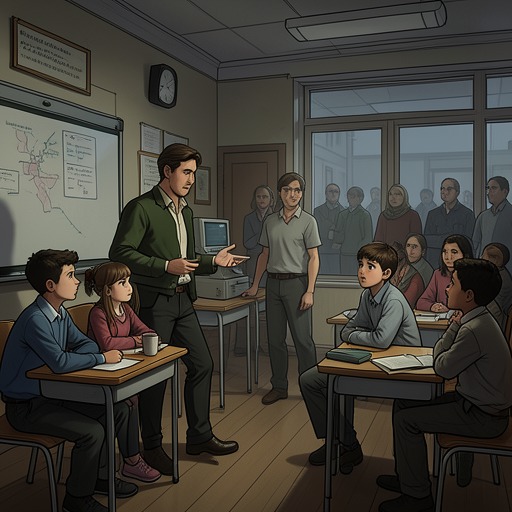
Disciplinary decisions reinforce the imbalance. Shania is expelled after slapping Gardner Wilson, although she had been hit first; Gardner, a Cross, receives only a telling-off. When Callum challenges Mr Costa over the disparity, he asks why Shania’s action counts as gross misconduct while a Cross’s does not. The contrast is not simply between two punishments: it shows the same conflict being interpreted differently according to who acts, and leaves the Nought student bearing the lasting educational consequence.
Callum places Shania’s expulsion within a broader pattern. Colin has left school, Shania has been expelled, and students are taking bets on how long he and Amu will remain. He describes Nought students as dropping out of the few schools that admit them, expelled or “excluded” for conduct that would bring Crosses detention or a severe telling-off. He allows that a Cross might occasionally be suspended, but says Crosses are not expelled at anything like the same frequency. Admission, in this account, is precarious: ordinary conflict can become a route out of school for Noughts while resulting in lesser penalties for Crosses.
Suspension and Institutional Rationale
That pattern reaches Callum directly when the school governors and Mr Costa suspend him while the matter concerning his father remains unresolved. The decision makes his educational standing depend on a family case still awaiting resolution; Callum objects that he is being treated as guilty until his father is proved innocent. Although the school presents the suspension as temporary and in everyone’s best interests, the timing connects access to school with suspicion surrounding his family rather than with a finding about his own conduct.
Callum interprets the decision alongside the departures of Colin and Shania, telling Mr Costa that it is now his turn. Mr Costa denies responsibility for Shania’s expulsion by citing gross misconduct, but Callum has already challenged the unequal treatment behind that description. The school offers to review his situation once the dust clears. Callum doubts that it ever will, and the exchange ends with Mr Costa wishing him good luck. The polite closing cannot undo the practical outcome: Callum is out of school, and the promised review has no definite resolution in the account.
Consequences and Wider Significance
The pressure to leave school is not confined to official decisions. Callum tells his father that he is wasting his time at Heathcroft, citing Colin’s departure, Shania’s expulsion, and the expectation that he and Amu will soon follow. He says he had been thinking of leaving anyway. His father refuses, insisting that he remain at school until eighteen and then go to university. Their disagreement captures the stakes of exclusion at home as well as at school: Callum sees an institution that offers little prospect of fair treatment, while his father insists that continued education remains necessary for the future he wants for his son.
The novel also places educational disadvantage among other encounters with administrative authority. At the hospital, Nurse Carter says that patient identification cards must be checked and registered before medical care can be given under a new government ruling. This is not itself a school rule, but it echoes the book’s presentation of institutions making access conditional on official procedures. In education, the consequences are especially stark because nominal entry does not protect Nought students from harassment, differential punishment, or removal.
The resulting pattern is broader than the actions of any single headmaster. Mr Costa’s willingness to tell Nought students to go elsewhere, the unequal outcomes for Shania and Gardner, the suspension of Callum amid his father’s unresolved case, and the lack of reliable university access all narrow the routes through which Nought students can advance. The novel’s account makes a distinction between opening a school to Noughts and enabling them to learn there on equal terms. Its recurring reversals—entry followed by hostility, conflict followed by unequal discipline, and promised review followed by uncertainty—show how exclusion can persist inside institutions that claim to have admitted them.