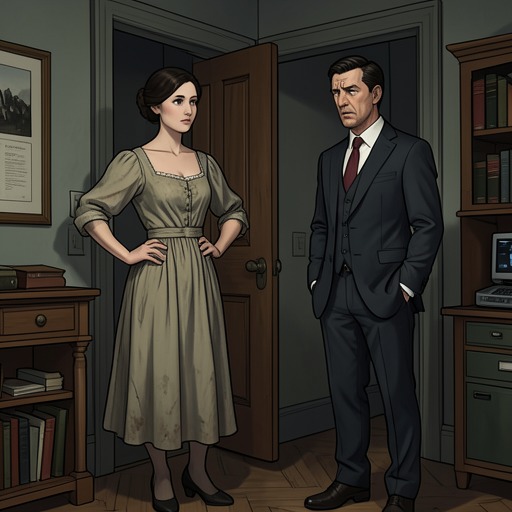
Jude
Noughts & CrossesJude is Callum’s seventeen-year-old brother, a member of the McGregor family, and a participant in the Liberation Militia. His characterization develops from the older brother who needles Callum at the family table into a politically committed militant whose actions contribute to the secrecy and strain dividing the household. Through Jude, the novel links domestic conflict to the wider struggle between Noughts and Crosses, while showing how political allegiance can become both a source of belonging and a line of separation within a family.
Identity and Background
Jude appears in the family’s constrained domestic life as Ryan and Meggie McGregor’s son and Callum’s older brother. Even the small details of the household suggest material hardship: Meggie sits sewing patches over the patches in Jude’s school trousers, which have become more patch than original fabric. The worn clothing gives a concrete measure of the family’s limited means, even as Jude’s later involvement draws him toward an armed political organization.
Callum’s early view of Jude is openly exasperated. At dinner, Jude grins knowingly when Callum arrives and tells the family that Callum had been with his “dagger friend,” using a racial slur for Callum’s Cross best friend. Callum bristles at the insult and warns Jude to stop, but Jude presses him by asking what he should call her instead. The exchange makes Jude’s teasing more than ordinary sibling friction: he targets the relationship that exposes Callum to the racial boundaries surrounding them.
Political Allegiance and Secrecy
Jude’s commitment to the Liberation Militia first surfaces in Callum’s account of watching a political broadcast at home. While Kamal Hadley denounces the militia as terrorists, Jude punches the air and declares, “Long live the Liberation Militia!” Ryan responds, “Too right, son,” and shares a knowing look with Jude. Their mutual understanding is visible to Callum, but its basis is not explained in the moment. Meggie immediately looks away when Callum turns to her, reinforcing his sense that his father, mother, and brother share information from which he has been excluded.
That exclusion shapes Callum’s response. He does not object to Jude’s sympathy for the militia; what troubles him is that there is something happening between Jude and Ryan that he has not been told. Jude’s political allegiance thus changes the emotional arrangement of the family before Callum knows its full extent. It brings father and son into tacit alignment while leaving Callum on the outside, turning the home into a place where political knowledge is unevenly shared.
The wider climate around the family helps frame that allegiance. Nought students are admitted to Heathcroft High amid a hostile Cross crowd, while police struggle to control the protest and Callum watches the confrontation unfold. On television, the report later describes the admitted students as meeting with “some hostility,” a phrasing Callum recognizes as an understatement of what he experienced. At school, a teacher argues that if Nought students are finding it difficult, they should go elsewhere, despite another teacher’s warning that they are being repeatedly targeted and that retaliation is only a matter of time. These scenes establish the institutional and public hostility surrounding Jude’s political choice, without reducing his allegiance to any single incident.
Family Conflict and Hidden History
Jude’s position at home is not simply one of secret political solidarity. When Callum returns home, he finds Jude and Lynette facing off, with Ryan trying to keep them apart. It is a striking reversal: Lynette, whose episodes have previously led Jude to lose his temper, is shouting back at him for the first time. Ryan’s intervention reveals that the conflict cannot be understood as a routine quarrel between siblings.
When Jude turns away from his father, Ryan slaps him—a departure from the restraint Callum has known from him. Ryan then tells Jude that he has no right to judge Lynette without knowing what she has endured. Three years earlier, Lynette and her boyfriend had been attacked by Nought men; her boyfriend was nearly beaten to death, and Lynette was hospitalized for more than two weeks. The parents had concealed the truth, telling the children that Lynette was staying with an aunt. Jude’s clash with Lynette therefore occurs against a history he had not been told, and Ryan’s anger exposes how secrecy has shaped the family’s understanding of her.
Jude’s participation in the militia forms a different strand of that same household secrecy. Callum sees the signs—the exchange with Ryan, the public declaration of support—but is not included in what they mean. The book places this political concealment beside the earlier concealment of Lynette’s assault: in both cases, crucial knowledge is withheld within the family, and Callum must make sense of the consequences before he understands the reasons.
Relationships and Conflict
Jude’s relationship with Callum combines sibling familiarity, provocation, and political distance. His taunting at the dinner table shows that he knows how to press on Callum’s attachment to his Cross friend, while the broadcast scene shows that the brothers do not share the same access to the family’s political life. Callum’s resentment is specifically about being excluded, not about Jude’s sympathy for the militia itself. That distinction gives their conflict an intimate edge: the divide is not only between opposing political positions, but between brothers who do not know what the other has been told.
Jude’s connection with Ryan is presented through small, legible gestures rather than an explanation of their dealings. Jude raises his fist in support of the militia; Ryan answers with approval; the two exchange a knowing look. The moment establishes a bond between them and signals that the militia is not merely a subject of television debate in the McGregor home. For Callum, the same gestures are evidence of a hidden relationship to which he has no access.
His relationship with Lynette is more openly volatile. Jude is described as letting her episodes wind him up, and the confrontation that follows brings their hostility into the open. Yet Ryan’s disclosure changes the context: Jude has been judging his sister without knowing the attack and its aftermath. The episode does not erase the anger between them, but it shows how missing knowledge can make family members misread one another.
Change and Narrative Role
The available scenes establish Jude as a character whose role shifts from household antagonist to a sign of the political forces moving through the McGregor family. Early on, he is the brother who needles Callum and makes a pointed insult about Callum’s friend. Later, his salute to the Liberation Militia, and Ryan’s approving response, place him inside a political allegiance that Callum can perceive but not yet understand. The change is chiefly in what the reader can see around Jude: the teasing brother is also part of a concealed political world.
Jude’s scenes help show that the racial conflict is lived not only in public demonstrations and institutional decisions but also through family loyalties, arguments, and silences. The school protest exposes public hostility to Nought students; the dismissive account on television reveals how that hostility can be softened in reporting; and Jude’s support for the militia appears within a home where Callum is left to infer what the adults and his brother know. The parallel is significant: just as public accounts can obscure the severity of discrimination, family silence can obscure the pressures and commitments shaping Jude’s actions.
Jude is therefore not presented in these scenes as a fully explained political figure. His allegiance is unmistakable, but its full origins and extent remain outside the moments shown here. That partial visibility is part of his narrative function: Callum encounters signs of Jude’s involvement before he can enter the knowledge shared by Jude and Ryan, making political secrecy itself a source of tension between the brothers.