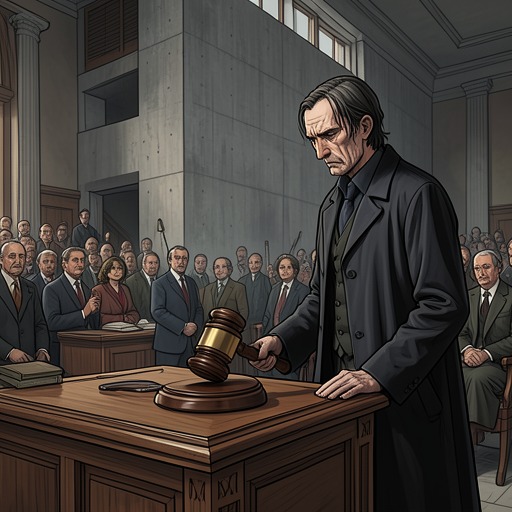
Judge Anderson
Noughts & CrossesJudge Anderson is the presiding judge at Ryan Callum McGregor’s political-terrorism trial, where his authority shapes both the courtroom’s conduct and the defence’s opportunity to challenge the case. He disciplines public outbursts, rules on objections, and intervenes when the prosecutor attempts to invoke legal precedent; his decisions show a judge exercising procedural control in a trial whose fairness is sharply contested.
Role in the trial
Judge Anderson presides over the proceeding in which Ryan is charged with political terrorism. When Ryan’s son Callum cries out from the public gallery, urging his father not to plead guilty, Anderson threatens to have the gallery cleared if there are further outbursts. The warning makes the division between courtroom authority and family anguish explicit: Callum’s protest is treated as a breach of order, even as Ryan’s battered face and silence make the human stakes visible to his family.
When the clerk repeats the plea question and Ryan remains silent, Anderson brusquely directs him to answer. Ryan eventually pleads not guilty. The episode establishes Anderson as an active manager of the trial rather than a distant presence: he enforces the court’s rules at the moment when Ryan’s response will formally set the course of the case.
Control of evidence and objections
Anderson’s rulings shape the examination of witnesses. When prosecutor Pingule asks whether Callum belongs to the Liberation Militia, defence counsel Kelani Adams objects that Callum is not the person on trial. Pingule argues that the question bears on witness credibility, and Anderson allows it. The decision permits the prosecution to bring Callum’s alleged political affiliation into the proceeding against his father, despite Adams’s insistence on the distinction between the accused and his son.
Anderson’s handling of the dispute over tapes is more openly corrective. Pingule argues that there are precedents for presenting evidence the defence has not yet seen and begins to cite them. Anderson interrupts, refuses to hear the citation, and reminds the prosecutor that he is not the only person who attended law school. The exchange checks Pingule’s attempt to use precedent as leverage and shows Anderson asserting his own command of legal procedure; it does not, by itself, establish what the court ultimately does with the tapes.
Later, when Pingule asks Sephy Hadley to describe Callum, Adams objects that her opinion of her friend is irrelevant to Ryan’s case. Anderson agrees that he is wondering the same thing and sustains the objection. The ruling cuts off that line of questioning, distinguishing a potentially prejudicial diversion into Sephy and Callum’s friendship from evidence bearing on the defendant.
Authority amid institutional inequality
The novel places Anderson’s courtroom authority within a wider pattern of institutions regulating Nought lives. At Heathcroft, a crowd chants against Nought students while police attempt to control the protest; the television report minimizes what the students experienced. At a hospital, government rules require patient identification cards to be checked and registered before care. In the trial, the court’s formal procedures likewise determine who may speak, which questions can be asked, and what arguments receive a hearing.
These scenes do not establish that Anderson authored the system or that he treats every participant according to a stated racial policy. They do, however, place his procedural decisions inside a society where Noughts face hostility in education, administrative scrutiny in healthcare, and the threat of severe punishment in criminal court. His courtroom can restrain a prosecutor, as it does when he sustains Adams’s objection, while also permitting questions that pull Callum’s political identity into Ryan’s defence. That tension makes his rulings consequential without reducing them to a simple verdict on his personal motives.
Narrative presentation and limits
Anderson is presented through scenes focused on the experience of people around him, especially Callum and Sephy, rather than through an account of his private thoughts. His character emerges in brief but consequential acts: the threat to clear the gallery, the brusque demand for Ryan’s plea, the allowance of Pingule’s question, the interruption over unseen tapes, and the sustained objection concerning Sephy’s friendship with Callum.
The record supplied here does not establish Anderson’s final judgment in the trial, his personal views about the political conflict, or the reasoning behind every ruling. What it does show is a judge whose interventions alternately close down disruption, permit contested questioning, and prevent an irrelevant line of examination. Through that uneven pattern, the courtroom appears not as an abstract venue for justice but as a place where authority is exercised through specific decisions, each with consequences for what the defendant, his family, and the witnesses can say.