Judicial injustice and wrongful convictions
Noughts & CrossesJudicial injustice and wrongful convictions are not confined to a single courtroom in the novel: they take shape across schools, hospitals, news coverage, police investigations, trials, and prisons. The prosecution of Ryan McGregor shows how evidence gathered through routine administration can be used amid political pressure, how a confession can conceal coercion, and how a death sentence can be imposed before a last-minute reprieve changes its form rather than restoring freedom.
Institutional Bias Before the Trial
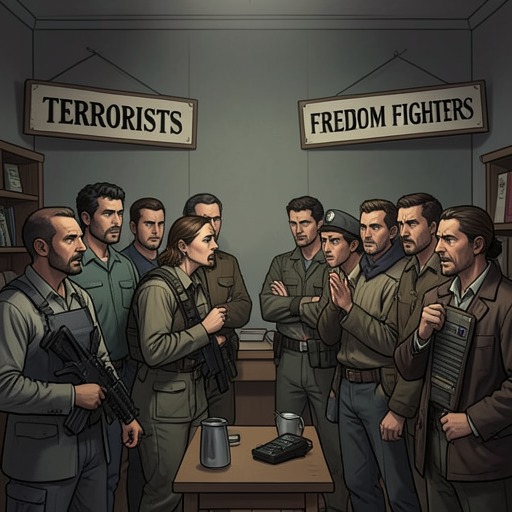
The novel places the criminal process within a wider landscape of Nought–Cross inequality. When Nought students arrive at Heathcroft, a crowd gathers to chant against their admission, while police attempt to manage the confrontation. In Callum’s account of the school’s appearance on television, the broadcast describes the hostility in muted terms and leaves out the police officers’ failure to protect the students from being poked, pinched, and punched. The contrast between what Callum experienced and what the news report showed makes representation part of the injustice: institutional harm is not only inflicted, but also softened or made less visible when publicly described.
That pattern appears inside the school as well. Mrs Paxton warns the headmaster that Nought students are being picked on and that retaliation may follow; Mr Costa responds that if they find the school difficult, they should go elsewhere. His answer recasts exclusion as a problem for the excluded students to solve, rather than a failure of the institution to protect them. In a separate confrontation, Sephy’s mother blames her for her association with Callum and his family, treating proximity to a Nought family as a source of scandal. Together, these scenes establish a social order in which unequal treatment can be presented as ordinary judgment, while the people exposed to it are made responsible for its consequences.
Data, Investigation, and Confession
A government rule requiring identity cards to be checked and registered before hospital staff can provide care creates the link between routine administration and criminal investigation. When Meggie and Jude take Callum to hospital, the nurse requests their cards, explaining that the requirement is intended to prevent benefit fraud. Later, after the Dundale Shopping Centre bombing, police claim that a drink can near the blast site bears Jude’s fingerprints and say they matched the print against information on his identity card. Meggie realizes that the hospital scanned the card and that the information may have been taken from the computer before it could be deleted. The sequence turns a seemingly mundane patient-registration process into a channel through which personal data can become investigative evidence.
The evidence is presented as more than a single fingerprint on a can. Ryan tells his family that police also found two of Jude’s prints on a cola-can fragment and a print on surviving bomb casing. He explains that he had brought the cola from home, that Jude may have handled it, and that equipment kept in the house could account for the casing print. The family’s understanding changes as these details are disclosed: the initial suspicion that Jude has been framed gives way to the devastating recognition, voiced by Callum, that Jude really was the bomber. The evidence therefore carries both a legal and a familial consequence, even as the account leaves its interpretation in the hands of a process already exerting extreme pressure on the family.
Ryan admits signing a confession to all the charges, but says police told him Jude was the bomber and that someone had to take responsibility for the Dundale bombing. They let him choose whether he or Jude would take the fall, and threatened that Meggie and Callum could also be imprisoned for conspiracy. Ryan describes the choice as a decision between his own life and the lives of his family. His confession is thus not presented as a straightforward admission of guilt: it is an act made under an explicit threat, intended to protect others, and later becomes the central formal statement of the case against him.
The prosecution disputes that account of coercion. Mr Stanhope tells Meggie that Ryan confessed as soon as Detective Inspector Santiago identified the person whose prints had been found, and that the dictation and signing were videotaped. He asserts that the recording will show the confession was made without duress. The conflict between Ryan’s account of the threat and the lawyer’s description of a recorded, apparently uncoerced confession exposes a gap between a procedure’s visible record and the pressure the record may fail to convey. The existence of a tape is treated as proof of proper process, but Ryan’s explanation gives the same confession a radically different meaning.
Trial, Evidence, and Verdict
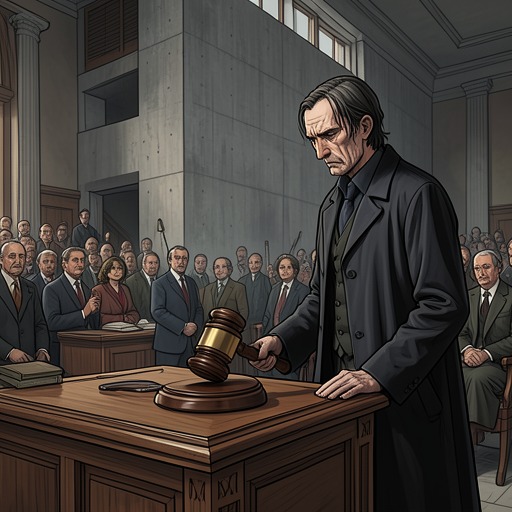
At Ryan’s trial, Callum watches from the public gallery and sees his father’s bruised face. The judge addresses the jury, and Callum’s narration emphasizes that the twelve jurors are Crosses. Ryan initially pleads not guilty to the political-terrorism charge, despite his earlier confession; Callum calls out for him not to do it, aware that his protest may worsen matters but unable to remain silent. The clash between the signed confession and the plea makes the trial’s central contradiction public: Ryan has formally accepted responsibility, yet the family knows that his statement was made to shield them and that he disputes the charge in court.
The examination of Callum also brings the political setting directly into the courtroom. When the prosecution asks whether he belongs to the Liberation Militia, Kelani Adams objects that he is not on trial, but the judge allows the question on the ground that it bears on witness credibility. The exchange shows how scrutiny can shift from the defendant and the evidence to the political associations of a witness. Callum’s account of the bombing is also tested against surveillance footage: the recording shows him leaving the café and pulling Sephy toward an exit, then running with her before a white flash appears and the tape goes dark. The footage supports his claim that he was trying to get her out, but its silence leaves the scene open to interpretation by the prosecution.
As the jury returns its verdict, Callum cannot hear the foreman’s first answer. He sees the foreman’s mouth move but experiences the moment as inaccessible; when the clerk asks about the murder of Aysha Pilling, Callum does hear the verdict. The narrated distinction between the unheard response and the verdict that breaks through conveys how judgment arrives as both a legal pronouncement and a shock the family struggles to absorb. The trial ends with Ryan convicted, and the eventual sentence places the case on a path toward execution.
Sentence, Reprieve, and Continuing Harm
The execution at Hewmett Prison makes the consequences of the verdict public and ceremonial. Sephy arrives with her family among a crowd that includes Noughts dressed in black; she sees Callum and only then understands that they have come to witness the hanging of Ryan, sentenced after being found guilty of seven murders and political terrorism. The scene joins legal authority to the visible division between the people seated as Crosses and the standing Nought mourners, whose expressions include grief and anger. The execution is not an abstract penalty but an event imposed on a family and witnessed across the novel’s racial divide.
The hanging is stayed at the last moment. A voice announces that the execution has been halted, and Governor Giustini tells the crowd that Ryan’s sentence has been commuted to life imprisonment. The reprieve interrupts the state’s planned killing, but it does not establish Ryan’s innocence or release him. The announcement produces stunned silence before the crowd surges forward in anger and desperation to reach him; physical barriers keep the crowd from the scaffold. Ryan’s sentence changes, yet he remains in prison, and the reprieve does not resolve the case’s contradictions or reunite the family.
Four days after the reprieve, a news report says Ryan has died while trying to escape Hewmett Prison. He was electrocuted as he attempted to climb the prison’s electrified perimeter fence. The report notes that he had been due to hang before the Home Office reprieve and that officials have opened an inquiry. The reversal from imminent execution to life imprisonment therefore does not become a route back to ordinary life: Ryan dies in custody, and the family is left devastated. The sequence makes the limits of the reprieve stark. The sentence is changed, but the underlying confinement and its lethal consequences remain.
Significance
The novel presents injustice as cumulative rather than as one isolated courtroom error. A school can normalize exclusion; a news report can conceal the severity of hostility; a hospital policy can make identity data available for police use; an interrogation can produce a confession under threat; and a trial can weigh political associations and incomplete images while moving toward a death sentence. These institutions need not all act through the same person or rule for their effects to reinforce one another. The progression from registration to accusation, confession, conviction, reprieve, and death gives the legal story its force: formal procedures remain visible at every stage, but their presence alone does not guarantee that evidence is fairly interpreted, pressure is recognized, or a person is protected from harm.