Lynette McGregor's suicide
Noughts & CrossesLynette McGregor’s suicide is a concealed death whose meaning changes when her letter to Callum McGregor reveals that she deliberately walked into the path of a bus. The family is initially told that she died in an accident; Lynette’s account instead links her decision to a life shaped by despair and the conviction that, as a nought, she could never be considered good enough. Her death becomes both a private family tragedy and part of the story’s wider pattern of loss under racial oppression.
The Reported Accident
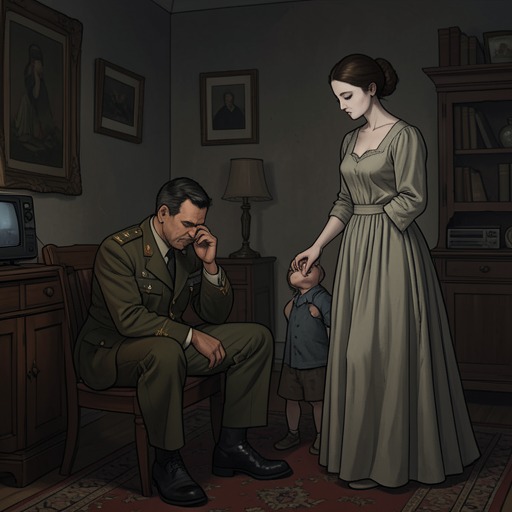
A police officer tells the McGregor family that Lynette walked into the path of an oncoming bus. Witnesses had said she seemed absorbed in her own thoughts, and the officer describes the death as an accident, adding that she was killed instantly. The family receives this account before it knows that Lynette had intended to die.
The official explanation does not settle the family’s response. Callum’s mother, Meggie McGregor, turns to the children and asks whether they are proud of themselves, then questions whether Lynette might have been thinking about what they had said to her. Ryan McGregor answers that the officer called it an accident, but Meggie continues to grieve for her child. The scene places an unresolved question of responsibility alongside the police account, without establishing that the family caused Lynette’s death.
The Letter and Its Disclosure
Afterward, Callum finds a letter from Lynette addressed to him. She writes that she is tired and wants to escape, and explains that she chose a route she believed could be made to look like an accident so that her parents would not be shamed. Her letter therefore overturns the account given to the family: the bus collision was not an accident, but a suicide Lynette had planned to conceal.
Lynette also makes clear that she is no longer ashamed of who she is. Her despair instead comes from believing that the society around her will never regard her as good enough because she is a nought, and that nothing she does can change that condition. In the same letter, she hopes Callum and Persephone Hadley will have better luck than she and Jed, and tells Callum to be strong for both of them. The message combines an intimate farewell with a stark account of the social pressure she could not endure.
Grief and the Family’s Response
The letter gives Callum knowledge that the rest of the family does not share in the initial aftermath. The family first has to respond to Lynette’s death through the public description of an accident, while Meggie’s anguished question brings the family’s recent words to the fore. The difference between the official explanation and Lynette’s private account leaves grief entangled with uncertainty and guilt.
The novel later places Lynette’s death beside Ryan McGregor’s execution. At the prison, Ryan is formally announced as having been found guilty of seven counts of murder and political terrorism, and sentenced to death by hanging. The two deaths are distinct: Lynette’s suicide is presented to her family as accidental, while Ryan’s death is carried out as a state punishment. Their juxtaposition widens the family’s losses from intimate bereavement to public, politically charged death.
Continuing Consequences
Months after Ryan’s execution, Callum says that his father was killed in July and that something in him died with his father. He rejects the authorities’ classification of Ryan’s death as suicide, expressing the nought community’s belief that the official account conceals what happened. Callum’s grief over Ryan is not the same as his earlier grief over Lynette, but the recurring conflict between public explanations and private knowledge binds the losses together.
The event’s narrative force comes from delayed disclosure: the family hears that Lynette died in an accident before Callum reads the letter that reveals her intention. That reversal does not resolve blame; instead, it makes the reader reconsider the officer’s account, Meggie’s question, and the social conditions Lynette names. Her death exposes the distance between a death’s public description and the truth a person leaves behind for someone who loved her.