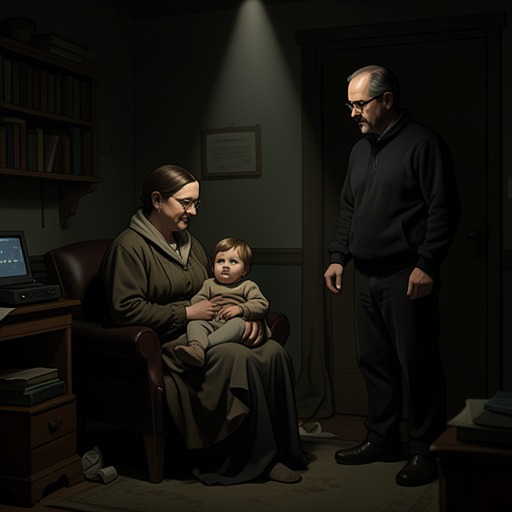
Lynette’s trauma-related dissociation
Noughts & CrossesLynette’s trauma-related dissociation is the lasting aftermath of an assault motivated by her relationship with Jed, a Cross. After the attack, she withdraws from ordinary life and seems lost outside time; when memory briefly returns, the family confronts both the violence she endured and the years of silence surrounding it.
Identity and Background
Lynette is Callum McGregor’s older sister. She and Callum resemble each other, with brown hair and grey eyes, and he remembers her as the sibling who cared for him when their mother had to work. Their closeness gives her later withdrawal particular force: the person who once looked after him can no longer reliably care for herself.
By the time Callum describes her, Lynette is twenty, but he understands her mind as having become detached from ordinary time after an accident three years earlier. She rarely leaves home or speaks, and her attention often rests on her lap. Her face can appear peaceful, as if she inhabits a private world her family cannot enter. Callum’s account also reveals the limits of his understanding: he sometimes envies that apparent peace, even while recognizing how much of his sister has become inaccessible to him.
The Attack and Its Concealment
The family eventually discloses that three years earlier Lynette and Jed were attacked by three or four Nought men. Jed was nearly beaten to death, and Lynette was injured so severely that she spent more than two weeks in hospital. Her parents had not told the younger children what happened because Lynette begged them to keep the truth from them.
The attack was not an unspecified accident. Lynette was targeted because she was dating a Cross. Her father explains that she feared the family’s reaction and did not want them to know the reason for the assault. The concealment thus compounds the injury: the family’s explanation for her absence was that she had gone to care for an aunt, while the actual cause of her changed life remained unspoken at home.
Memory, Time, and Family Recognition
Lynette’s condition appears in daily family scenes as withdrawal punctuated by unsettling signs of recognition. When Callum asks whether she is all right, a slow frown returns to her face, prompting his fear that something is happening again. He tries to reach her through a shared memory of his seventh birthday, when she took him to his first cinema film and told him he could blink. The childhood recollection is both evidence of their former intimacy and an attempt to find a path back to her.
During a later family confrontation, their father strikes Jude after Jude turns away from him. He then reveals the assault and rebukes Jude for judging Lynette without knowing what she endured. The outburst changes the family’s understanding of her withdrawal: it is connected to violence, bereavement, and the continuing pain of a relationship she has lost, not simply a failure to engage with those around her.
A Return to the Past
After striking a cracked mirror, Lynette looks at the blood on her hands and at her reflection as though both are unfamiliar. She asks where Jed is, then insists that his departure was recent. Her father tells her that Jed has been gone for years. Lynette believes she is seventeen, then struggles to reconcile that belief with the fact that she is twenty; her account of time moves between the past she seems to inhabit and the present her family describes.
The episode does not offer a recovery. Rather, it makes visible the cost of the years that have passed outside her awareness. The peaceful, remote expression her family associates with her dissociation disappears in the moment she confronts her own age and the loss of Jed. Her brief return to painful memory does not undo the condition; it reveals why the apparent calm could never be treated as proof that she was unharmed.
Narrative Significance
Lynette’s experience ties private family silence to the wider Nought–Cross racial order. She is attacked for crossing its intimate boundary, and the resulting harm is initially hidden even from her siblings. Her story shows how racist violence can reach beyond its immediate victims: it reshapes family relationships, leaves a lasting absence in the household, and makes silence part of the aftermath.
The narrative first presents Lynette through Callum’s limited view—quiet, distant, and apparently at peace—before the family’s disclosure supplies the history that view could not contain. The contrast exposes the danger of mistaking withdrawal for well-being. Her dissociation is neither a simple mystery nor a temporary plot device: it is represented through disrupted time, damaged connection, and the gradual recognition of violence that the family had kept unnamed.