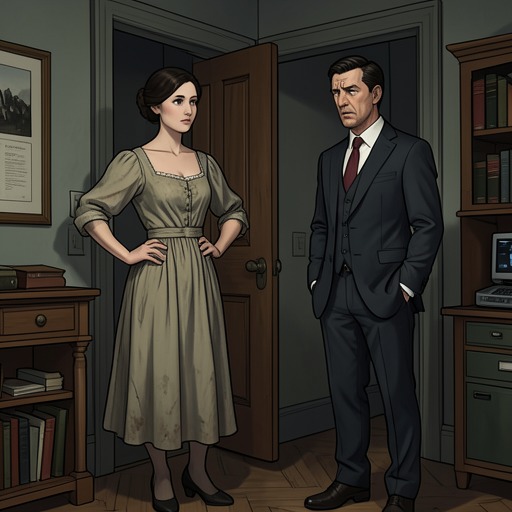
Nought oppression
Noughts & CrossesNought oppression is the systemic subordination of Noughts in a society where Crosses hold greater institutional power. The novel makes that hierarchy visible not only through open hostility but through ordinary procedures, selective representation, and the unequal consequences of political conflict. Its effects range from exclusion and humiliation to intensified policing and imprisonment; resistance gives voice to demands for equal rights, but the Liberation Militia’s violence also turns the struggle into a cycle of retaliation.
Identity and Everyday Exclusion
The school protest makes prejudice public and collective. When Callum and three other Noughts arrive at Heathcroft, a large crowd of Crosses gathers outside, chanting, “NO BLANKERS IN OUR SCHOOL. NO BLANKERS IN OUR SCHOOL.” Police try to move through the crowd toward the entrance while another line of officers pushes the Crosses into groups. The spectacle frames educational access not as a settled right but as a point of racial confrontation, with Nought students entering a hostile space under police supervision.
The institution’s response compounds the crowd’s hostility. On television, Kamal Hadley appears before a report that says the Noughts admitted to Heathcroft met with “some hostility.” Callum’s account describes a sharper reality omitted from the broadcast: the police assigned to protect the students let members of the crowd reach them, and his jacket was covered in spit. The contrast between the report’s minimizing phrase and the experience it leaves out shows how public narration can reduce Noughts’ mistreatment to a mild disturbance while concealing the failure of protection.
Exclusion also appears in the language of school authority. Mrs Paxton tells Mr Costa that Nought students are constantly picked on and warns that one of them may retaliate. Mr Costa replies that if the “blankers” find school difficult, they should go elsewhere. His response shifts responsibility away from the hostile environment and onto the targeted students: rather than address discrimination, he treats Noughts’ departure as a solution. Mrs Paxton’s warning identifies the danger in that refusal to act, while the exchange reveals that prejudice can be sustained by the very authorities responsible for responding to it.
Institutional Power in Daily Life
The unequal order reaches beyond school. When Callum is stopped for sitting in first class, his narration anticipates being punished simply for occupying a space associated with privilege. Sephy intervenes, telling the officer that Callum is with her and that she bought the tickets. The incident exposes a social expectation that a Nought passenger does not belong in first class; Sephy’s presence can challenge the assumption, but the need for her intervention shows how access remains vulnerable to racialized scrutiny.
At a hospital, administrative procedure becomes another point of contact with state authority. Nurse Carter says that before medical care can be given, the family’s identity cards must be checked and registered under a new government ruling. She suggests this is intended to prevent benefit fraud, but the requirement makes official identification a condition encountered even at the threshold of treatment. The scene does not establish that care is ultimately denied; it shows how an apparently routine policy brings registration and government oversight into a vulnerable, everyday setting.
The family’s exposure to public judgment also appears in private conversation. After the case involving Callum draws attention to the Hadleys, Sephy’s mother blames her association with his family for the prospect of their names appearing in court and newspapers. She warns that if Sephy lies down with dogs, she will get fleas. The proverb casts association across the social divide as contamination, making the Nought family itself a reputational danger. In this exchange, the wider hierarchy is reproduced within the home through fear of scandal and insistence on separation.
Media, Law, and the State
The novel connects unequal social standing to unequal control over how events are described. The television report from Heathcroft acknowledges hostility but leaves out the police failure and the assaults Callum recounts. The discrepancy is more than a difference in tone: it determines which details become publicly visible and whether institutional conduct is questioned. Noughts’ testimony confronts a version of events that presents the school conflict as limited hostility rather than a failure to protect them.
The same unequal landscape shapes the novel’s account of state force. At the execution of Ryan Callum McGregor, Noughts stand in the prison courtyard while Crosses sit in the designated seats. The formal announcement identifies Ryan as convicted of seven murders and political terrorism and declares that his hanging will proceed after his appeal has been denied. The scene establishes the severity of the punishment and the division among those assembled; it does not, on its own, demonstrate that the conviction is wrongful. Its place in the broader account of Nought oppression lies in how state power and racial division meet in a public act of punishment.
After Callum’s death, Jude sees the Liberation Militia as hunted by the authorities. He describes police pressure, large cash rewards for information leading to members’ capture and conviction, and a fellow Nought fighter shot dead at a station. His account presents an organization forced to scatter and focus on immediate survival. These are Jude’s perceptions as a militant narrator, not an independent accounting of every operation; they nevertheless show how he understands the state’s campaign against the movement and why he regards Nought lives as exposed to force.
Resistance, Equality, and Retaliation
Callum’s own progression inside the Liberation Militia shows how opposition takes organizational form. He recalls beginning as a tea boy, then following orders as a grunt in a cell of six men and three women, before advancing through the ranks to sergeant at nineteen. The account links his growing role in the organization to a life increasingly shaped by its hierarchy and duties. His advancement offers status within the movement, but it also places political struggle inside an armed structure.
The limits of that resistance are sharply drawn in Jude’s dispute with Minerva. He rejects the label “terrorists” and calls the group freedom fighters, arguing that Cross oppression kills Noughts mentally and physically and that Noughts are ignored when they try to explain their lives. When Minerva points out that the Militia bombs and kills innocent people, Jude answers that violence gets attention. He then states the demand beneath the argument: the group wants equality and the same rights and freedoms that Crosses enjoy, not sympathy. The exchange makes the gap between political aim and method explicit: an appeal for equal treatment is voiced through a strategy that harms civilians and alienates potential allies.
Jude’s account after Callum’s death further shows how oppression and resistance feed retaliation. He says that the Militia became hunted, that its cells were scattered, and that many Noughts demanded reprisals. He promises each night and morning that those responsible for Callum’s death will suffer. His language turns a political grievance into a personal vow, while the movement’s weakened position leaves little room for long-term planning. The result is not a resolution of Nought inequality but a narrowing of political possibility, as survival and revenge displace sustained strategy.
Narrative Significance
Across school, transport, healthcare, family life, media, policing, and punishment, the novel presents oppression as a structure sustained by more than individual animosity. A crowd can make exclusion immediate; a headmaster can treat departure as the answer; a report can omit the experience of those it describes; and an identification rule can extend official scrutiny into medical care. These scenes differ in scale and form, but together they show how inequality is reproduced through both conspicuous hostility and ordinary institutional practice.
The novel also refuses to make the Liberation Militia’s political claim and its actions interchangeable. Callum and Jude articulate a concrete demand for equal rights and freedoms, while the bombing, killing, and retaliation discussed in the book carry consequences that cannot be erased by that demand. Nought oppression explains the conditions to which the characters respond; it does not make every tactic just or effective. By setting their stated aim beside the escalating harm and repression surrounding them, the narrative shows how a struggle for equality can be trapped in a conflict that keeps the hierarchy’s violence in motion.