Nought–Cross inequality and segregation
Noughts & CrossesNought–Cross inequality and segregation shapes both public institutions and intimate relationships: Noughts face exclusion, unequal discipline, surveillance, and state violence, while Cross privilege is treated as the ordinary measure of whose safety, testimony, and belonging count. The novel makes this hierarchy visible through recurring contrasts between official explanations and lived experience, and between the protections available to Crosses and the dangers imposed on Noughts.
Identity and Structure
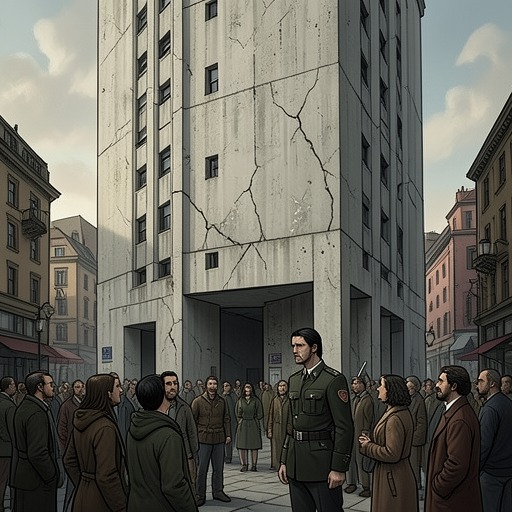
The system is more than a collection of individual prejudices. It is a racial order reinforced across daily life, from school admission and discipline to policing, medical administration, news coverage, and punishment. The evidence repeatedly places these institutions alongside one another: the crowd at Heathcroft, the handling of student complaints, the hospital’s identity-card rule, and the public execution of Ryan McGregor all show different mechanisms producing the same unequal status.
That structure also shapes what people can imagine for themselves. Lynette asks whether life under the existing arrangement has any purpose for Noughts, wondering whether, from the Crosses’ point of view, their assigned place works while Noughts themselves might as well not exist. Her question gives the hierarchy an existential consequence: exclusion is not only a barrier to a particular opportunity but a message about whose life is recognized as meaningful.
Education and Public Hostility
At Heathcroft, the formal admission of Nought students does not bring acceptance or equal protection. A large Cross crowd gathers outside the school, chanting against Nought pupils as police try to manage the confrontation. Inside the school, the danger continues: Callum describes officers who were meant to protect the students allowing members of the crowd to reach them, while the news report reduces what happened to “some hostility.” The gap between the students’ treatment and the broadcast account makes media language part of the same unequal order: violence against Noughts is softened, and the public record omits what would make that violence unmistakable.
School discipline likewise makes formally shared rules work differently in practice. When Sephy challenges the expulsion of Shania, she says Shania slapped Gardner Wilson only after he hit her, yet Shania was expelled while Gardner received only a telling-off. The contrast is not presented as an isolated dispute: Sephy describes Nought students admitted to a small number of schools as being expelled or “excluded” for conduct that would bring Crosses detention or a severe reprimand. Some Cross pupils may be suspended, but they are not expelled at anything like the same rate. Mr Costa refuses to justify school policy and suggests the matter could be reviewed after the unrest has passed; Sephy recognizes that the promised calm will not arrive on terms that correct the disparity.
The school’s adult authorities expose another divide between acknowledging harm and accepting responsibility. Mrs Paxton warns that Nought pupils are constantly targeted and that retaliation is only a matter of time. Mr Costa answers that if they are finding school difficult, they may go elsewhere. His response turns the victims’ exclusion into a reason for their departure, rather than treating the hostility as a failure of the institution charged with educating them.
Administration, Policing, and Public Narratives
The hierarchy reaches into policing as well as education. When two officers arrive at the McGregor home, they are both Crosses; the narration notes that Nought police officers are exceptionally rare. This detail suggests that the authority enforcing the law is itself racially imbalanced. Their arrival at the family home also links the unequal institutional order to the McGregors’ private life, where police action is not an abstract policy but a direct presence at the door.
At the hospital, administrative procedure makes access to care conditional on state registration. Nurse Carter tells Meggie that before treatment the hospital must inspect and register patients’ identity cards, including their photographs and fingerprints. The stated rationale is to stop patients moving between hospitals for sickness certificates and to prevent hospitals from misreporting the number of patients treated. But the rule is applied across Nought hospitals, and refusal to hand over an identity card means refusal of treatment. A policy described as preventing fraud therefore places biometric scrutiny between Nought patients and medical care, irrespective of whether a particular patient receives benefits.
The news report about Heathcroft demonstrates a parallel form of control: not the registration of a person’s identity, but the management of what the public is allowed to see. The reporter’s restrained description does not mention the officers’ failure to protect Nought pupils or the mistreatment Callum describes. Official language and routine procedure can thus conceal unequal outcomes even while presenting themselves as neutral accounts or administrative safeguards.
Family Power and Intimate Consequences
The hierarchy also crosses into family life, though power within a household does not simply mirror public racial status. Sephy is a Cross and benefits from the social position attached to that identity, yet her father uses his authority to control her choices when her relationship with Callum becomes public and consequential. After she says her pregnancy followed mutual love, Kamal strikes her and orders her to have an abortion, declaring that she is no longer his daughter. The moment shows how racial privilege cannot be treated as freedom from every form of coercion: Sephy’s status as a Cross coexists with her vulnerability to patriarchal control within her family.
The unequal social order also marks the relationship between Sephy and Callum as a boundary-crossing attachment. At the beach, Callum kisses her briefly, then four Noughts approach; Sephy reads the scene as a threat and runs. Later, during their captivity, the two become intimate. These episodes make the relationship a personal bond formed within a world that assigns them opposing social positions, while the surrounding danger prevents love from becoming a refuge untouched by that order.
Sephy’s intervention when Jude threatens Minerva reveals the conflict in especially concentrated form. She slaps her sister to stop her screaming and warns her that Jude will kill her if she does not become quiet. The act protects Minerva in the immediate crisis, but it also shows fear and threatened violence shaping the sisters’ choices. Their position as Crosses does not erase the danger imposed by Jude, even as the wider society continues to grant Crosses structural advantage over Noughts.
Violence, Law, and the Cost of the Order
The social divide is enforced not only through rules but also through conflicts in which individual resistance meets unequal power. When Lola uses racist claims to demean Noughts, Sephy rejects the assertion that Noughts are inferior and fights back after being struck. Her response challenges the prejudice, but it does not dissolve the surrounding hostility: she is outnumbered, and Dionne is known as the strongest fighter in her year. The episode sets verbal dehumanization beside physical aggression, showing how a racial ideology can be repeated in speech and backed by force.
Violence also appears within the McGregor family as the effects of social conflict press on individual relationships. When Jude turns away from Ryan during an argument, Ryan slaps him, an act Callum identifies as unprecedented from their father. Ryan then insists that Jude cannot judge Lynette without knowing what she has endured. The scene does not equate a family assault with institutional discrimination, but it shows how strain and pain enter the household, complicating the idea that the racial order operates only in public spaces.
The execution of Ryan McGregor makes the state’s power over Nought life public and ceremonial. Sephy reaches Hewmett Prison among silent Nought mourners dressed in black and sees Noughts standing before the scaffold, some crying and others facing the Crosses seated at the front with visible hatred. Only when the official announcement names Ryan’s conviction for seven murders and political terrorism, and declares that his sentence will be carried out by hanging, does Sephy understand why she has been brought there. The scene places legal authority, racial division, and public spectacle in one courtyard: Noughts stand, Crosses sit, and the sentence becomes an event witnessed across the divide.
Taken together, these episodes show segregation as a repeated distribution of credibility, protection, and consequence. Nought students describe harm that a news report minimizes; a school authority treats their departure as a solution; a patient must surrender biometric information or forgo care; and Ryan’s execution is carried out before a racially divided crowd. The force of the pattern lies in its reach across institutions and intimate life: unequal treatment is not an exception to the social order but one of the ways that order is maintained.