People's Liberation Army
Noughts & CrossesThe Liberation Militia is a secretive armed organization operating against the racial hierarchy that subordinates Noughts to Crosses. It presents itself as a force for political change and calls its members Freedom Fighters, but its underground structure, suspected bombing, and later kidnapping make it a target of state repression. The novel traces the organization both through public argument about reform and through the private choices of people drawn into its ranks, showing how its claim to pursue equality becomes entangled with secrecy, violence, and revenge.
Origins, Aims, and Political Context
The organization enters the story amid arguments over reforms prompted by the Pangaean Economic Community. In a conversation overheard by his daughter, Kamal Hadley complains that the government has opened schools to Noughts and begun recruiting them into the police and armed forces, yet the Liberation Militia continues to press for more change. He had expected educational access to weaken the Militia’s appeal; instead, he describes it as increasingly impatient with the pace of reform. His alarm also reflects a personal political stake: he fears losing his place in government because of the organization.
The Militia’s leadership is difficult for authorities to identify. A guest speaking with Kamal explains that working up through its ranks is slow and that its military groups are divided into separate cells or units, with multiple drop-off points for communication. The structure makes it hard to discover who is in charge. Kamal rejects this explanation and demands that his contact keep investigating. The exchange establishes a network designed to conceal its command and communications, while also showing the government trying to penetrate it from within.
The movement’s name is itself contested. Kamal’s guest says its members call themselves Freedom Fighters; Kamal dismisses that self-description and demands that they be wiped out. On television, he instead describes the government’s school policy as the result of a Pangaean Economic Community directive, denying that the state has been blackmailed by an illegal terrorist group. The two accounts—an organization exerting pressure, and a government insisting that reform is its own decision—leave the political effect of the Militia disputed even as both sides recognize its influence.
Cells, Membership, and Internal Debate
The cell structure is reflected in Callum McGregor’s later account of joining the Militia. He begins as a tea boy, advances to grunt while following orders from anyone in a cell of six men and three women, then rises to private and eventually sergeant. At nineteen, he is proud of earning the rank and moving into a new cell. His progress supplies a human scale to the organization’s otherwise concealed hierarchy: recruitment does not immediately confer authority, but sustained participation creates rank, contacts, and access to resources.
The organization’s politics are debated inside the McGregor family rather than accepted uniformly. Ryan McGregor argues that peaceful methods have failed, invoking Alex Luther as evidence; Meggie McGregor objects to the militant alternative and calls the General, the anonymous head of the Militia, a warmonger. She argues that killing and maiming may attract attention more effectively than peaceful protest, sit-ins, and passive resistance, but that effectiveness does not make violence right. Ryan counters that Alex Luther’s repeated imprisonment demonstrates the limits of nonviolent change. Their argument recurs without resolution, and Meggie resists Ryan’s reverence for the General, while Ryan treats the leader as nearly sacred within the movement.
The dispute also reaches into language and identity. When Ryan calls Alex Luther a slur used against Noughts, Meggie objects that oppressed people should not adopt the same insult used against them. Ryan answers with the principle of naming and claiming the word. The disagreement makes clear that joining or sympathizing with the Militia does not settle how its members understand resistance: even the language of opposition is contested within the family.
Public Image, State Response, and Violence
The organization becomes a prominent subject of national news. A report says that an earlier car bomb outside the International Trade Centre is suspected of being the Militia’s work, though the report calls this unconfirmed. Kamal responds by promising to find those responsible and states that political terrorism causing the death or serious injury of even one Cross is a capital crime. The reported bombing therefore becomes part of the state’s justification for severe punishment, while the accusation remains unconfirmed in the broadcast evidence.
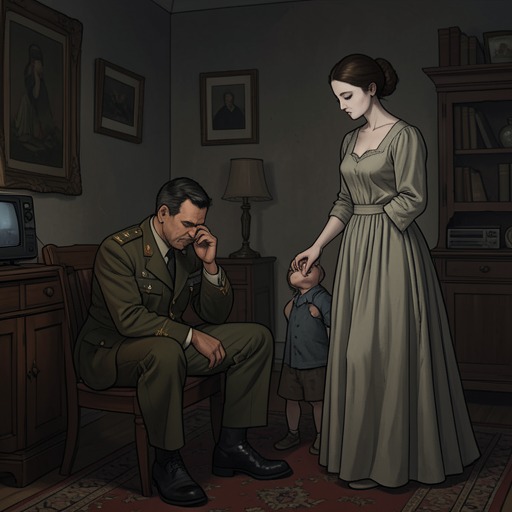
Kamal’s public position contrasts with the more complicated signals at home. When he appears on television to reject the suggestion that school admissions resulted from Militia pressure, his son Jude McGregor punches the air and calls for the organization to endure. Ryan approves, exchanging a knowing look with Jude. Callum notices that his brother and father appear to share knowledge about the Militia and resents being excluded, though the moment does not establish exactly what either knows. The family scene places the organization within private loyalties as well as public policy: it can command allegiance even in a household where its methods are disputed.
Its political effect is also visible in the conflict around Heathcroft High. A crowd protests the admission of Nought students, while police officers fail to prevent the students from being targeted; news coverage later softens the hostility into a report that they met with some opposition. Elsewhere, a school headmaster suggests that Noughts who are struggling should go elsewhere, while a colleague warns that they are continually picked on and that one may retaliate. These scenes do not establish that the Militia organized the school violence. They show, instead, the unequal conditions against which the organization claims to act, alongside the gap between events on the ground and their public description.
Recruitment, Revenge, and Escalation
Callum’s development within the Militia links political membership to personal grievance. After moving through its ranks, he uses the contacts and resources available to him to locate three Heathcroft students who had attacked Sephy Hadley for associating with him. He investigates their homes, families, and preferences, then targets them in turn. He describes the acts as revenge for what they did to Sephy and recognizes that he loses more of himself as he carries them out. His account presents the organization as a source of practical capacity for private retaliation, not only as a vehicle for collective political aims.
The Militia’s secrecy also becomes part of the family’s immediate danger. When Callum realizes that it is planning an operation at the Dundale Shopping Centre and that Jude knows about it, he understands that his brother does not want him involved. Remembering that Sephy is at the shopping centre, he reacts with alarm. The evidence establishes that the organization is planning something there, but not the details of the plan in this moment. That uncertainty drives Callum’s recognition of the danger without making him an informed participant in the operation.
After the bombing, police question Callum about his brother’s involvement and ask which Militia cell he belongs to. He denies that his brother is a member, exhausted by the interrogation. The exchange illustrates how the cell system, intended to compartmentalize the organization, also shapes the state’s questioning: investigators seek affiliations and cell membership, while Callum’s denial leaves the precise information he has undisclosed in the scene.
The organization later uses kidnapping and ransom as part of its campaign. At a concealed cabin in the woods, information has circulated for more than two weeks that Sephy may be on her way home. Jude and Pete have planned for that possibility and obtained permission from the General. The cabin is known only to a select few; the group arranges for two guards to be on duty at all times, one outside the front and one at the back. Their preparations are intended to protect the operation and hold Sephy as a prisoner.
The ransom plan combines immediate funding with political demands. On a crisp early-autumn evening, the group intends to collect the money and tell Kamal that he will not see his daughter until five Militia members are released from prison. Three of the five are key members, contrary to what the authorities believe. Leila is to remain with Sephy, while Pete, Morgan, and Jude make relay calls from three different places around town to frustrate tracing; Callum is assigned to deliver a second set of instructions, collect the money, and return to the cabin. The episode shows the cell network operating through concealment, delegated roles, and dispersed communication, while turning Sephy’s captivity into leverage over both the government and the organization’s members in prison.
Narrative Significance
The Liberation Militia occupies an unstable position between a response to entrenched discrimination and a source of further harm. Its demands arise in a society where Nought students face hostility and public accounts can minimize that hostility, yet the organization’s methods include suspected bombing, violent retaliation, and hostage-taking. The story does not make the Militia’s self-description as freedom fighters equivalent to the government’s label of terrorists; instead, the opposing names expose the struggle over who gets to define political violence and legitimate change.
Its hidden cells offer members belonging, advancement, and means to act, but those same structures keep leadership remote and knowledge partial. Callum’s rise from tea boy to sergeant brings status and resources, while his retaliation against the Heathcroft students shows how organizational power can carry private anger into planned action. The Militia’s place in the plot is therefore not simply that of a rebel force opposing the state: it is also the setting in which political grievance, family loyalty, revenge, and coercive tactics converge.