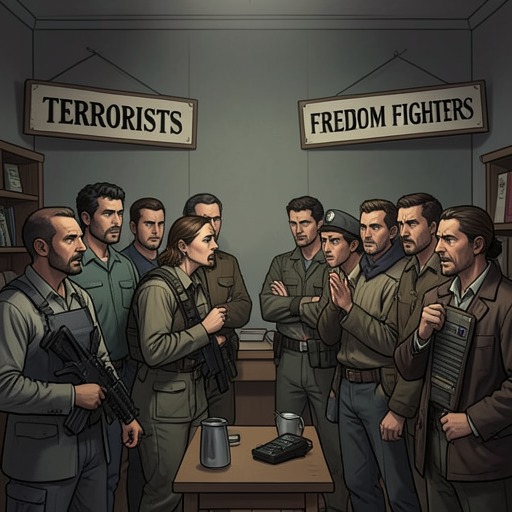
Pursuing equality through revolutionary violence
Noughts & CrossesPursuing equality through revolutionary violence names the novel’s central political contradiction: the Liberation Militia challenges the Nought–Cross hierarchy through clandestine organization and armed action, but its methods bring civilian deaths, state repression, and further personal violence. The story does not treat the demand for equality as equivalent to every action taken in its name. Instead, it traces how structural exclusion helps make militancy intelligible to the oppressed, while the consequences of violence test the claim that a just end can excuse its means.
Inequality and the appeal of militancy
The appeal of resistance is grounded in ordinary institutions as well as in the Militia’s underground activity. At Heathcroft, a crowd gathers to oppose Nought pupils’ admission, while police struggle to control the demonstration. Later, the news reports that the newly admitted pupils met with “some hostility”; Callum’s account of the same coverage points out that it omits the abuse and assault directed at them, including the spit covering the back of his jacket. The contrast makes the conflict one of power over public description as well as power in the school: discrimination is experienced directly, then softened or left out when the event is narrated to the wider public.
The injustice is also acknowledged from within the school. Mrs Paxton tells Mr Costa that Nought pupils are being constantly picked on and warns that one of them may retaliate. Costa’s answer is that they can go elsewhere if they find the school difficult. The exchange shows how exclusion can be sustained without an explicit policy of expulsion: complaints are met by shifting the burden onto those targeted, while the conditions that provoke resentment remain in place. In this setting, the Militia’s promise of resistance can appear to Callum as an alternative to a school system that offers neither welcome nor reliable protection.
Recruitment, secrecy, and the choice to join
Callum’s early encounters with the organization reveal both its attraction and its limits. When he infers that Jude belongs to the Liberation Militia, he asks Ryan to let him attend a meeting. Ryan refuses: Callum is too young, and discovery could end his school career. Callum says school is already a waste of time and cites other Nought pupils who have left or been expelled. His request joins political commitment to a sense of blocked possibility; Ryan, by contrast, sees education as something his son should retain, even while he is himself involved in the Militia.
That tension sharpens when Callum realizes the organization is planning an operation at the Dundale Shopping Centre and understands that Sephy is there. Jude has warned him away from the subject, but the implication reaches him before he knows what will happen. The planned action is no longer an abstraction about equality or resistance: it places someone Callum cares about within reach of the Militia’s operation, forcing the political and the personal into direct conflict.
The organization is presented as a clandestine network rather than a loose public protest movement. Callum later recalls starting as a tea boy, then following orders as a grunt, advancing to private and eventually sergeant in a cell of six men and three women. He is nineteen when he earns that rank. His account depicts a hierarchy with assigned roles and advancement, and it also shows how participation can become a source of purpose and status. Yet the same structure makes individuals answerable to orders and draws them further into a system whose actions extend beyond the equality they profess to seek.
The bombing and the struggle over justification
The Dundale bombing makes that contradiction unmistakable. A television report announces that a bomb has exploded at the shopping centre, that at least seven people have been killed and many more wounded, and that the Liberation Militia issued a warning only five minutes before the explosion. The report establishes the human cost and connects the attack to the organization. Jude calls the announcement a lie, but the supplied scenes do not establish precisely what he means by that denial; the discrepancy remains part of the uncertainty surrounding responsibility and public accounts.
The government’s response frames the attack as an act of terrorism that will strengthen public resolve against the Militia. That condemnation does not undo the deaths, but it marks a further consequence of the attack: the organization’s violence supplies the state with a powerful argument against its political cause. The novel places this public framing beside the earlier omission of violence against Nought pupils. In both cases, media and political accounts shape what the public is asked to see, although the bombing’s victims and the state’s condemnation make it impossible to treat militant violence as merely a matter of distorted reporting.
Ryan articulates the logic behind his commitment in a family confrontation. He says that he wants something better for his sons, then answers that, in this case, the end does justify the means, because the “daggers” have left them no other option. His statement makes the moral wager explicit: he sees violence as a response to a social order that denies meaningful alternatives. But the scene gives that defense no uncontested authority. It is spoken amid the breakdown of family trust, and the very insistence that no other option exists exposes how the cause has narrowed Ryan’s choices as well as shaped them.
From equality to retaliation
The courtroom brings the conflict between political ends and violent means into direct question. Asked about the Militia, Sephy says she supports any organization that promotes equality between Noughts and Crosses and tries to bring it about. When the questioner follows by asking whether the end justifies the means, the exchange turns her broad commitment into a test of whether she will also defend the organization’s methods. Her answer supports equality; it does not settle the moral status of violence. The distinction matters because the political aspiration and the means used in its name are not interchangeable.
Callum’s own trajectory shows how militant politics can also become a vehicle for private revenge. As he rises through the ranks, he uses the Militia’s contacts and resources to identify the Heathcroft pupils who attacked Sephy for sitting with him. He targets them in turn, taking particular care with Dionne. He describes the revenge as deliberate and cold, and recognizes that he loses more of himself in carrying it out. His account marks a shift: political organization gives him power to answer a racist assault, but retaliation does not restore the earlier self he associates with sitting on the beach and watching the sunset. It changes what he is willing to do and who he understands himself to be.
The later kidnapping plot extends the same logic from retaliation to coercive bargaining. Jude and others plan to obtain ransom money from Kamal Hadley and withhold Sephy until five imprisoned Militia members are released. The group’s demands are connected to its future activities, and three of the five prisoners sought are key members rather than the minor figures the authorities assume they are. The plan reveals a disciplined capacity for secrecy and coordination, but also the conversion of a person into leverage for political and financial aims. Equality remains the stated cause; the means increasingly subject other people to the very denial of agency that the cause opposes.
Political and moral significance
The novel’s treatment of revolutionary violence rests on a persistent tension between a valid grievance and the harm done in answering it. School exclusion, inadequate protection, and public minimization help explain why the Militia can attract members; they do not erase the consequences of its attacks or of Callum’s revenge. Conversely, condemning the bombing does not make the earlier discrimination disappear. The story holds both truths in view rather than allowing either state denunciation or militant justification to close the argument.
Its most revealing pattern is the repeated passage from a structural injustice to a personal response, and from that response to a new injury or restriction. Callum’s desire to join grows out of the limited future he sees at school; Ryan’s defense grows out of his wish for a better life for his sons; the bombing brings deaths and strengthens opposition to the Militia; and Callum’s use of organizational power for revenge leaves him alienated from his former self. Across these episodes, the pursuit of equality through violence appears not as a simple liberation but as a strategy that can reproduce coercion, deepen division, and compromise the people who adopt it.