Ryan McGregor
Noughts & CrossesRyan McGregor is Meggie McGregor’s husband and the father of Callum McGregor, Jude McGregor, and Lynette McGregor. He believes his children must find ways to live within a society governed by Cross privilege, but he rejects the Liberation Militia’s armed struggle. Convicted of the Dundale bombing and sentenced to death, he is executed at Hewmett Prison; the loss shapes his family’s grief and exposes the force of the racial and political order surrounding them.
Identity and Family
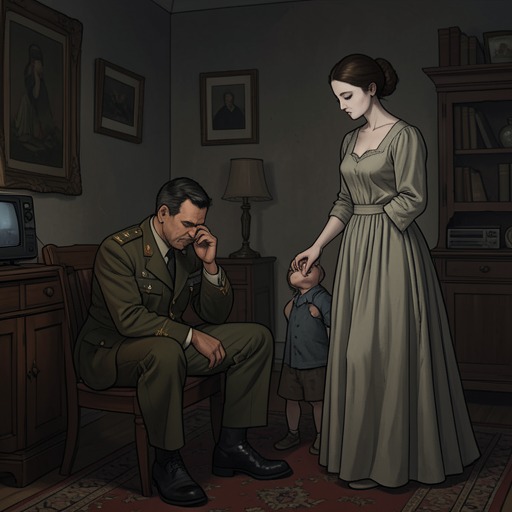
Ryan is presented through his family life as well as through the politics that divide Noughts and Crosses. At home, Meggie worries about the direction of events and what her children may face. Ryan tries to reassure her, but she remains troubled, and the ringing phone interrupts their exchange. In another domestic conversation, Meggie’s hands are occupied with sewing patches over patches in Jude’s school trousers, an everyday sign of the family’s modest circumstances.
Ryan’s hopes for Callum are pragmatic. He argues that his son needs to attend Cross schools, learn to operate by their rules, and become better at doing so than those around him. When Meggie asks whether that is all he wants for their son, Ryan appeals to the prospect of a better life than the parents themselves had. His outlook is not that the system is fair, but that his children must contend with it to get ahead.
Politics and Resistance
Ryan’s approach to change is debated within the family. He invokes Alex Luther as an example, but the surviving exchange records Meggie’s sharp rejection of the reference rather than establishing what Ryan hoped to achieve through it. Their disagreement reflects a larger tension between gradual or peaceful change and armed resistance.
Meggie is explicit in her opposition to the Liberation Militia’s anonymous leader, the General. She acknowledges that killing and maiming can attract more attention than peaceful protest, sit-ins, or passive resistance, but insists that this does not make violence right. Ryan’s arguments place him in the political debate around resistance, yet the evidence does not establish him as a member of the militia. His position is better understood through the contrast between his interest in political change and Meggie’s rejection of violent methods.
Family and a Divided Society
Ryan’s family encounters racial hostility in schools and public life. When Nought students are admitted to Heathcroft, a crowd gathers outside the school, chanting against their presence while police try to control the confrontation. Callum and three other Noughts are surrounded as they approach the entrance. The incident gives concrete context to Ryan’s insistence that his son learn to navigate Cross-run institutions: access to education brings neither safety nor acceptance.
The public account of that hostility is also contested. Callum observes that the television report describes the Nought students as meeting “some hostility,” while omitting what he says the students experienced and the failure of the police to protect them. At Heathcroft, Mr Costa suggests that Nought students who find conditions difficult should go elsewhere. Mrs Paxton counters that they are being persistently targeted and warns that one of them may retaliate. Together, these moments show the pressures facing Ryan’s children and the disagreement over whether the institution should protect them or make them leave.
A government policy requiring patient identity cards to be checked and registered reaches the family in hospital, where staff say verification is required before medical care can be administered. The rule is explained as a way to prevent benefit fraud. Its appearance in a family medical encounter links official administration to the broader climate of scrutiny experienced by Noughts, although the scene does not establish Ryan’s personal involvement in the policy.
Trial and Execution
Ryan is convicted of seven counts of murder and political terrorism in connection with the Dundale bombing. His appeal is denied, and the sentence is hanging. The available evidence does not detail the trial or establish the circumstances of his confession, so the public announcement at the execution is the clearest account of the conviction and its stated grounds.
At Hewmett Prison, Nought mourners stand in silence while Cross spectators sit in the courtyard. Callum arrives among the mourners, and Sephy, seated with the Crosses, unexpectedly sees him. The official announcement identifies the condemned man as Ryan Callum McGregor, gives his address as 15 Hugo Yard, Meadowview, and declares that the sentence will be carried out. Only then does Sephy understand why she has been brought to the prison: Ryan, Callum’s father, is to be executed.
Narrative Significance
Ryan’s execution joins the private consequences of family loss to the public machinery of punishment. The prison scene contrasts the standing Nought mourners with the seated Cross audience, making the racial division visible at the moment the state carries out its sentence. For Callum, the death of his father is also a decisive turning point in the story’s wider movement from political grievance toward personal grief and further conflict.
Ryan’s family conversations complicate any simple opposition between accommodation and resistance. He sees education and competence within Cross institutions as necessary for his son’s future, while Meggie condemns the violence associated with the General. Yet the school scenes show how hostile those institutions can be, and Ryan’s execution places the harshest consequence of the political order at the center of his family’s story.