Ryan McGregor's confession
Noughts & CrossesRyan McGregor’s confession is a false admission to the Dundale Shopping Centre bombing, made under threat to keep the authorities from imprisoning his wife and sons. Its significance lies in the terrible exchange it sets in motion: Ryan accepts responsibility for a crime he denies committing so that Jude will not die, but the confession gives the state the evidence it needs to prosecute and condemn Ryan instead.
Background and Coercion
The confession emerges from the aftermath of the bombing and the police’s pursuit of Jude. Ryan tells his family that the authorities said they had Jude and proof that he was the bomber, then made clear that someone had to take responsibility for the Dundale attack. They left him to choose who would bear the blame. Ryan says he confessed because the police threatened to imprison Meggie and Callum as well for conspiracy, making his own life the price of protecting his family.
The decision is not presented as a genuine admission of guilt. When Meggie asks whether he planted the bomb that killed people, Ryan answers no. He distinguishes the confession he signed from the truth he says he told police, insisting that his family’s safety, rather than responsibility for the bombing, compelled him to claim the charges.
The Evidence and Ryan’s Account
The confession acquires the appearance of legal certainty through both procedure and physical evidence. Detective Inspector Santiago tells the family that Ryan confessed as soon as he was told whose fingerprints had been found. His dictation and signature were videotaped, and the police maintain that the recording shows no duress. Ryan’s account of intimidation is thus set against the official claim that the confession was voluntary.
The fingerprints belong to Jude: two were found on a cola-can fragment in the bin where the bomb went off. Ryan explains that he brought the cola from home to avoid being seen buying one in a shop. Jude had apparently handled the can and returned it without Ryan noticing. Ryan also says that he kept the necessary equipment for the casing at home and that Jude must have touched it out of curiosity. He presents these contacts as innocent explanations for traces that otherwise appear to connect Jude to the attack.
Ryan makes his defense emphatic and public, raising his voice and insisting that Jude had nothing to do with the bombing. He calls himself guilty and nobody else. The insistence cannot erase the physical evidence, but it reveals the confession’s purpose: Ryan is trying to take Jude’s place in the case, not to describe his own actions as bomber.
From Confession to Prosecution
The recorded confession is quickly converted into a public account of guilt. A news report identifies Ryan by his full name and address, says he has been charged with political terrorism and seven counts of murder, and describes the case as a formality because he has confessed. It also reports that Meggie and their sons are in hiding. The speed of this announcement contrasts with the uncertainty and coercion the family has just described: the official story is already settled while Ryan’s reasons for confessing remain private.
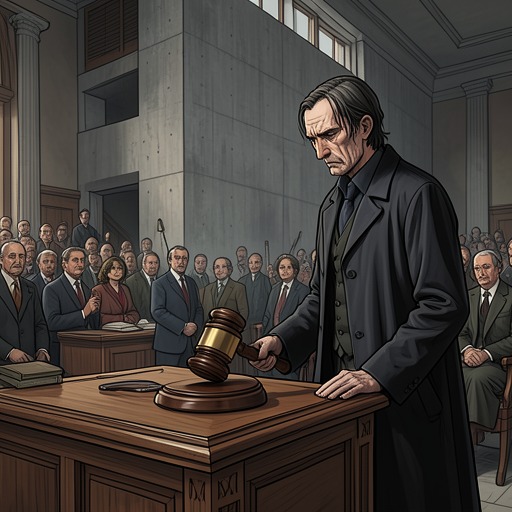
At trial, Ryan pleads guilty to the charge of political terrorism. Callum cries out for him not to do so, but Judge Anderson threatens to have the public gallery cleared if there are further outbursts. Ryan meets Callum’s eyes only briefly; Callum remembers his father’s split lip, bruised cheek, and black eye, and sees sadness rather than condemnation. The plea therefore carries consequences beyond the courtroom formality described in the news: it leaves Ryan’s family watching him accept a sentence built on the confession.
Consequences and Significance
Ryan’s chosen lie protects Jude from immediate execution. He tells Meggie to make sure Jude stays lost so the police will not find him and says that, at least, his confession means Jude will not die. Protection is not absolution: Ryan’s action conceals Jude from the authorities while transferring the full legal danger to himself.
The consequences reach beyond the trial. At Hewmett Prison, Crosses are seated while Noughts stand before the scaffold, and Callum recognizes his father among those brought to be executed. The execution announcement names Ryan as convicted of seven murders and political terrorism after his appeal has been denied. The false confession thus becomes the link between a family’s attempt to survive police threats and the state’s public, irreversible punishment of Ryan.
The episode also belongs to a wider pattern in which institutions turn the Nought family’s vulnerability into procedure. Earlier, a school crowd chants against Nought students while police struggle to reach the entrance; on television, the hostility is softened to “some hostility.” At school, Mr Costa suggests that Noughts who find conditions difficult should go elsewhere, despite Mrs Paxton’s warning that they are being constantly targeted. Later, even hospital care is preceded by a government requirement to check and register patients’ identity cards. Against these ordinary and official forms of exclusion, Ryan’s taped confession demonstrates how a process presented as lawful can still conceal coercion and make a Nought father’s sacrifice look like proof of guilt.
Ryan’s confession is therefore both an act of familial protection and a mechanism of injustice. He claims the bombing to keep Meggie and Callum from prison and to prevent Jude’s death; the authorities record his words as voluntary, the news treats the case as settled, and the court carries the claim through to execution. What Ryan means as a shield for his sons becomes the state’s instrument for condemning him.