Ryan’s false confession
Noughts & CrossesRyan’s false confession is a coerced act of protection that turns Ryan McGregor’s family from the targets of a bombing investigation into the family of a condemned man. Ryan admits to the Dundale Shopping Centre bombing despite denying that he planted it, explaining that the authorities threatened his wife and sons and made him choose who would take the fall. His account transforms a criminal accusation into a choice between his own life and the safety of his family—and the state’s prosecution makes that choice devastatingly real.
The accusation and the choice
Ryan’s confession emerges after Jude returns home amid the investigation into the bombing. Jude tells his parents that members of his cell helped set up the attack and that they had been promised a warning call an hour before it went off, so the building could be evacuated. He says he swears the warning was supposed to come and looks bewildered when Ryan’s earlier assurance fails to make sense of what happened. His explanation does not undo the deaths; it exposes how the perpetrators’ expectation of an evacuation collided with the actual catastrophe.
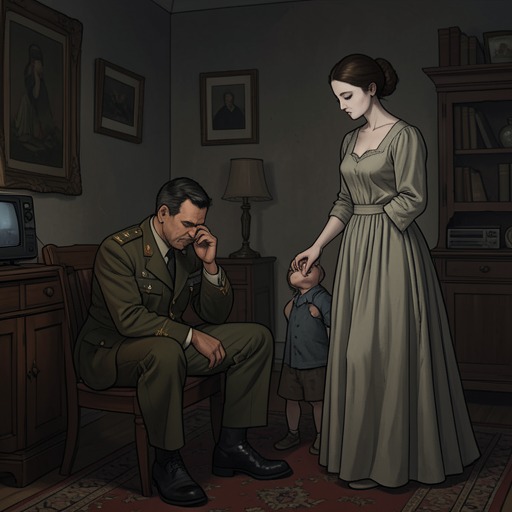
Ryan then tells his family that he has signed a confession admitting to all the charges. He says the police claimed they had Jude and proof that Jude was the bomber, and told Ryan that someone had to take the blame for the bombing. When Meggie challenges him about whether he planted the bomb, Ryan looks directly at her and answers no. He repeats that denial even while accepting responsibility in the legal sense, distinguishing the confession he has made from what he says actually happened.
His stated reason is the threat to his family. Ryan tells Meggie that the authorities warned that she and Callum could also go to prison for conspiracy, making his decision, as he presents it, a choice between his own life and the lives of his entire family. The confession is therefore not an admission of guilt but a protective substitution: Ryan accepts the accusation to keep the authorities from pursuing his wife and sons, while attempting to shield Jude from prison as well.
The fingerprints and Ryan’s defense
The apparent physical evidence against Jude gives the confession its immediate force. Ryan explains that he brought cola from home because he did not want to risk being seen buying it in a shop. Jude must have handled the bottle and put it back without Ryan realizing, he says; the same explanation applies to the bomb casing. Ryan had kept the necessary equipment at home, and Jude, curious, must have touched it without understanding what he was handling.
Ryan presents these details as the source of Jude’s fingerprints, not as evidence that Jude assembled the bomb. He raises his voice and insists that Jude had nothing to do with the attack and that he, Ryan, is guilty. His account asks his family—and the authorities—to accept an explanation that turns suspicious traces inside the home into an accident of ordinary handling. To Callum, the idea that Jude was the bomber seems impossible, and Ryan’s explanation sounds implausible; the mismatch between his son’s disbelief and his father’s insistence underscores the cost of the confession.
Ryan’s defense is also a deliberate attempt to manage what happens next. He tells Meggie to make sure Jude stays lost so that the authorities cannot find him and send him to prison. Ryan believes that his confession will at least prevent Jude from dying. The protective logic is stark: by making himself the named culprit, he hopes both to divert the investigation from his family and to keep Jude beyond the reach of the law.
Public account and trial
The confession rapidly becomes a public verdict. A news report names Ryan Callum McGregor, gives his address as 15 Hugo Yard, Meadowview, and announces that he has been formally charged with political terrorism and seven counts of murder in connection with the Dundale Shopping Centre bombing. Because he has confessed to all the charges, the report says the trial will be a mere formality. It identifies Meggie and their sons, Jude and Callum, as being in hiding.
The report’s compressed account turns Ryan’s private explanation into an official narrative of guilt. It supplies the charge and the family’s circumstances but not Ryan’s denial that he planted the bomb, his account of the police threats, or the distinction he draws between the fingerprints and responsibility for the attack. Once his confession is public, the claim that he is guilty appears to settle the case before the trial has tested his account.
At court, Callum cries out for his father not to do it as Ryan is asked how he pleads to the charge of political terrorism. The judge warns that any further outburst from the public gallery will result in its members being removed. Meggie restrains Callum with a hand over his; Ryan meets his son’s eyes, then looks away. Callum sees Ryan’s split lip, bruised cheek, and black eye, but sees no condemnation in his father’s expression—only intense sadness. The physical injuries and the warning to the gallery frame the plea as a proceeding in which the family’s protest cannot interrupt the formal machinery of the trial.
Family and racial power
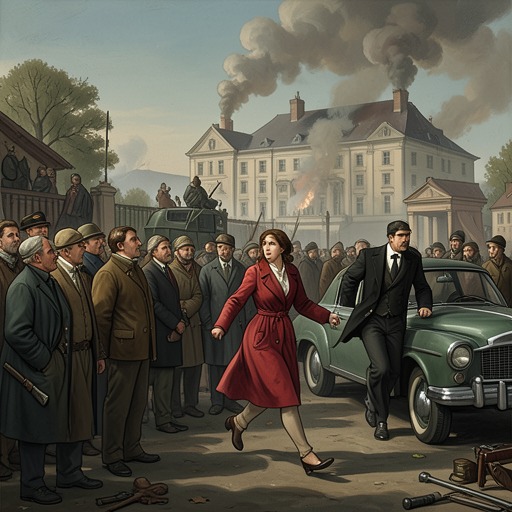
Ryan’s decision unfolds against the family’s earlier experience of institutions that present unequal treatment as ordinary procedure. When the nought students are admitted to Heathcroft, a crowd gathers outside the school, chanting against their presence while police struggle to control the crowd. The news later describes the hostility as “some hostility,” leaving out the violence Callum says the cameras failed to show: police allowing members of the crowd to poke, pinch, and punch the students, and the back of his jacket covered in spit. These episodes do not prove how Ryan’s confession was obtained, but they establish the unequal public and institutional setting in which the family faces the accusation.
At the school, Mr Costa suggests that if the nought students find it difficult, they should go elsewhere, while Mrs Paxton argues that they are being constantly picked on and warns that one of them may retaliate. The dispute exposes two competing responses to exclusion: remove the targets, or acknowledge the pressure being put upon them. Later, when Ryan tells his family that the authorities threatened them with prison, that choice between protection and exposure takes a more intimate form. The confession is made within a world where a formal charge can threaten not only the accused but also relatives drawn into a conspiracy allegation.
The state’s reach appears in another family scene at the hospital, where a nurse says that medical care cannot be administered until Meggie and Jude show their ID cards under a new government rule requiring patient identification to be checked and registered. This administrative encounter is distinct from the police threats Ryan describes, but it reinforces how readily official systems enter ordinary family life. In the courtroom, the threat becomes lethal in its consequences: Ryan’s confession carries seven murder charges and a political-terrorism charge, while the family can do little beyond listen and protest.
Sacrifice and consequences
Ryan’s confession does not end with the declaration that he is guilty. He tells Meggie that he will stick to the story because he will not let the authorities send her, Callum, or Jude to prison. His insistence makes the protective purpose explicit, but it also closes off the possibility that his family can simply correct the public account without endangering the people he is trying to save. He asks them to preserve Jude’s concealment, while the official report already describes the family as in hiding.
The sacrifice carries Ryan into a trial where his confession is treated as making the case almost a formality. Later, at Hewmett Prison, the family arrives among crowds of people dressed in black, and Callum sees his father again in the setting of an execution. The announcement identifies Ryan as convicted of seven counts of murder and political terrorism, says his appeal has been denied, and declares that the hanging will now be carried out. Ryan’s earlier hope that the confession would protect Jude from death is sharply contrasted with the execution awaiting Ryan himself.
The confession’s tragedy lies in the distance between its private purpose and its public effect. Ryan means it to keep his family from prosecution and Jude from prison; the courts and news turn it into the basis for charges, conviction, and execution. His denial that he planted the bomb remains central even as his legal admission makes him answer for it. In this way, the act is both a father’s effort to place himself between danger and his family and a mechanism through which the state converts that effort into an apparently settled account of guilt.