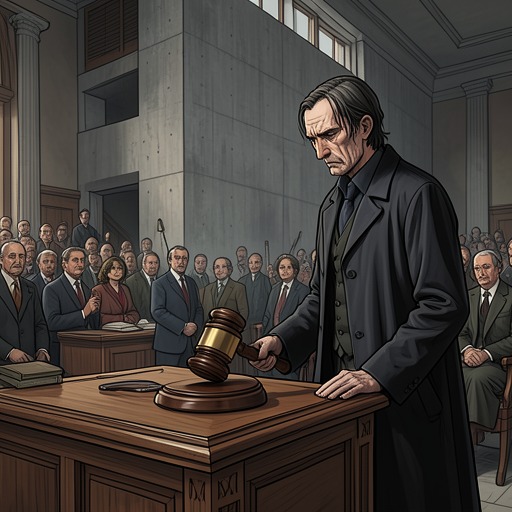
Shaun Pingule
Noughts & CrossesShaun Pingule, identified in court as the prosecution lawyer and addressed as Mr Pingule, prosecutes Ryan McGregor in the case arising from the Dundale Shopping Centre bombing. His role is most visible during Callum’s testimony: he presses the witness on his political affiliations, introduces surveillance footage that places Callum at the shopping centre, and asks him to identify himself on it. Through Pingule, the trial turns a complicated sequence of events into prosecutorial evidence against the McGregor family, even as the scenes expose the strain between courtroom procedure and the search for justice.
Identity and Courtroom Role
Pingule is the hard-faced prosecution lawyer in Ryan’s trial. He represents the state against Ryan, who has confessed to the charges, and questions Callum as a witness. Callum sees Pingule glaring at him from the prosecution side of the courtroom; later, the narration describes the prosecutor’s smile as oily. These impressions are filtered through Callum’s anxious perspective, but they establish the adversarial pressure under which Pingule conducts his questioning.
The trial is presented through the alternating first-person accounts of Callum and Sephy. Pingule’s conduct is therefore shown not through an independent account of his intentions, but through the witnesses’ experience of the proceeding: Callum’s apprehension as he takes the stand and watches the evidence appear, and Sephy’s presence as a witness when Pingule questions her about the bombing. This limited viewpoint makes his courtroom tactics legible while leaving his private motives unstated.
Questioning Callum
When Pingule asks Callum whether he belongs to the Liberation Militia, defence counsel Kelani Adams objects that Callum is not on trial. Pingule argues that the question bears on the witness’s credibility, and Judge Anderson allows it. The exchange makes political association part of the prosecution’s test of a witness, even though Callum is appearing to testify in Ryan’s case rather than answer a charge of his own.
Pingule’s questioning continues long enough for Adams to complain that he has asked the same question for ten minutes and to demand that he get to his point. He replies that he intends to do so, then introduces exhibit D19. The delay and the reveal give the footage a staged force: Callum is already uneasy, and his father silently shakes his head when the court prepares to play it. Pingule’s approach builds tension before the visual evidence is shown, and shifts the examination from Callum’s credibility to what the recording can establish.
Exhibit D19 and the Dundale Footage
D19 is a video made from closed-circuit cameras at the Dundale Shopping Centre. Pingule asks Callum to identify the person running from Allan and Shepherds Fine Goods; Callum recognizes himself. The footage then shows him leaving the Cuckoo’s Egg café and pulling Sephy with him. Though the recording has no audible dialogue, Pingule’s case can point to the visible sequence: the shopping-centre alarm appears to sound, Callum leads Sephy towards an exit, and both run. After they leave, a white flash comes from the café and the recording goes dark.
Pingule uses the sequence to challenge the claim that the McGregor family knew nothing about the bomb. The footage establishes Callum’s presence and actions at the scene, but it also shows him trying to get Sephy out before the explosion. That contrast gives the evidence its double edge: it invites suspicion by placing him in the centre, while the same images support Callum’s account that he was helping her escape. The prosecutor’s question frames the tape as a challenge to the defence; its silent images do not, by themselves, disclose what Callum knew about the bombing.
Sephy’s Testimony and the Trial’s Stakes
Pingule also questions Sephy about what happened when she was in the Cuckoo’s Egg café on the day of the bombing. He asks whether she knows who was responsible. Sephy says she does not, expressing shock at the question, and Pingule ends his examination. Her testimony does not provide him with an identification of the bomber. In the courtroom, her connection to Callum is also treated as relevant to the case: she says that he is her friend, while the surrounding questioning reflects the significance the trial assigns to that relationship.
Pingule’s prosecution unfolds against a chain of contested evidence. Jude’s fingerprints are said to have been recovered from a drink can near the bombing and cross-referenced with prints from his identity card, which had been scanned during a hospital visit under a government patient-identification rule. Ryan later says that he confessed after investigators told him Jude was in custody and presented proof against him, leaving him to decide who would take the blame. The narrative does not establish Pingule’s involvement in obtaining the fingerprint evidence or Ryan’s confession; these details instead show the wider evidentiary and political pressures surrounding the case in which he prosecutes.
Narrative Significance
The trial’s central image is not a spoken confession from Callum but a silent recording played to the court. Pingule’s examination turns that recording into a prosecutorial argument, while Callum’s account preserves the ambiguity between fleeing the scene and rescuing Sephy from it. The contrast between what the footage shows and what it cannot establish is crucial: the court sees actions, but the witnesses’ knowledge and intentions remain matters of dispute.
The proceeding also places the family’s fate within institutions whose authority is repeatedly questioned by the surrounding narrative. Sephy recalls a news report that described hostility toward Nought pupils at Heathcroft without showing their mistreatment; at school, Mrs Paxton warns that the pupils are continually targeted, while Mr Costa suggests they should go elsewhere. In the courtroom, Pingule’s use of Callum’s political affiliation and the footage likewise demonstrates how events are selected and framed for official judgment. Ryan is ultimately convicted of political terrorism and sentenced to death; after a last-minute reprieve, he dies in an attempted escape from Hewmett Prison. Pingule is not shown as responsible for those later outcomes, but his prosecution forms a consequential part of the legal process through which the case against Ryan is presented.