Liberation Militia insurgency
Noughts & CrossesThe Liberation Militia insurgency is a clandestine Nought armed movement formed in a society where political authority and social privilege are concentrated among Crosses. Its demand for faster change gives organized expression to anger at inequality, but its covert cells and violent methods also allow the government to depict Nought resistance as terrorism and to impose severe consequences. Through the movement’s public image, hidden organization, recruitment of Callum McGregor, and role in the Dundale plot and kidnapping of Persephone Hadley, the novel presents insurgency as both a response to entrenched injustice and a force that deepens the conflict it seeks to overcome.
Political Context and Public Image
The movement operates against the background of pressure to admit Noughts into institutions previously dominated by Crosses. In a private conversation overheard by Persephone Hadley, her father, Kamal Hadley, complains that the Pangaean Economic Community has compelled the country to open schools and recruitment to Noughts. He argues that these concessions should have weakened the Liberation Militia, but instead its demands are growing. The scene makes clear that limited reforms have not ended the conflict, while Kamal treats the movement as a threat to his government and political position.
The same conversation reveals that Kamal’s guest has been attempting to work up through the Militia’s ranks but cannot identify its leader. He describes separate cells or units and multiple drop-off points for communication, explaining that the structure makes it difficult to discover who is in charge. Secrecy is not incidental: it is built into the organization’s arrangement and frustrates the state’s efforts to identify its leadership. Kamal rejects the explanation and orders his guest to act, saying he will not lose his place in government because of the movement.
The government’s public language hardens the distinction between insurgents and citizens. On television, Kamal announces that there will be no safe haven for Noughts who join the Liberation Militia. When asked about an alleged car bomb outside the International Trade Centre, he says political terrorism causing the death or serious injury of even one Cross is a capital crime. His declaration connects the movement directly to the state’s use of the death penalty and presents severe punishment as a settled policy rather than a response limited to a particular incident.
The insurgency is also entangled with the institutions it opposes. News coverage links the government’s limited school admissions to pressure from the Militia, while the government uses the prospect of political violence to defend its punitive stance. At Heathcroft, Persephone sees a crowd chanting against Nought pupils as police try to control the demonstration; later, the television report describes the school’s hostility in softened terms and omits the mistreatment she witnessed. These scenes situate the armed movement within a broader struggle over integration, public description, and whose account of racial conflict is believed.
Secrecy, Recruitment, and Command
The organization’s internal structure emerges through fragments rather than a single authoritative account. Its hidden leader is known as the General, but the movement’s layered cells make it hard for outsiders to determine who commands it. Ryan McGregor argues about the choice between organized resistance and peaceful change, while Meggie McGregor calls the General a warmonger and insists that killing and maiming do not become right merely because they attract attention more effectively than protests, sit-ins, or passive resistance. Their disagreement exposes a strategic division: the movement’s ability to command attention through force is precisely what makes its methods morally contested.
Callum’s own path into the organization illustrates its capacity to absorb a young recruit into an expanding hierarchy. He recalls beginning as a tea boy, then serving as a grunt who followed orders from anyone in his cell of six men and three women. He progressed to private, then sergeant, and joined a new cell. Reaching sergeant at nineteen gave him pride and standing within the organization. His ascent turns the Militia from an indistinct presence in family arguments and news reports into a concrete system of work, rank, orders, and group membership.
That upward movement also changes how Callum can act beyond his assigned duties. He uses the contacts and resources made available through the Militia to locate three Heathcroft pupils who had assaulted Persephone because she associated with him. He investigates their home lives, families, and preferences, then targets them in turn, taking particular care with Dionne Fernandez. Callum describes the revenge as deliberate and cold, and recognizes that carrying it out has altered him. The episode shows how the organization’s networks can serve private retaliation as well as collective political struggle, blurring the line between membership, access to power, and personal grievance.
Escalation and State Repression
The confrontation between the state and the insurgency appears not only in official statements but also in ordinary encounters with authority. When Callum is challenged for sitting in first class, he expects to be removed because a Nought in that carriage is treated as an offence; Persephone intervenes, saying she bought the tickets and asking whether there is a problem. Elsewhere, at a hospital, staff require identity cards before providing medical care, under a new government rule requiring patient identification and registration. These incidents do not establish that every discriminatory practice is directed by the Militia conflict, but they show the unequal institutional environment in which the movement gains significance and in which state authority reaches into daily life.
The plot at Dundale marks a decisive point in Callum’s understanding of the organization’s plans. Jude warns him away from the subject, and Callum realizes that the Liberation Militia is planning something at the shopping centre—something Jude knows about and does not want him near. He remembers that Persephone is there and reacts with horror. The sequence reveals the danger the movement’s covert planning poses to people outside its membership, including someone bound to Callum by friendship and affection.
The novel also presents the government’s response as a mechanism of personal as well as political pressure. After Callum is taken into custody, plain-clothed officers question him about his brother’s involvement and demand to know which Militia cell he belongs to. He denies that his brother is a member, but exhaustion is already affecting his answers. The interrogation’s focus on cell affiliation reflects the organization’s structure, while its pressure makes clear how suspicion of insurgent membership can bring the state directly into family relationships.
The criminal consequences are made stark at Hewmett Prison. Persephone arrives with the Crosses and discovers Callum among the Noughts assembled to witness Ryan McGregor’s execution. The formal announcement identifies Ryan, gives his address in Meadowview, and states that he has been convicted of seven murders and political terrorism; his appeal has been denied, and the sentence is to be carried out by hanging. This public execution gives material force to Kamal’s earlier declaration that political terrorism against Crosses is a capital crime. It also leaves the movement’s surrounding families to bear the consequences of the state’s campaign against it.
Kidnapping, Resources, and Consequences
The Militia’s later operations combine political leverage with the practical need to finance future activity. At the wooded cabin used to hold Persephone, the group has received information that she might be on her way home. Jude and Pete have spent more than two weeks planning what to do if that happens, and have received permission from the General. The cabin is known only to a limited number of people on a need-to-know basis; the group arranges for two guards to remain on watch, one in front and one behind. The precautions show the security demands of a clandestine operation, while the use of a prisoner as leverage reveals the cost imposed on its target.
The ransom plan is organized as a coordinated operation rather than an improvised demand. On a crisp early autumn evening, the group intends to collect the money and tell Kamal that further demands must be met before he can see his daughter. The ransom is meant to fund future Militia activity, and Persephone is not to be reunited with her father until five members have been released from prison. Three of the five are key members, although the authorities believe they are only underlings. The distinction shows the group using its knowledge of its own membership to pursue a strategic release as well as financial support.
To reduce the likelihood of being traced, Jude assigns calls from three separate locations around town to Leila, Pete, and Morgan. Callum is tasked with delivering a second set of instructions, picking up the money, and returning to the cabin, while Leila remains with Persephone. The relay plan demonstrates how compartmentalized communication and divided roles turn secrecy into operational practice. It also places Callum inside the machinery of the kidnapping, even as his personal connection to Persephone complicates the idea that he can treat her simply as a political instrument.
The Movement’s Contradictions
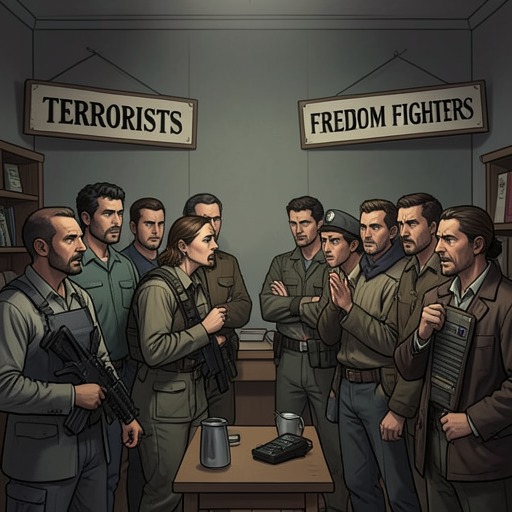
Across these episodes, the Liberation Militia is neither reduced to a faceless terrorist label nor presented as an uncomplicated vehicle of liberation. Its existence is framed by unequal access to schools, state employment, and political power; its supporters see change as intolerably slow, while opponents such as Meggie distinguish the pursuit of equality from the use of killing and maiming. The organization’s clandestine structure gives it resilience and reach, but its use of violence, revenge, and hostage-taking creates new victims and gives the government grounds to intensify punishment.
Callum’s trajectory concentrates that contradiction. The Militia offers him rank, belonging, and resources, yet his rise through its hierarchy is accompanied by retaliatory violence that he understands as having displaced the person he once was. Later, the same organization turns Persephone into leverage for money and prisoner releases. The insurgency therefore transforms both public conflict and private relationships: it contests a racial order that the state has only partly changed, while its methods draw its members deeper into the cycle of coercion and reprisal.