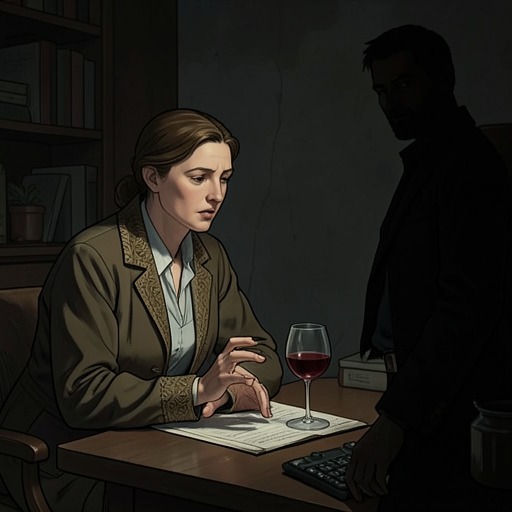
Minerva Hadley
Noughts & CrossesMinerva Hadley is the elder daughter of Kamal Hadley and Mrs Hadley, and the older sister of Persephone Hadley, known as Sephy. Sephy’s teasing name for her, Minnie, begins as a deliberate irritant, but their relationship develops beyond its early antagonism. Across family conflict, public prejudice, and private grief, Minerva becomes one of the people Sephy can turn to, even as both sisters struggle to escape the atmosphere of their home.
Identity and family background
Minerva grows up in a wealthy household whose grandeur means different things to the two sisters. Sephy sees the Hadley home as cold and museum-like, while Minerva calls it grand and loves it. Their mother’s expectations sharpen their differences: Sephy feels that Mrs Hadley wishes she were more ladylike, like her elder sister. These contrasting responses make Minerva a figure of the family’s established respectability, but do not mean that she is untouched by its troubles.
The marriage in the household is strained. When Kamal arrives home for what Mrs Hadley calls his fourth visit in four months, she reacts with astonishment and bitter irony, while Meggie, the family’s employee, stays out of what she expects will be another quarrel between the couple. Minerva’s family life is therefore marked not just by the sisters’ friction but by the instability between their parents.
Rivalry and public hostility
At first, the sisters’ closeness is limited. Sephy calls her sister Minnie precisely because Minerva dislikes the nickname, and does so repeatedly. That private antagonism sits against the public divisions shaping their lives: when Nought students try to enter the school, Minerva is among the Cross students in the crowd shouting against them. Sephy recognizes her own sister in the hostile protest, making the division between the girls more than a disagreement confined to home.
Later, when Sephy is asked who beat her, Minerva insists that whoever did it will not get away with it and says she will find out who was responsible. Sephy has not experienced that kind of support from her sister before. Minerva’s anger does not undo the earlier estrangement, but it gives Sephy a first reason to imagine they might grow closer. Her protective response is an important counterpoint to her earlier participation in the crowd’s hostility.
The nickname remains part of their uneasy affection. When Sephy finds Minerva crying, Minerva sharply insists that her name is Minerva, spelling it out; Sephy answers by calling her Minnie again. Yet Minerva smiles reluctantly and answers her with a teasing insult of her own. The exchange preserves their habit of provocation while showing that it can coexist with a tentative warmth.
Grief and solidarity
The death of Lynette brings the family’s unresolved pain into the open. After the police leave, Mrs Hadley blames the family, asking whether they are proud of themselves and whether Lynette may have acted because of what they had said to her. Minerva is present as the household absorbs that accusation and loss. In a later crisis, Sephy and Minerva sit together, Minerva’s arm around her sister’s shoulder, while Minerva tries to reassure her that their mother will be all right.
Minerva’s sympathy is not limited to quiet comfort. When Juno uses the phone to arrange for the story of their mother’s hospital emergency to be circulated as an accident, Minerva takes the phone from her and destroys it. Sephy watches with admiration. The action shows Minerva refusing to let Juno control the account of what happened, although the evidence does not establish everything Minerva intends by intervening.
Confronting their home and seeking change
As the sisters grow older, Minerva can describe their shared failures without disguising her own part in them. She tells Sephy that they have never got on and regrets that they could not count on one another. In her account, they have both tried to cope alone: Sephy drinks to escape, while Minerva becomes more spiteful. The admission turns their rivalry into a shared pattern of evasion rather than a simple contest between a difficult elder sister and a troubled younger one.
When Sephy breaks down and says she needs to get away before she explodes, Minerva comforts her and says she is working on their father. She clarifies that she is trying to persuade him to get them both away from the atmosphere in the house, not only to secure an escape for herself. The promise matters in light of Minerva’s own plans: she is determined to attend a university as far from home as possible, but their mother cries or throws a tantrum whenever she raises the subject. Minerva’s attempt to make departure possible for both sisters gives practical form to the solidarity she has begun to express.
Separation and later relationship
When Sephy is about to leave for Chivers Boarding School, Minerva rushes out to say goodbye. Sephy tells her she wishes Minerva could come too, a marked change from the earlier household exchanges in which each sister seemed to belong to a different side of the family. Their farewell does not resolve their difficulties, but it confirms that separation now matters to them both.
Minerva’s later life remains difficult. Sephy reports that their mother is still drinking, while Minerva is still at home and wants to go to university far away. Sephy considers inviting her to join a dissident group working for change, but decides against it because Minerva has only one school year remaining and is already struggling with life at home. The decision is Sephy’s, not Minerva’s; it nonetheless underscores the difference in their circumstances and the distance between their routes out of the household.
After Sephy’s ordeal in the woods, Minerva finds her in the kitchen and asks if she is all right. She notices that Sephy has been sick over several mornings, a concrete sign of concern that also precedes Sephy’s disclosure of her pregnancy. At the end of the narrative, Minerva is the viewpoint character in the opening of a section: she waits outside Sephy’s flat, asks where she has been, and shivers in the cold hallway. Her return to Sephy’s life frames the sisters’ bond as ongoing, not as something settled by their earlier separation.