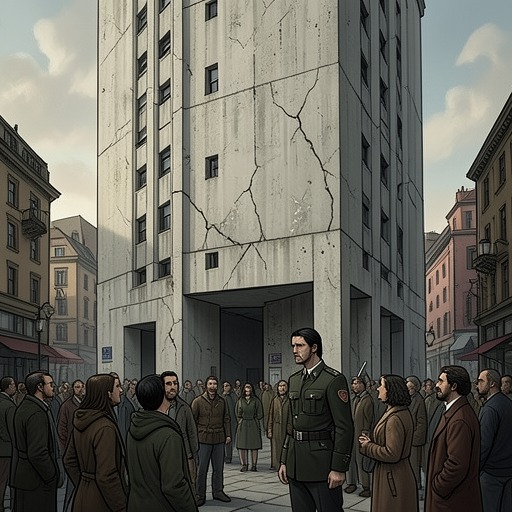
Sephy was beaten for dating a nought student
Noughts & CrossesSephy’s assault by Lola, Joanne, and Dionne is the violent consequence of her choosing to sit with Nought students at Heathcroft. In the school toilets, her classmates demand that she keep to her own kind; when she refuses their racial logic, they slap and beat her. Sephy fights back, but the attack makes clear that friendship across the Nought–Cross divide is policed not only by school customs and public hostility, but by threats of exclusion and physical force.
Causes and School Context
The confrontation grows out of the school’s segregated social order. Earlier, a crowd had gathered outside Heathcroft chanting against Nought students, while police tried to control the crowd and reach the entrance. Sephy later saw how the television report softened what happened: it described the new Nought students as meeting “some hostility” and omitted that the police had allowed the crowd to reach them, where they were poked, pinched, and punched. The back of Sephy’s jacket was covered in spit. The assault in the toilets therefore takes place within a broader pattern: open hostility is minimized in public accounts even as it is experienced directly by students.
The immediate pretext was Sephy’s presence at the Noughts’ table in the food hall. She had been avoiding the school corridors and, above all, Callum, afraid to face him after what had happened the previous evening and hoping that avoiding him might let her pretend their friendship had not changed. When she finally left a toilet cubicle, Lola, Joanne, and Dionne pushed her back inside and crowded in after her. Their choice of the enclosed space made the confrontation an ambush, separating Sephy from the school’s ordinary public spaces and leaving her alone with the three girls.
The Assault
Joanne named Sephy’s offence plainly: she had sat at the “blankers table.” Sephy challenged the girls to explain why they cared. Lola answered with a slap, which shocked Sephy less because of its force than because nobody had hit her before, not even her sister, Minerva. Lola then warned her that if she sat with Noughts again, the whole school would treat her as one of them. Joanne reinforced the demand by telling Sephy to recognize which side she belonged on. Their threat was not simply that she would be hurt again, but that solidarity with Nought students would cost her place among Cross classmates.
Sephy initially imagined that Callum might enter and stop the attack. Instead, Lola pushed her down when she tried to stand and held her by the shoulder. Lola warned that Sephy would have no friends left if she did not stay away from Noughts. When Sephy asked why the girls hated them, Joanne treated service work in shops and restaurants as sufficient grounds for claiming she had spoken to Noughts. Lola recited the insult behind that hierarchy: Noughts were supposedly blank in appearance and mind, and therefore fit to serve Crosses. Sephy rejected the claim as ignorant and insisted that Noughts were people like them.
Lola slapped her again. This time Sephy was ready: she punched Lola in the stomach, then fought with her fists, elbows, and feet. The burst of resistance briefly gave her the element of surprise, but Joanne and Lola seized her arms. Dionne, known as the best fighter in her year, then faced her. Calling Sephy a “blanker-lover,” Dionne said she had had the attack coming for a long time before joining in. The movement from verbal warning to two slaps and a group beating shows how quickly the girls’ demand for conformity becomes physical punishment once Sephy openly defends Noughts.
Institutional Silence and Aftermath
The school’s adults offer no immediate protection within the assault scene: Sephy is attacked in a toilet cubicle, and the prospect of someone intervening exists only in her anxious expectation that Callum will arrive. Elsewhere, the institutional response is shown as compromised. Mrs Paxton tells Mr Costa that Nought students are constantly picked on and warns that one will eventually retaliate. Mr Costa replies that if they find Heathcroft difficult, they should go elsewhere. His response shifts responsibility from the school’s failure to protect Nought students onto the students themselves, echoing the attackers’ demand that Sephy accept the racial division rather than challenge it.
Afterward, Callum asks who hurt her. Sephy identifies Lola, Joanne, and Dionne, specifying that they are in Mrs Watson’s class, then tells him it is over. The exchange confirms both that the attack is known to Callum and that Sephy does not describe her resistance or injury as a reason to withdraw from him or from the Nought students. Her account is brief, but the contrast is telling: the assailants tried to make her choice carry a lasting social cost, while Sephy insists on setting the terms of what happens next.
Significance
The assault turns a seemingly small school choice—where Sephy sits at lunch—into a test of the racial order. Lola’s warning makes the consequence explicit: to sit with Noughts is to risk being treated as one of them. Sephy’s defence of Nought students does not erase her position as a Cross or make the violence symmetrical; she is a member of the privileged group whose solidarity is punished by other Cross students, while the wider school has already admitted Nought pupils into a hostile environment and failed to represent that hostility honestly on television.
The episode also links public language to private violence. The chant outside the school, the euphemistic news report, the insults in the toilet, and Mr Costa’s suggestion that Nought students leave all help preserve the same boundary in different forms. Sephy’s blows interrupt that pattern in the immediate encounter, but do not undo the institutional conditions that made the attack possible. The event marks her refusal to treat friendship with Callum and the Nought students as a private matter that can be separated from the school’s rules of belonging.