Begin
O fenômeno Jungkook: O sucesso do BTS e a criação de um superstar mundialBegin is Jungkook’s 2016 solo song from BTS’s Wings, a nearly four-minute ballad built around his love for the six older members of BTS. Rather than presenting the group’s youngest member chiefly as a versatile performer or future solo star, it makes his emotional dependence, gratitude, and loyalty the song’s central subject. Its decisive image is not ambition but attachment: Jungkook measures his own life through the suffering, care, and companionship of the older members who helped him become himself.
Origin and Emotional Premise
The song emerged from a period when Jungkook was already widely regarded as BTS’s golden maknae, center, and member with the greatest solo potential. Yet he had difficulty writing lyrics because he struggled to express his feelings directly. RM therefore helped capture Jungkook’s story, turning the song into a collaborative self-portrait rather than a conventional showcase of youthful pop ability.
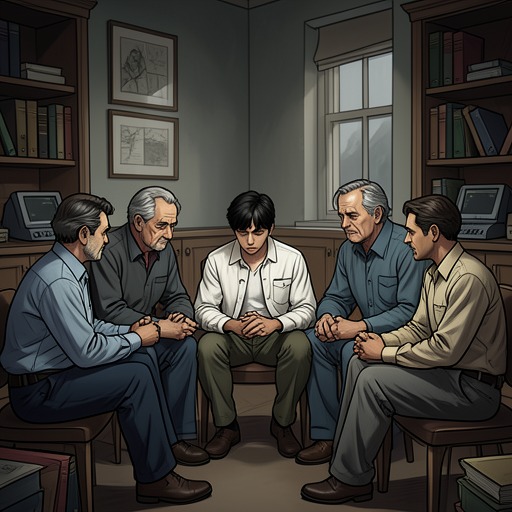
The emotional source was a January 2016 gathering at which all seven members met to cry, share their complaints and difficulties, and comfort one another. Jungkook was normally not inclined to cry or complain. He rarely spoke when he was struggling, continued working diligently, and reassured the others that he was fine. During that gathering, however, he cried openly for the first time, startling members who had never seen the youngest member shed so many tears.
When the members asked what was troubling him, Jungkook said that he had no personal problems: he had signed a contract while still very young, come to Seoul because singing and dancing were what he wanted, and done his best. What hurt him was seeing the other members suffer. Begin therefore transforms an apparently simple confession into its emotional structure: Jungkook’s pain is displaced from himself onto the six older brothers with whom he lived, who helped him mature, and to whom he had pledged love and loyalty.
Musical and Performance Identity
Begin refuses the expectation that Jungkook’s first memorable solo statement should be light, effortless, or designed only to display his rising skills as a pop performer. Instead, it takes the form of a tender ballad about what he owes the members who supported him. The song presents a younger Jungkook who had been taken in as a small, empty boy without a distinct identity and taught, through collective life, how to feel.
Its significance is amplified by the contrast between Jungkook’s public image and the restraint revealed in the song. He was already recognized for a rich tenor voice, a three-octave recorded range from G2 to Bb5, and an ability to preserve clear pitch while dancing intensely. He was also known for blending chest and head voice, moving naturally into falsetto, and shaping phrases with delicate rhythmic understanding. Begin redirects those technical capacities away from spectacle. The voice becomes an instrument of confession, allowing feeling to carry meaning even when the words are not understood by every listener.
That emotional function belongs to a larger development in Jungkook’s singing. In 2016, he appeared on King of Mask Singer and performed BigBang’s If You after a nervous first-round rendition of Ra.D’s I’m in Love. Although he lost in the semifinals, the panel described his voice as sweet, distinctive, mysterious, and dreamlike, noting his ability to place delicate feeling and nostalgia inside heavy songs. Begin belongs to the same turning point: it helped establish that Jungkook’s appeal was not limited to polish, range, or performance reliability, but included an unusually direct capacity to transmit tenderness.
A Portrait of Brotherhood
Begin’s central relationship is Jungkook’s bond with BTS as a found family. The song does not frame the older members merely as colleagues or co-performers. They are the six people who witnessed his growth, shared his difficult years, and gave him a language for emotions he could not easily articulate on his own. The song’s emotional movement is therefore from silence to recognition: Jungkook cannot initially write the story himself, but the group’s shared intimacy makes the story speakable.
That loyalty also clarifies why Jungkook’s later solo career does not erase his group identity. During his solo promotions, he repeatedly said that he missed the relaxed moments shared with the other members and wanted to perform with them again as soon as possible. At his 2023 Golden Live On Stage showcase, he thanked ARMY from the stage and promised that, regardless of when or where he was, he would always be with them. The promise echoes Begin’s earlier orientation toward relationship over individual triumph: achievement remains meaningful, but it is never detached from the people who made it possible.
The song’s emotional claim is supported by the group’s conduct under pressure. During a 2017 BTS performance in Chile, Jungkook continued performing while severely exhausted, requiring oxygen, ice, massage, and medical attention backstage. SUGA cried privately out of concern, and Jimin stayed beside Jungkook as he recovered. That later scene does not replace Begin’s origin, but it gives the song’s language of mutual care a visible counterpart. The brotherhood described in the ballad appears not only as memory or sentiment but as an ongoing practice of watching over one another.
From Private Feeling to Public Meaning
Begin also marks a shift in how audiences could understand Jungkook. Before it, his image was strongly associated with versatility, youth, and exceptional potential. The song instead made his inner reserve part of his public identity. It showed that the youngest and most technically complete member could be emotionally vulnerable without abandoning the discipline and composure expected of an idol.
The song’s importance grew as Jungkook’s voice reached listeners across linguistic boundaries. BTS’s songs were able to communicate hope and longing even to people who did not speak Korean, and Jungkook’s singing was repeatedly presented as a vehicle for those nuances. His voice could make emotion legible without translation. In Begin, that quality is directed toward gratitude: the listener need not share Jungkook’s exact biography to recognize the ache of loving people whose suffering feels more painful than one’s own.
The track therefore functions as an early counterpoint to the later image of Jungkook as an international pop star. By the time he released Golden in 2023, he had become capable of handling pop and R&B at a level compared with leading Western artists, recording songs such as Seven and Standing Next to You through an intense solo schedule. Yet Begin preserves the emotional origin beneath that expansion. The artist who could sing for global audiences remained the younger member whose defining confession concerned the six older brothers who helped him find a self.
Lasting Significance
Begin is significant because it makes loyalty the foundation of Jungkook’s individual voice. The song does not treat solo identity as separation from BTS; it constructs individuality through the relationships that formed him. Its most revealing subject is consequently not celebrity ambition but the difficulty of saying thank you when gratitude has become inseparable from love, dependence, and shared endurance.
The song also complicates the usual narrative of the golden maknae. Jungkook’s exceptional ability could invite an individualistic success story, in which the youngest member naturally rises above the group. Begin tells a different story. His growth is collective, his emotional life is tied to the older members, and his strongest solo statement is an acknowledgment of what he received from them. In that sense, the song becomes an early key to Jungkook’s broader public persona: technically formidable, increasingly independent, yet repeatedly drawn back toward BTS and ARMY as the relationships that give achievement its meaning.