Brian Puspos
O fenômeno Jungkook: O sucesso do BTS e a criação de um superstar mundialBrian Puspos appears in the narrative as a professional dancer and choreographer whose response to Jungkook’s solo performance helps establish the unusually demanding standard of “Standing Next to You.” His role is not that of a biographical protagonist, but of an expert witness: by observing Jungkook in rehearsal and performance, Puspos gives technical language to abilities the book has already shown through movement, rhythm, and physical control.
Role in Jungkook’s Solo Performance
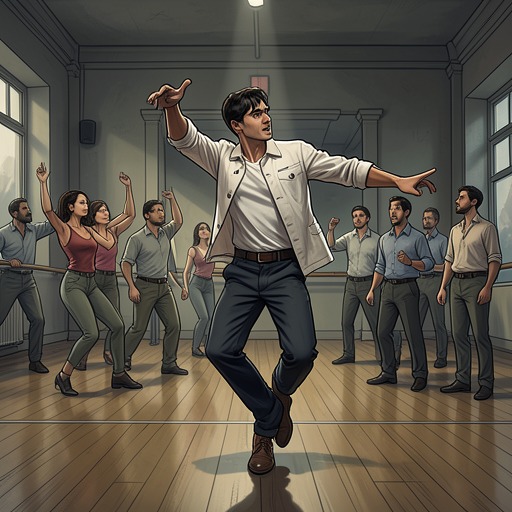
Puspos was among the dancers in “Standing Next to You,” the title track of Jungkook’s 2023 solo album, Golden. He also participated in the song’s choreography, placing him close to the performance’s physical construction rather than merely viewing the finished stage from a distance. The choreography was presented as a demanding test of stamina, precision, and stylistic confidence, and Puspos’s involvement connected Jungkook’s solo work with a professional dance environment beyond the established group dynamic of BTS.
The song marked a shift in how Jungkook’s movement was framed. In BTS, his dancing functioned within the force and visual unity of a seven-member group. As a soloist, he had to make style itself carry the performance. Puspos’s observations therefore illuminate not only whether Jungkook could execute choreography, but whether he could command the stage without the collective momentum that had previously surrounded him.
Technical Assessment of “Standing Next to You”
Puspos described the choreography as physically demanding and filled with subtle references to Michael Jackson’s movement vocabulary. These references were not limited to obvious imitations. They included minute gestures and controlled pauses, such as the way Jungkook stopped and gestured in front of the microphone stand. The difficulty lay precisely in making small movements register as deliberate, musical actions rather than letting them disappear beneath the larger structure of the routine.
In a video for the online dance studio Steezy, Puspos and director Clay Boonthanakit watched and discussed footage of Jungkook’s dance rehearsal. They expressed literal astonishment at his stability and bodily control, while also noting his ability to handle polyrhythm, in which contrasting rhythms occur simultaneously. Jungkook was able to match the energy of highly accomplished professional dancers, including Puspos, without losing the clarity of his own timing or the coherence of the choreography.
Puspos’s most vivid comparison treated Jungkook’s development as unfinished rather than complete. He remarked that Jungkook had not yet reached “Gear 3,” invoking the escalating abilities of Monkey D. Luffy in One Piece, and imagined that a future “Gear 5” would force everyone around him to improve. The joke carries a serious evaluation: even after Jungkook had reached a level capable of impressing elite dancers, Puspos saw further capacity in him rather than a finished ceiling.
The Performance’s Split-Second Control
The book gives a concrete example of the control Puspos admired. During the final dance break, at two minutes and forty-five seconds into the performance, Jungkook’s thin silver chain caught on his ear. As he raised his arm in a wave-like movement, he removed the chain from his neck and threw it aside without missing a beat. The action was so clean that it almost passed unnoticed, turning a potential disruption into an incorporated gesture.
That moment condenses the larger argument about Jungkook’s dancing. His skill is not defined only by executing a sequence under ideal conditions; it also appears in the speed with which he solves an interruption while preserving rhythm, posture, and visual authority. The chain becomes a small physical obstacle, and his response demonstrates the kind of automatic coordination that allows technical difficulty to look effortless.
Relation to Jungkook’s Broader Artistic Development
Puspos’s assessment reinforces the book’s account of Jungkook’s transition from group performer to solo artist. Ms. Vee, discussing his dance development from earlier training footage through Golden, emphasized that he appeared increasingly comfortable not only with choreography but with himself. She also identified his expanded groove—the relaxed, musical way he moves through rhythm—as a defining quality of the solo work. Puspos’s observations add the complementary perspective of professional precision: the performance is relaxed in effect because its underlying control is so exact.
The same elasticity appears when Jungkook performs “Perfect Night” with members of Le Sserafim. There, he adopts the restrained hip movement, arm placement, and contained framing associated with a girl-group center, showing that his musicality can serve styles beyond the powerful, synchronized vocabulary commonly associated with BTS. Puspos’s comments on “Standing Next to You” belong to the more physically demanding side of that range, where strength, polyrhythm, subtle Jacksonian detail, and endurance must coexist.
Significance
Brian Puspos functions as an external professional validator of Jungkook’s solo identity. The praise does not depend on fandom enthusiasm or on the prestige of Jungkook’s existing career. It comes from a dancer examining rehearsal footage, the mechanics of the choreography, and the performer’s ability to sustain precision alongside specialists. In that context, Puspos’s astonishment confirms that Jungkook’s global solo ambition was supported by a specific, observable discipline: he could absorb demanding choreography, translate rhythm into controlled movement, recover from physical disruption without breaking time, and still project a distinctive style of his own.