Found family
O fenômeno Jungkook: O sucesso do BTS e a criação de um superstar mundialFound family names the bond that makes BTS more than a successful idol group: its members become one another’s formative community, emotional shelter, and enduring obligation. The relationship is built through years of shared rooms, training, performance, pressure, and public life, and it extends outward through ARMY, whose collective devotion turns the group’s intimacy into a global community. For Jungkook, this chosen family explains both who he became and why he continued to place the group’s future above the privileges of individual stardom.
Formation Through Shared Youth
Jungkook entered adulthood inside BTS rather than alongside an ordinary adolescent peer group. He spent middle school training and living in a dormitory, then attended high school as a full-time idol, unable to experience school and social life in the usual way. His six older members surrounded him constantly, and their influence accumulated through everyday proximity: he absorbed their knowledge, personalities, and shared ambitions almost as a sponge. Jungkook later reflected that the members shaped him one by one and that he had become a manifestation of all six personalities together. The phrase makes the group sound less like a collection of collaborators than a household whose members participate in forming one another’s identities.
That formative process also appears in the contrast between Jungkook’s childhood home and his life with BTS. He remembers his parents in Busan as unusually permissive and affectionate: his father dressed as Santa Claus and crept into his room, his mother took him to play basketball, and his grandmother lovingly raised two chicks he had bought for a thousand won. His parents allowed him to pursue what he wanted rather than placing him under the academic pressure common in many Korean families. After leaving that protected childhood, Jungkook found in the six older members a new, improvised structure of care and instruction. They were not substitutes for his parents, but they became the people through whom his adolescent life was lived.
Everyday Intimacy and Public Proof
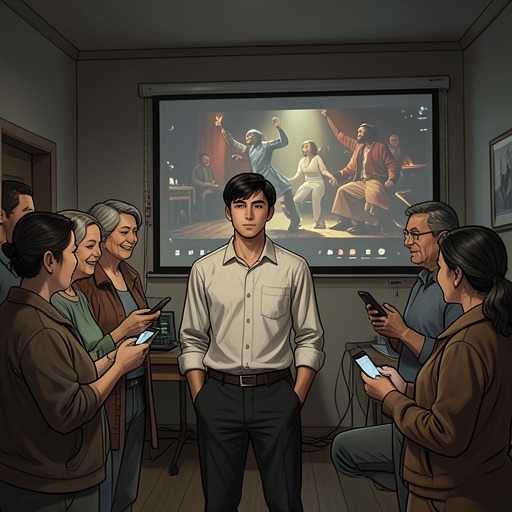
The group’s found-family quality is made visible through BTS’s informal video culture. Bangtan Bombs did not present the members as a list of biographical facts; they accumulated small observations of daily behavior. The first Bangtan Bomb, “130617 vj Jungkook,” showed Jungkook clowning with a handheld camera in a changing room for thirty-four seconds. Other clips captured Jungkook and V lip-syncing to Linkin Park while Jimin and J-Hope cleaned their lunchboxes, or Jungkook holding a small Bluetooth speaker and selfie stick as the members headbanged and danced wildly in Chippewa Woods near Chicago. These fragments turned backstage disorder into a record of familiarity.
The importance of the Bombs lies in their cumulative method. Viewers came to know the members as people encountered in passing—messing around, singing spontaneously, or occupying waiting rooms together—rather than as performers described by official profiles. The videos offered personality through repetition and accident, allowing fans to see an apparent brotherhood that exceeded the contractual bond of a band. Their lightness also had a practical emotional effect: watching the members enjoy themselves gave fans temporary relief from their own worries. The same informality that distinguished BTS within the hypercompetitive K-pop industry therefore became a form of care extended beyond the group, offering ARMY joy through the sight of shared joy.
Loyalty Under National and Institutional Pressure
The family bond exists within a demanding system. At BTS’s debut, the K-pop industry was dominated by SM Entertainment, YG Entertainment, and JYP Entertainment, companies with financial resources, established talent pools, and relationships with brands, sponsors, broadcasters, and media outlets. Big Hit Entertainment, founded by Bang Si-hyuk in 2005 after his work as a songwriter at JYP Entertainment, was younger and less connected. BTS had to establish itself among Seoul’s entrenched cultural elites. Its later success made the group a national asset: government investment in Korean popular culture and the Ministry of Culture, Sports and Tourism’s promotion of K-pop helped convert idol entertainment into an instrument of cultural soft power.
That transformation placed BTS in a paradoxical position. The members were expected to represent South Korea abroad while also negotiating new cultures and ideas through extensive international travel. They did not simply perform national identity; they were asked to carry it. In 2018 they joined the United Nations to support UNICEF’s global education and development campaign, and during the pandemic Moon Jae-in brought them to the United Nations General Assembly as special presidential envoys for future generations and culture. They received red diplomatic passports and certificates, performed “Permission to Dance” in the Assembly Hall, encouraged vaccination, and addressed young people facing pandemic uncertainty. Jungkook, dressed entirely in black with silver earrings, spoke calmly and firmly about using their voices to give people strength.
The group’s public responsibility also shaped its moral community. In 2020 BTS donated one million dollars to the Black Lives Matter movement, and ARMY matched the amount within twenty-five hours. The group’s willingness to oppose racism and violence made its supporters active participants rather than passive consumers. ARMY, named in July 2013 after Adorable Representative M.C. for Youth, developed a highly international and digitally skilled identity across Twitter, Discord, Reddit, Tumblr, YouTube, and TikTok. Its members promoted BTS across borders and joined other K-pop fandoms in 2020 to combat white supremacy and anti-Black racism by overwhelming the hashtag #WhiteLivesMatter with K-pop fancams and reaction GIFs. The chosen family thus operates on two levels: the six older members form Jungkook, while the group and its audience form a transnational community organized around loyalty, care, and collective action.
Jungkook’s Place Within the Family
Jungkook’s public prominence could have separated him from the group, but the evidence repeatedly presents him as resistant to individual elevation. He became the BTS member most likely to appear in the Western cultural imagination, was mentioned in The Simpsons in 2021, and topped Billboard’s inaugural K-pop Artist 100 in 2024. He was compared with Justin Timberlake and Harry Styles as a potential solo star after BTS’s 2017 American Music Awards appearance, invited by Charlie Puth to collaborate on “Left and Right,” selected by FIFA to perform “Dreamers” at the 2022 Qatar World Cup opening ceremony, and named a global ambassador for Calvin Klein in 2023. Yet these opportunities are described alongside his humility, shyness, devotion to the group, and concern for ARMY. His visibility does not erase the collective that made him.
His conduct toward fans also reflects the family’s ethic of respect rather than possessiveness. During a February 2023 Weverse livestream, a fan tried to provoke playful jealousy by asking how he would feel if she liked other male idols. Jungkook refused the expected fan-service performance and answered that her preferences were her own life, which he had to respect. He identified respect, understanding, and consideration as principles a person should always maintain. The response matters because it declines to turn intimacy into ownership. Even within a commercial system built on emotional attachment, Jungkook presents care as recognition of another person’s freedom.
The same moral continuity appears in his response to the “hamburger incident.” In 2016, before BTS won its first Daesang, Jungkook appeared alone on Flower Crew and brought hamburgers and soft drinks for the staff. Jo Se-ho rejected them as if they were leftovers, an encounter later stripped of context and transformed online into an image of Jungkook being publicly humiliated. Jo apologized formally after the fandom reacted, but the incident became a symbol of the contempt BTS had endured before its breakthrough. When BTS returned to You Quiz on the Block in 2021, with Jo as a co-host, Jungkook embraced him warmly. The gesture suggested reconciliation without denying the earlier wound, and fans read it as proof that success had not destroyed the kindness of the boy who began as an underdog.
Separation, Duty, and Continuity
The found family is tested most severely by separation. BTS’s 2022 Festa announcement of Chapter 2 paused group releases and allowed each member, for the first time in nine years, to pursue personal projects before mandatory military service. The announcement shocked the public and caused HYBE’s stock to fall by almost 28 percent, but it also acknowledged that the members needed room to make individual music, rest, and prepare for an interruption imposed by law. For Jungkook, the pause included nearly five months away from work, an unusual interval for someone whose adolescence had been organized around the group.
Military service gives the family bond a national and bodily dimension. South Korean men between eighteen and thirty-five are eligible to serve and must complete their obligation before age twenty-eight under the rules described for Jungkook’s enlistment; the period had been reduced to about eighteen months in 2022. Service is treated as a patriotic rite of passage, yet it also means losing nearly two years of youth, an especially painful interruption for idols whose careers depend on youth and beauty. Shaving the head marks a temporary departure from idol life and the end of an era. The possibility of exemption was politically sensitive because BTS’s image as the nation’s pride could have been damaged by any appearance of special treatment, even though exemptions existed for certain internationally prestigious achievements.
Jungkook’s decision to enlist can be understood through his stated loyalty to the six older members. He may have wished to help ARMY see all seven reunited as soon as possible, but the deeper motive described in the narrative is fidelity to the brothers he credits with everything he has become. His service is therefore not framed as a withdrawal from the family but as an act performed on its behalf. BTS also softened the period of separation collectively by preparing songs, videos, and other content in advance. Jungkook released “Never Let Go” for the group’s eleventh anniversary, appeared with Jimin in the Disney+ reality show Are You Sure?!, and released the documentary I Am Still. The members’ coordinated preparation made absence feel less absolute, preserving the rhythms of the family while its members were physically apart.
The continuity became visible when Jin completed his service in June 2024. Despite appeals for fans to stay away, enthusiasts and journalists gathered outside the military base in Yeoncheon. Jin emerged in uniform and beret, saluted, and was greeted by RM playing a passage of “Dynamite” on a saxophone. The whole group reunited for a photograph for the first time in years. Four months later, J-Hope completed his service and Jin received him in a burgundy outfit and sunglasses. These reunions transform military separation from a simple interruption into a sequence of returns, each return renewing the promise of a complete family still waiting to reassemble.
Narrative and Cultural Significance
Found family explains why BTS’s success cannot be reduced to individual charisma, even though Jungkook became its most recognizable face. The group’s estimated contribution of 32.6 billion dollars to the South Korean economy, its brand contracts with Samsung, Louis Vuitton, and the NBA, the roughly 800,000 foreign tourists visiting South Korea annually because of BTS, and the 1.5 million commemorative stamps sold by Korea Post in 2023 all register collective achievement in institutional terms. Behind those figures is a relational structure repeatedly represented through affection, shared labor, reconciliation, and mutual formation.
The concept also complicates the boundary between private feeling and public institution. BTS becomes a national representative through diplomatic passports, United Nations appearances, and military obligations, while ARMY becomes a global community through platforms, translations, fundraising, and coordinated political intervention. National belonging and transnational fandom do not operate identically, but both depend on repeated signs of participation: a passport, a uniform, a performance, an anniversary song, a livestream, a shared symbol, or a collective response. Jungkook’s place within this structure is distinctive because his solo visibility continually points backward toward the people who formed him.
The family is therefore both emotional reality and narrative principle. BTS’s story repeatedly converts hardship into shared meaning, whether the hardship is early industry marginality, public humiliation, racist stereotyping, pandemic uncertainty, or military separation. Jungkook’s most decisive achievement is not simply that he becomes a global star while remaining gentle; it is that his changing public identities remain anchored in a promise of mutual belonging. The six older members gave him the adolescence and vocabulary he missed elsewhere, and he carries that inheritance into solo work, public service, and eventual reunion. In this sense, found family is not a decorative metaphor for BTS. It is the structure that makes the group’s endurance intelligible.