Jin
O fenômeno Jungkook: O sucesso do BTS e a criação de um superstar mundialJin is the eldest member of BTS and a formative presence in Jungkook’s life from the group’s precarious trainee period through its national prominence and military transition. He appears not as a distant senior figure but as someone whose everyday acts—driving younger members to school, standing beside Jungkook at a graduation his parents could not attend, and later opening the path into military service—helped make the group function as a family. His story illustrates how BTS’s collective identity was built through practical care as much as through music.
Identity and Early Role
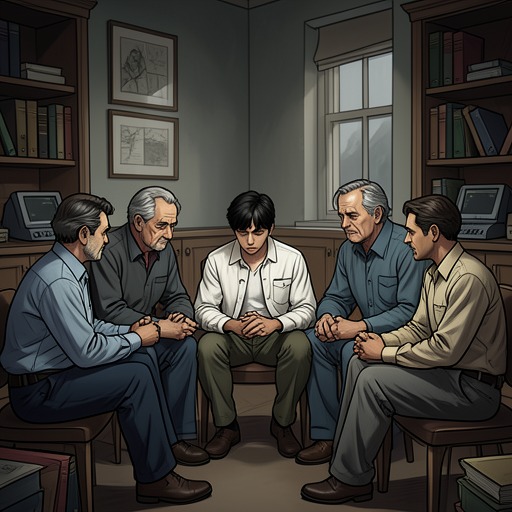
Jin entered Jungkook’s life during the years when Big Hit Entertainment was still a small company struggling against the established power of SM Entertainment, YG Entertainment, and JYP Entertainment. The trainees lived together in cramped accommodation in Nonhyeon-dong, in Gangnam, while the company lacked the resources and industry connections enjoyed by the larger agencies. In that setting, the older members became Jungkook’s immediate social world after he left Busan as a young teenager to train in Seoul.
The dormitory that preceded BTS’s debut was small enough to intensify every relationship. Once the seven members had been selected, they moved into the so-called Blue House, an apartment with cobalt-blue doors, a bathroom, and balcony. All seven boys slept in one room on three bunk beds, while Jungkook, the youngest, used a single mattress on the floor. The arrangement made seniority visible in physical space, but it also made care unavoidable. Jin, the oldest, drove the members in his Mini Cooper and dropped Jungkook at Shingu Middle School, a ten-minute journey from the Han River.
Jin’s role was especially clear on Jungkook’s middle-school graduation day in February 2013, four months before BTS’s debut. Jungkook recorded his first Bangtan Log while wearing a white dress shirt, a narrow tie, and a wool coat, holding his diploma in a transparent folder and bouquets of chrysanthemums. His parents were absent, but Jin, SUGA, and Jimin attended in their place, posing proudly with the youngest member. The scene captures the group before fame had supplied them with protection or prestige: a teenager’s family milestone witnessed by the people who shared his dormitory, rehearsals, and uncertainty.
Care Within the Trainee Household
The members’ daily routine was punishing. They generally woke at around 10 a.m., ate a simple breakfast of salad, bread, or grilled chicken, and trained until approximately 10 p.m.; during the two months before debut, rehearsals could last twelve or fourteen hours. Vocal instruction came from Kim Sung-eun, while Son Sungdeuk directed the dance training, with J-Hope and Jimin offering additional help because of their prior experience. Jin therefore occupied a household in which the older members taught through example and assistance rather than through formal authority alone.
The dormitory and its surrounding places became refuges from that schedule. The convenience store, the swing in Hakdong Park, and the bicycle path along the Han River offered brief escapes from the demands of training. Jungkook sometimes went to the convenience store to eat instant ramen while crying from homesickness, then bought banana milk after rehearsals as a small consolation for missing his mother’s cooking. Jin’s presence in this period belongs to the same material world: he was the member who could place the youngest in a car and get him to school, helping convert an unfamiliar city and an overcrowded dormitory into a livable shared environment.
That practical intimacy continued into BTS’s early self-documentation. The group’s Bangtan Logs and social-media activity were unusually informal for the K-pop industry, whose agencies often closely monitored young idols. Jin’s first documented appearance in this stream came on December 22, 2012, when he posted a spontaneous selfie and a simple greeting, promising to tweet regularly. The following day he uploaded another low-definition, unfiltered, unedited selfie with the caption "my lower lip is charming.jpg." These gestures helped establish the unpolished, direct relationship between BTS and its audience, a relationship that contrasted with the heavily produced introductions used by competitors such as EXO.
From Underdog Group to National Symbol
Jin’s personal trajectory unfolded alongside BTS’s transformation from an underfunded newcomer into a cultural and economic force. The group’s success eventually generated an estimated 32.6 billion dollars for the South Korean economy, attracted approximately 800,000 foreign tourists annually, and supported billions of dollars in tourism spending. BTS also secured partnerships with major brands, including Samsung, Louis Vuitton, and the NBA. The distance between Jin driving Jungkook to school and the group becoming a national asset is therefore immense, but the evidence presents the later prominence as an extension of the earlier collective rather than a replacement for it.
As BTS became an international representative of South Korea, the members were asked to balance the expectations of pop stars with those attached to national delegates. Government investment in Korean popular culture after the 1997 financial crisis helped develop K-pop as soft power, and BTS eventually became associated with the country’s international prestige. In 2018, the group was invited to the United Nations to support UNICEF’s global education and development campaign after launching Love Myself with the organization. During the pandemic, the members appeared at the United Nations General Assembly as special presidential envoys for future generations and culture, performed Permission to Dance in the Assembly Hall, and encouraged vaccination and support for young people facing hardship.
Jin’s significance in this collective public role is inseparable from the group’s reputation for sincerity and social responsibility. BTS donated one million dollars to the Black Lives Matter movement in 2020, inspiring the ARMY to match the amount within twenty-five hours. The fandom had been named in July 2013 and developed an unusually international, digitally organized identity, using Twitter, Discord, Reddit, Tumblr, YouTube, and TikTok to promote the group and to oppose white supremacy and anti-Black racism. Jin was one of the seven members through whom this public image was sustained: the group’s national representation did not erase its origin as a network of young men who depended on one another.
Military Service and the First Departure
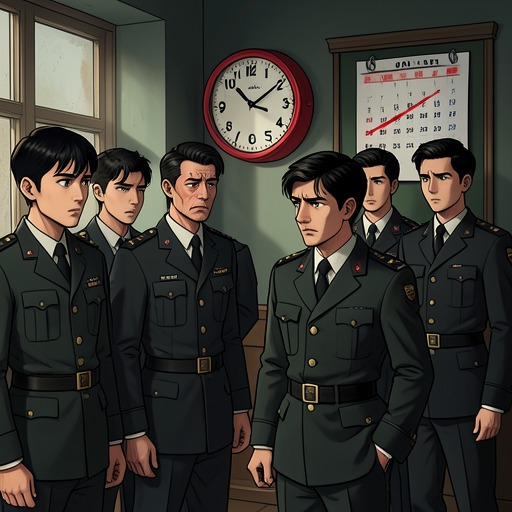
Military service made Jin the first decisive marker in BTS’s next transition. South Korean men between eighteen and thirty-five are eligible for service and are required to complete their obligation before the ordinary upper age limit; the service period had been reduced to approximately eighteen months in 2022. For idols, enlistment means more than a bureaucratic interruption. Shaving the head and leaving the stage signify a temporary departure from an industry organized around youth and beauty, while return is treated as evidence that the idol has become a man.
The question of whether BTS should receive an exemption was politically and emotionally charged. Existing precedents allowed exemptions for achievements that enhanced South Korea’s international prestige, but the criteria were clearer for Olympic medals or major classical competitions than for the less tangible influence of pop music. In 2020, the National Assembly’s National Defense Committee approved the measure popularly known as the BTS Act, allowing a pop-culture artist recommended by the Minister of Culture, Sports and Tourism to postpone enlistment until age thirty if the artist had significantly improved the country’s image. A complete exemption remained controversial, and public suspicion could attach even to comfortable civilian assignments.
The members did not request exemption. Jin announced his enlistment in December 2022 at the age of thirty, followed by J-Hope in April 2023 and SUGA in September. His decision made him the first member to serve and, in the book’s metaphor, the one who began clearing the path for the others. Rather than preserving a continuous public presence through staggered enlistments, BTS later chose to enlist together: RM, V, Jimin, and Jungkook entered while they still had time available under the ordinary schedule. Jin’s early departure thus became part of a collective strategy that treated shared timing and group loyalty as more important than minimizing every interruption to individual careers.
Return and Continuing Function
Jin’s return in June 2024 turned military completion into a reunion ritual. Despite appeals for fans not to gather, journalists and enthusiasts assembled outside the iron gate of the base in Yeoncheon. Jin emerged in uniform and beret, delivered an immaculate salute, and was greeted by RM, who appeared with a saxophone around his neck and played a passage from Dynamite. The entire group gathered for a photograph together for the first time in years, transforming a solitary institutional threshold into a visible restoration of the group bond.
Four months later, J-Hope completed his service and was received by Jin, who wore a burgundy outfit and sunglasses. The two members were positioned as the people keeping the group’s flame alive until the others could be discharged. Jin then announced a fan event in which he hoped to give light hugs to one thousand fans; the original plan had been three thousand, but HYBE persuaded him to reduce the number. The gesture extended his role beyond the group’s internal hierarchy: after being the eldest member who led the way into service, he became one of the first to convert return into renewed contact with ARMY.
Jin’s narrative importance lies in this continuity. He belongs to the period when Jungkook slept on a mattress under the shadow of three bunk beds, to the era when BTS became a national symbol, and to the military interval in which the group’s future was temporarily dispersed. His care is expressed through concrete actions rather than grand declarations: a car ride, a graduation photograph, a first enlistment, a salute, and a reunion. Across those moments, Jin embodies the elder-brother structure that allowed BTS to survive both obscurity and extraordinary fame without losing the sense that its members had begun by carrying one another.