K-pop Synchronization Dance
O fenômeno Jungkook: O sucesso do BTS e a criação de um superstar mundialK-pop synchronized dance, known as kalgunmu, is a defining performance practice of K-pop: a group’s movements are aligned with such exactness that the dancers appear to operate as one body. Its importance lies not only in visual spectacle but in the labor and ideology it makes visible. Kalgunmu turns repetition, discipline, hierarchy, and collective sacrifice into an aesthetic achievement, even as its demand for uniformity can conceal individual style.
Definition and Visual Language
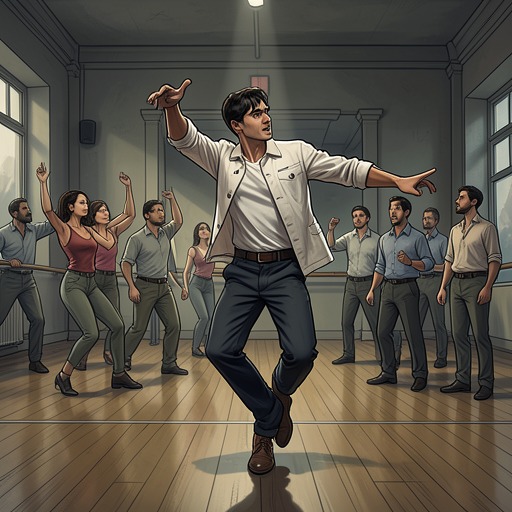
Kalgunmu literally refers to a group dance that is sharp like a knife. The term describes the tightly synchronized movements of boy and girl groups, whose precision can evoke military discipline. Synchronized dancing itself predates K-pop; Western groups such as the Jackson Five and *NSYNC performed in formation for decades. In K-pop, however, the unusually high level of coordination became a recognizable genre signature, especially through formations that make increasing numbers of dancers appear increasingly monumental.
The style depends on more than obvious unison. Its choreography commonly combines several dance traditions on a hip-hop foundation, and its technical difficulty may remain invisible to viewers who do not know dance. Shifts of weight follow the beat, heavy falls contrast with light rises, and clean lines emerge from small controlled actions such as bending a knee or flicking a wrist repeatedly. The result is both an artistic and athletic display: the dancers can resemble synchronized swimmers cutting through water or a pendulum moving with exact regularity.
Training and Institutional Production
Kalgunmu is purchased not with money alone but with time, repetition, and physical endurance. Dancers must rehearse until every movement and beat is embedded in memory and muscle. Ms. Vee described mastery as requiring “thousands and thousands and thousands of repetitions to really master.” Practice videos were created so dancers, instructors, choreographers, and company directors could inspect each incorrect step. Jin recalled that Bang Si-hyuk studied recordings frame by frame until even the positions of the members’ fingers were synchronized.
The training demanded of BTS illustrates the scale of this process. As trainees, the members sometimes practiced for fourteen hours a day, with some days involving twelve consecutive hours of dancing. The group’s dance line originally consisted of J-Hope, Jimin, and Jungkook, with V added in 2018, although Ms. Vee regarded every BTS member as an exceptional dancer. Their clean execution was therefore not presented as an accidental gift but as the outcome of a system that transforms stamina and repetition into collective precision.
That system also reflects the wider pressures of Korean society. The culture surrounding education and work places extraordinary value on endurance, competition, hierarchy, and the ability to accomplish what appears impossible. Kalgunmu embodies the same demand: the individual must continue beyond exhaustion until the body no longer hesitates and the group can perform as a single mechanism. The choreography’s polish is thus a record of labor, not merely a decorative surface.
Infinite and the Standard of Synchronization
Infinite, which debuted in 2010 through Woollim Entertainment, is presented as a spiritual predecessor to BTS because both groups began with seven members and modest circumstances outside the Big Three companies. Infinite reached the top partly by opposing industry expectations through an unusually disciplined approach to dance. The group became strongly associated with kalgunmu and helped popularize the term as a description of near-perfect synchronization.
Its choreography offered a concentrated demonstration of what the style could achieve. In “BTD (Before the Dawn),” from the group’s 2011 second EP, the members performed the Scorpion technique, associated with former member Hoya. Beginning in a circular formation, the dancers lay face down and rose together in one movement, like the petals of a rose closing. Other routines featured exact transfers of weight, geometric formations, heavy drops, gentle recoveries, and repeated gestures performed seven times in succession. The pleasure of watching seven dancers exert complete bodily control at the same instant became central to the style’s appeal.
The same principle shaped how BTS was trained and evaluated. The company’s practice of reviewing rehearsal footage made synchronization a measurable standard, while the group’s collective performance required each member to adjust personal movement to the ensemble. In this sense, kalgunmu expresses the organizational logic of the idol industry: coordinated bodies, standardized processes, and an integrated result that is greater than any single performer.
The Cost of Uniformity
The strength of kalgunmu is also its inherent limitation. Perfect unison leaves little room for individual expression or creativity. Stronger dancers may reduce their movements to match the group, while weaker dancers must struggle to reach the required level. The uniformity can disguise differences in ability, but it can also prevent dancers from developing their own styles. Hoya argued that remaining within kalgunmu did not help dancers improve their individual skills because the form required them to suppress personal movement.
Infinite eventually recognized this problem. Hoya said that the group had created the image of kalgunmu even though every member had a different physique and different feelings, and that it was time to stop hiding their styles. Dongwoo similarly observed that the members had been unable to show their individual approaches, while Woohyun said that his dancing improved considerably after he stopped performing in the synchronized style. Their later position reframed the form’s celebrated perfection as a possible barrier to artistic growth.
This tension also affects how K-pop is interpreted outside East Asia. Western audiences often place greater value on freedom, individuality, and expressive movement than on strict collective precision. To some viewers, synchronization can appear beautiful but soulless, and it may reinforce the racialized stereotype that K-pop idols are manufactured, interchangeable, and unable to demonstrate personality. The spectacle that East Asian audiences may read as proof of sacrifice and hard work can therefore be decoded elsewhere as evidence of artificiality.
BTS and a Modified Collective Style
BTS used synchronization without allowing it to erase the members’ individual energy. The group debuted with “No More Dream” on the weekly music program MCountdown after rehearsing the choreography for almost two full months. The performance was coordinated, but it was not as polished or impersonal as Infinite’s most characteristic kalgunmu. The members’ bounces and shimmies answered the song’s challenge to the conformism of Korean youth culture, giving the routine a roughness that made the choreography feel connected to the lyrics.
Its most striking moment came when Jimin, supported by Jungkook, ran across the backs of the other five members. The movement depended on formation and collective trust, yet it also emphasized the members’ differing energies. Rather than presenting harmony as the disappearance of the individual, BTS used synchronization as a structure through which personality could remain visible.
That approach connected the group to the hip-hop spirit associated with Seo Taiji and Boys, whose music had challenged the restrictive social atmosphere of South Korea in the 1990s. BTS’s debut goal was to share the dreams and frustrations of youth, and the choreography made that purpose physical: disciplined enough to display the labor of the idol system, but forceful and imperfect enough to preserve the urgency of protest. Kalgunmu therefore becomes, in BTS’s case, not simply a demonstration of obedience to the group but a way to make collective experience feel immediate and alive.