Michael Jackson
O fenômeno Jungkook: O sucesso do BTS e a criação de um superstar mundialMichael Jackson functions in the book as more than a celebrated predecessor to Jungkook. He is the central figure through whom Jungkook’s musical inheritance, performance discipline, and transnational pop ambitions become legible. Jackson’s influence reaches Jungkook through the history of Korean popular culture, then reappears in the solo era as a demanding artistic standard: to invoke Jackson is not merely to borrow a gesture, but to prove control of voice, rhythm, body, and spectacle at once.
A Transnational Performance Legacy
Michael Jackson’s importance to Jungkook is rooted in the way American popular culture entered South Korea before contemporary social media made global circulation instantaneous. In the 1970s and 1980s, the American Forces Korean Network broadcast continuously and was accessible to Korean viewers, exposing them to American films, music, and television. Music-video programming brought Jackson’s signature performances into Korean homes, where songs such as “Billie Jean,” “Thriller,” and “Smooth Criminal” became models for a generation of artists. Park Jin-young, the founder of JYP Entertainment, recalled being overwhelmed by Jackson’s movements, clothing, and even socks, while treating Quincy Jones as a musical reference and Jackson as a model for stage performance.
That transmission helped shape the later K-pop system in which Jungkook was trained. Jackson’s influence therefore does not appear as an isolated personal preference; it forms part of a relay connecting American pop, Korean hip hop, idol performance, and the global K-pop marketplace. The book places Jungkook within that longer history, showing how material first encountered through television could eventually return to the world as a Korean artist’s deliberate tribute.
The Standard Jungkook Inherits
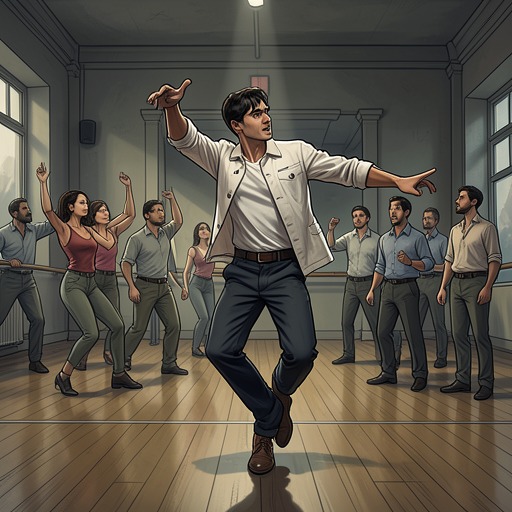
Jungkook’s dancing is described through musicality: the ability to make movement answer the rhythm, then to enlarge or restrain that response according to the song. In his solo work, he expanded the relaxed groove that had made him compelling within BTS, allowing greater individual style and freedom. The clearest expression of this development came in “Standing Next to You,” whose choreography was explicitly conceived as a tribute to Michael Jackson and was choreographed by Keone Madrid.
The tribute required more than recognizable poses. Brian Puspos described the choreography as physically demanding and full of references to Jackson’s minimal movements, including the subtle stops and gestures Jungkook performs near the microphone stand. Its difficulty lay partly in its restraint: Jackson’s vocabulary often depends on tiny changes in timing, weight, and gesture that are harder to execute convincingly than large movements. Puspos and director Clay Boonthanakit were impressed by Jungkook’s stability, bodily control, and ability to manage contrasting simultaneous rhythms while matching the energy of highly accomplished professional dancers.
The performance also marked a change in Jungkook’s relation to his own body. A dance observer noted that, unlike the collective force of BTS’s synchronized performances, Jungkook’s solo work displayed distinctive personal style. In “Standing Next to You,” he appeared comfortable not only with the choreography but with himself. The cleanliness of the execution suggested hundreds of repetitions, while the confidence required by the routine made technical mastery visible as self-possession.
“Standing Next to You” as Deliberate Tribute
“Standing Next to You” became the title track of Golden and the culmination of Jungkook’s attempt to move beyond the image of BTS’s youngest member. He traveled to Budapest in October to film the video, which included difficult footwork and hip movements inspired by Jackson. Even while resting during the shoot, Jungkook remained conscious of the risk involved in presenting such a performance after “Seven” and “3D.” He hoped general audiences would recognize that the singer of those songs could also dance at that level, and that the result would reinforce the continuing excellence associated with BTS.
The hoped-for recognition arrived from figures Jungkook could scarcely have expected to reach. Diana Ross praised the songs and videos, saying that Jackson could be seen in every movement. The response matters because it confirms that the tribute was not only legible to fans or to Korean performance specialists; it could also be acknowledged by someone connected to Jackson’s own generation of pop. The book thus frames Jungkook’s performance as a conversation across eras rather than a simple imitation.
Jackson’s influence also extends to Jungkook’s vocal ambitions. Jungkook identified Jackson as a principal inspiration both as a singer and as a dancer, making “Standing Next to You” a test of the complete performer. The song’s achievement depends on the coordination of singing, groove, sharply controlled movement, and theatrical presence. Jackson supplies the standard against which that coordination is measured, while Jungkook supplies the Korean and contemporary context in which the standard is revived.
Beauty, Masculinity, and Global Legibility
The book connects Jackson’s legacy to Jungkook’s broader challenge to established ideas of male pop stardom. Jungkook’s appeal is presented as more expansive than the conventional Korean flower-boy image: he can move between masculine and feminine codes, combining polished beauty with tattoos, piercings, and a more visibly rebellious styling. His declaration that style means wearing what one wants regardless of gender echoes a performance tradition in which pop masculinity is constructed through clothing, makeup, gesture, and theatrical transformation rather than through a single fixed model.
This matters in a Western context shaped by racialized assumptions about Asian men. The book argues that stars such as Jungkook have helped unsettle the historic representation of Asian men as sexually undesirable or emasculated. Jackson’s own importance to this process is indirect but substantial: his global model of pop masculinity made extravagance, beauty, dance, and vulnerability compatible with extraordinary power. Jungkook inherits that possibility while embodying it as an Asian artist whose appearance and performance circulate through Western media on unprecedented terms.
Influence Converted into Achievement
Jackson’s presence ultimately becomes a measure of transformation. Jungkook does not remain only a student absorbing an American icon through television or trainee practice. In “Standing Next to You,” he converts that inheritance into a major solo statement, using a Jacksonian performance language to establish an identity separate from, though still connected to, BTS. The song’s reception from Diana Ross and the collaboration with Usher, another childhood idol of Jungkook’s, place his work within a lineage of artists he once studied from a distance.
That conversion is part of the book’s larger account of how Jungkook became globally visible. His success combines artistic ability, the history of K-pop, technological change, international fandom, industry investment, and the cultural opening created by a more receptive global audience. Jackson represents one crucial strand in that totality: the American performance tradition that Korean artists absorbed, refined, and sent back into the world. For Jungkook, the tribute is therefore both homage and declaration. It honors the performer who taught generations to see the stage as a total art while asserting that the inherited language can now be spoken fluently by a Korean solo artist on the global pop stage.