New York City
O fenômeno Jungkook: O sucesso do BTS e a criação de um superstar mundialNew York City functions as the principal American proving ground for Jungkook’s solo career: a city where his audience can occupy public space at extraordinary scale, where the machinery of global pop places him under intense scrutiny, and where a formerly group-centered performer begins to appear as an independent international star. His relationship with the city is defined by contrast. It contains both the anxious backstage artist struggling with a sore throat and the assured performer whose unprocessed voice carries across Times Square.
First Solo Arrival and Fan Mobilization
New York City became the setting for Jungkook’s first major solo American appearance in July 2023, when he launched his solo era with "Seven (feat. Latto)" and opened the Good Morning America Summer Concert Series. Unlike his debut with the little-known Big Hit Entertainment, this second debut was supported by HYBE, a multibillion-dollar company with a United States branch managed by Scooter Braun. The song was sung in English, lasted three minutes and three seconds, and was presented not on a Korean music program but on Good Morning America, making New York City part of a deliberate movement toward the global pop market. The concert was scheduled for Central Park, and the free-ticket demand exposed the scale of Jungkook’s following before he had even performed. The 1iota lottery opened at noon local time and closed in less than a minute. Fans began forming a line on Monday for a Friday-morning show, stretching from 72nd Street along Fifth Avenue and the park wall. In temperatures approaching 32 degrees Celsius, they brought folding chairs, inflatable sofas, pool floats, shopping carts, and large bags; groups shared blankets and rotated between hotel rooms, gyms, and the Apple Store bathroom on Madison Avenue. By Thursday afternoon more than 700 people were waiting, by night nearly 2,000, and by Friday morning the line extended for more than 12 blocks to 60th Street and around the park’s East Drive.
Weather, Illness, and the Central Park Stage
The Central Park appearance also made New York City a scene of uncertainty rather than uncomplicated triumph. Jungkook had flown from Seoul two days earlier and was still suffering from a persistent throat inflammation that had lasted several weeks. At Rumsey Playfield, dressed in light jeans, a white tank top, silver chains, and a black hooded sweatshirt, he leaned against the metal fence and appeared nervous as dark clouds gathered overhead. Shortly after seven in the morning, a storm warning and imminent lightning made the planned eight-o’clock show impossible. Good Morning America halted the rehearsal and moved directly to the soundcheck recording for broadcast, a contingency that caught Jungkook off guard. The fans were then admitted quickly, many carrying phones in one hand and Cooky dolls in the other. Behind the scenes, Jungkook laughed in disbelief while his hairstylist arranged his fringe, and his stylist exchanged the sweatshirt for a white Givenchy shirt with studs. The scene exposed the gap between the controlled image of a major pop production and the improvised conditions imposed by the city’s weather. New York City did not offer a polished beginning; it forced Jungkook to perform within a disrupted schedule while preserving the appearance of ease.
Rehearsal, Recovery, and Public Pressure
Jungkook returned to New York City in July to prepare for the concert series and rehearsed at New 42 Studios in Times Square. The day before the performance, he visited a doctor because his throat had remained dry and irritated for weeks and received temporary treatment to reduce the pain. On the morning of the show, the threat of rain caused Good Morning America to move his performance forward. Despite feeling unwell and being surprised by the change, he regained his habitual rhythm while climbing the stairs and resolved to give the best performance possible. Once onstage, he sang perfectly and showed no visible sign of illness, recalling an earlier Chile performance during which he had also completed the show after collapsing backstage. Seconds after leaving the stage, rain began to fall. He nearly slipped on the stairs as his left foot came out of a Balenciaga sneaker, then coughed heavily in the dressing room. Looking toward the clouds that had interrupted what should have been a triumphant live appearance, he expressed sadness and disappointment, describing it as his first solo performance and observing that things never went well for him at the beginning. New York City therefore became a place where technical professionalism and physical vulnerability were visible at the same time.
Times Square as Career Climax
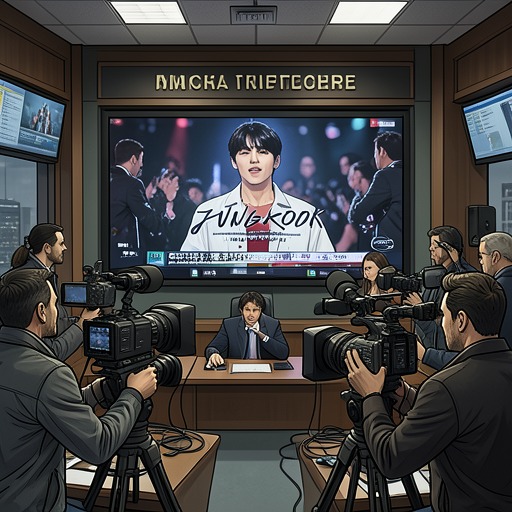
The city’s most important setting for Jungkook’s solo identity was Times Square. On November 8, 2023, the day before his surprise show, he visited a Barnes & Noble while holding an iced coffee and stared with genuine astonishment at a display of Golden. The sight connected the global star to his earlier identity as an ordinary music fan: he wondered whether, if he were not a singer, he would buy another artist’s album to show support and whose fan he might be. The following afternoon, Jungkook slept for about 12 hours, ate a burrito bowl in his hotel room, and prepared for the TSX stage positioned behind a digital billboard in the center of Times Square. He knew that the privileged location would draw people who were not part of the ARMY, increasing the pressure to perform well. An Instagram announcement gave New York City only 30 minutes’ notice, but fans had already decoded clues from a cryptic Big Hit post and a change in the TSX billboard to his Calvin Klein advertisement. They had explored the site the day before and begun queuing early that morning. By showtime, the crowd had filled the plaza and surrounding blocks; helicopters circled overhead, radio hosts called it the crowning moment of his solo career, and screams could be heard from his hotel room as he warmed up. Jungkook ran onto the elevated stage to the opening chords of "Standing Next to You," greeted the city as Jungkook of BTS, and performed five songs. His microphone was live, his voice carried without processing over the landmark, and he danced through steps fixed in memory by hours of rehearsal. The performance transformed Times Square into a public confirmation of arrival. The teenager who had once walked through Los Angeles carrying a plain flyer and asking suspicious strangers to attend a free BTS show could now summon thousands in New York City with half an hour’s warning, while more than 280,000 people watched from home.
Significance of the City
New York City represents the movement from mediated promise to visible accomplishment. At Central Park, the scale of the audience was undeniable, but the performance was threatened by illness, lightning, and rain. In Times Square, the same global city became the backdrop for control: Jungkook stood above a crowd that included casual observers as well as ARMY, sang live, danced without losing the rhythm, and completed the promotional arc of Golden at a symbolic crossroads of mass culture. The city also reveals how Jungkook’s public and private selves remain connected rather than entirely separate. In a 2017 Los Angeles interview setting, he had appeared startled, shy, respectful, and quietly singing to himself; in New York City, he still showed surprise when confronted with his own album display and anxiety before an unfamiliar audience. Yet those private gestures no longer cancelled his public authority. They became part of the appeal of a performer whose international capital rests not only on records, branding, and stage technique, but on the visible persistence of the earnest young artist beneath them.