Reverse narrative
O fenômeno Jungkook: O sucesso do BTS e a criação de um superstar mundialThe underdog narrative is the defining structure of BTS’s public story: seven boys from outside Seoul move toward the capital and pursue dreams in an industry dominated by larger, better-established powers. Its decisive force lies not simply in showing that they eventually win, but in making every later achievement appear to answer an earlier condition of neglect, uncertainty, or exclusion. Jungkook’s place within this story gives the narrative a particularly intimate scale: the global star remains connected to the tired, homesick teenager who once had to prove that his group deserved attention.
Origins in Distance and Disadvantage
The story begins with a classic hero pattern. The seven members come from cities and regions beyond Seoul: Gwacheon and Ilsan in Gyeonggi Province, Daegu, Gwangju, Geochang, and Busan. These places are not treated as uniformly backward—Busan is South Korea’s second-largest city, while Gwacheon and Ilsan lie close to Seoul—but the text emphasizes the immense social and cultural gaps between Seoul and the rest of the country. Moving toward the capital therefore becomes more than a change of address. It marks entry into a hierarchy in which regional origin can signify distance from the center.
The industrial circumstances sharpen that distance. Before founding Big Hit Entertainment, Bang Si-hyuk was a respected composer and producer who had worked with Park Jinyoung, g.o.d., and 2am, but Big Hit remained a small company struggling financially after the weak public reception of Glam, a girl group managed jointly with Source Music. BTS was its first male idol project, and the company stood outside the established dominance of the Big Three. The group was therefore almost a Nugu act, with little institutional protection and limited expectation surrounding its debut. Their early disadvantages became the raw material of the story: what the company could not provide financially, it compensated for through artistic freedom.
The official history Beyond the Story: Uma história dos 10 anos de BTS reinforces this arrangement by presenting Big Hit as David confronting the industry’s Goliaths with little more than a slingshot. The image is not incidental decoration. It supplies a moral geometry in which scale, money, and prestige belong to the powerful, while persistence and ingenuity belong to the smaller challenger. BTS’s later success can consequently be read as a reversal of the industry’s presumed order rather than as a straightforward ascent within it.
Repeated Proofs of the Unlikely Victory
The narrative gains credibility through small, concrete moments that precede the grand triumphs. During the group’s isolation around debut, BTS members shared daily hardship and happiness through tweets, Bangtan Logs, Bangtan Bombs, and blog posts. On February 12, 2013, a member celebrated the group’s having gained more than one thousand followers after a month and a half. The emotional scale of that achievement matters: before arenas, awards, and international recognition, even a modest increase in attention felt like a breakthrough.
This direct communication helped create an unusually intimate relationship with fans. J-Hope described the contact as becoming a daily routine that brought the members closer to their audience. BTS appeared not only as idols but as seven young people doing their best despite adversity. The underdog narrative thus depends on access as much as on plot. Fans are invited to witness fatigue, loneliness, family separation, and the members’ care for one another, so that later victories feel personally earned rather than merely announced.
The 2015 Idol Star Athletics Championships relay became an almost diagrammatic version of the same story. During the 400-meter final, commentators expected B1A4 or TeenTop to win and barely mentioned BTS. Jungkook ran the anchor leg; when J-Hope handed him the baton, B1A4 appeared to have secured victory. Jungkook then sprinted from behind and passed the other runners by several meters. The commentators compared the race to BTS’s real life: nobody expected the group to succeed, yet it did. The event condenses the narrative into a visible reversal, with an overlooked contestant turning the final stretch into proof that the established prediction was wrong.
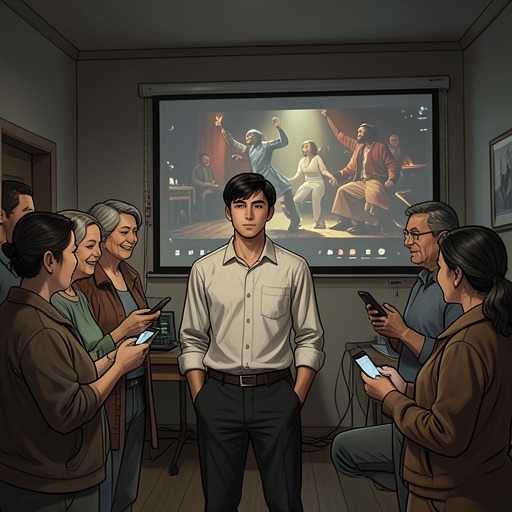
The pattern also appears in the so-called hamburger case of 2016. Before BTS received its first Daesang, Jungkook appeared alone on the variety program Flower Crew and brought hamburgers and soft drinks for the staff. The comedian Jo Se-ho refused them, saying they looked like leftovers. Although the context was later distorted, the surviving public image was that of Jungkook being disrespected and closing off after his modest gesture was rejected. ARMY’s reaction drew strength from the group’s accumulated experience of online hostility, including accusations of sajaegi, or chart manipulation, and attempts by haters to make hostile hashtags trend on Twitter.
The apparent closure came in 2021, when BTS appeared on a special episode of You Quiz on the Block, with Jo Se-ho as a co-host. Jungkook embraced him warmly. The gesture turned an old humiliation into a scene of return: the person once associated with rejection now appeared within the world of the group’s triumph. The point was not revenge but reversal without cruelty. Jungkook could acknowledge the past while refusing to be defined by it.
Why the Story Produces Attachment
The appeal of the underdog narrative is presented as psychological as well as commercial. People may support an unlikely winner out of empathy, or because supporting the disadvantaged offers a small way to respond to perceived injustice. Producers and companies have long used this structure to generate attachment, and in the United States the working-class hero who overcomes adversity has particular cultural resonance. South Korea, heavily influenced by American culture after the war, likewise responds strongly to the fable that sustained effort can be rewarded, especially within a culture that prizes relentless achievement and the willingness to push body and mind to their limits.
BTS was frequently compared with One Direction, another boy band framed as a group of ordinary young men who forged a genuine connection with fans while trying to avoid conventional pop formulas. One Direction’s members described themselves as people doing an unusual job rather than as distant products of a boy-band machine. BTS inherited and extended that line of appeal, though its position was riskier: the group was already an unconventional choice in South Korea, and its prospects in Western pop culture appeared still less secure.
The story becomes especially powerful when its evidence is visual and recurring. A fifteen-year-old Jungkook, far from his family, exhausted, lonely, and marked by dark circles under his eyes, appears in the group’s informal content as someone whose future is visibly at stake. Older members caring for younger ones intensifies the impression of a found family. Fans are not merely consuming a finished success; they are watching a real young person endure uncertainty and feeling that their own support can help him continue.
The same emotional mechanism explains the intensity of the backlash against BTS between 2015 and 2017, a period described as particularly difficult in the official biography. As the group became more successful, cyberbullying from the general public and rival fandoms increased. ARMY’s protective instinct grew in response, turning hostility into another chapter of the struggle between vulnerable outsiders and powerful opponents. The narrative does not require BTS to be powerless forever. It requires the memory of powerlessness to remain available whenever a new obstacle appears.
From National Outsiders to Global Representatives
As BTS expanded internationally, the underdog story acquired a national dimension. South Korea’s government invested heavily in cultural promotion after the 1997 financial crisis, directing funds through the Ministry of Culture, Sports and Tourism and later establishing a committee to support the expanding Korean cultural wave. K-pop changed from entertainment regarded as a lesser diversion into a major export and instrument of soft power. BTS consequently became, alongside internationally celebrated South Koreans such as Yuna Kim and Son Heung-min, a source of national pride.
That elevation created a new tension. The group had to satisfy audiences seeking both an artist and an idol while also representing South Korea abroad. International travel exposed the members to new cultures and ideas, and V described Jungkook as having become the most open-minded of them. The former outsiders were now asked to embody national values, yet their movement beyond the domestic bubble encouraged them to absorb perspectives that exceeded any single national script.
The 2018 United Nations invitation made the transformation visible. After BTS launched the Love Myself campaign with UNICEF in 2017 and partnered with the organization’s program to end violence against children, the group was invited to help promote global education and development. During the pandemic, President Moon Jae-in brought BTS to the United Nations General Assembly, gave the members red diplomatic passports and certificates, and appointed them special presidential envoys for future generations and culture. They performed Permission to Dance in the Assembly Hall, encouraged vaccination, and addressed young people facing the uncertainty of the period.
Jungkook’s appearance in the recorded address—seated in black, with silver earrings visible, speaking calmly and firmly—preserves the underdog’s moral vocabulary even after the group has acquired official status. He said that although people were living in uncertainty, nothing essential had changed: if his voice could give people strength, that was what he and the group would continue doing. The statement is significant because it refuses to treat institutional recognition as a replacement for the original purpose. The group’s authority is presented as an extension of shared vulnerability rather than as a departure from it.
ARMY and the Collective Underdog
The underdog narrative cannot be separated from ARMY, whose name was established in July 2013 as an acronym for Adorable Representative M.C. for Youth. The fandom became as recognizable as the artists and is described as a crucial ingredient in Jungkook’s emergence as a global pop star. Its role was not passive admiration. ARMY’s devotion helped the members pursue solo careers, break records, defend the group against attacks, and convert each new achievement into a collective victory.
What made ARMY distinctive was its highly international composition. International ARMY pioneered a cross-cultural form of support for a group initially directed toward East Asian audiences, using Twitter, Discord, Reddit, Tumblr, YouTube, TikTok, and each successive social platform to circulate BTS’s work. The fandom transformed digital connectivity into infrastructure: fans could exchange information, organize defenses, and promote the group across borders faster than traditional industry boundaries could contain it.
In 2020, ARMY joined other K-pop fandoms to oppose white supremacy and anti-Black racism by overwhelming the harmful hashtag #WhiteLivesMatter with K-pop fancams and reaction gifs. Because BTS had publicly opposed racism and violence and had donated one million dollars to the Black Lives Matter Global Network Foundation, the fandom’s activism appeared as an extension of the group’s stated commitments. ARMY was therefore not simply the audience that completed the underdog story; it became another organized collective that could redirect digital power against a larger hostile force.
Endurance, Justice, and the Limits of Triumph
The story’s moral durability depends on the belief that success should not destroy the qualities that made the early struggle meaningful. Jungkook’s response to a fan who asked how he would feel if she liked other male idols illustrates this ethic. Rather than perform jealousy for fan service, he answered that her preferences were her own life and should be met with respect, understanding, and consideration. The episode presents emotional generosity as a continuation of the group’s beginnings, not as a polished performance imposed by fame.
Questions of national fairness place the same ideal under pressure. South Korean military service is socially charged because collective suffering is expected to be shared, while inequality remains visible in gender pay gaps and widening income disparities. When the government considered whether BTS might receive an exemption, international fans welcomed the possibility, but the group’s public image as a national symbol made exemption politically dangerous. Even celebrities who serve in comfortable civilian roles can be suspected of receiving special treatment; the appearance of fairness matters almost as much as the formal rule.
The resulting tension clarifies the narrative’s final condition. BTS’s ascent does not abolish the systems that once placed them at a disadvantage, nor does national recognition guarantee freedom from scrutiny. Instead, the underdog identity survives as an ethical obligation: to remember where the group began, to share burdens rather than claim exemption from them, and to answer power with humility. The economic effects of BTS’s success—an estimated 32.6 billion dollars contributed to South Korea over a decade, approximately 800,000 foreign tourists visiting annually because of the group, and commemorative stamps selling about 1.5 million units in 2023—make the fairy-tale scale undeniable. Yet Jungkook’s affectionate embrace of Jo Se-ho suggests why the story remains compelling. Even at the summit, he is represented as retaining the gentleness of the boy who started with little. The underdog narrative ends not with the disappearance of vulnerability, but with its transformation into a lasting bond among artist, group, nation, and fans.