Yongheng Foreigner Syndrome
O fenômeno Jungkook: O sucesso do BTS e a criação de um superstar mundialPerpetual foreigner syndrome names the belief that Asian-looking people are permanently marked as outsiders, regardless of birthplace or citizenship. Applied to K-pop, it turns cultural unfamiliarity into a racial judgment: idols are not merely seen as different, but as members of a supposedly uniform, machine-like Asia whose people look, act, and sound alike. The concept therefore exposes the racial logic beneath seemingly aesthetic or market-based doubts about whether Korean performers can be understood and desired in the West.
Definition and Racial Logic
The term is traced in the book to a 2002 article by the law professor Frank H. Wu and is presented as a central feature of Asian American experience. Asian features are treated as proof of foreignness, while Asia itself is imagined as a monolith containing billions of people with similar physiology and behavior. This perception does not stop at unfamiliarity; it can imply that Asians are false, untrustworthy, or incapable of belonging. The syndrome thus converts appearance into a permanent social boundary.
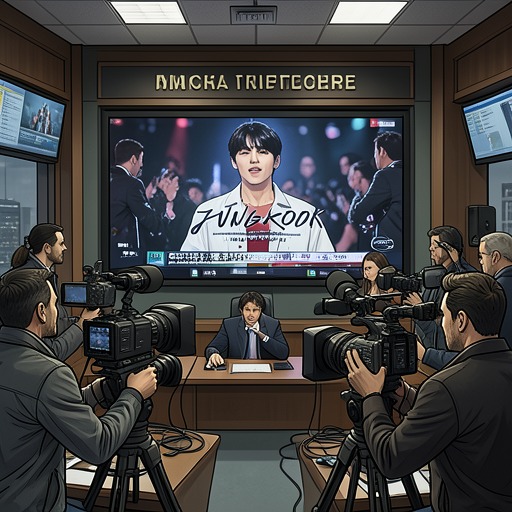
The book connects this logic to older stereotypes of Asian men in the United States, who have historically been represented as emasculated and sexually undesirable. That history reduced their perceived power while preserving existing racial hierarchies. The contrast with the intense public response to Jungkook is consequently significant: Western viewers expressing overwhelming desire for him reveal how Korean pop stars can disrupt a stereotype that had long been treated as normal. The reaction to a brief shirtless clip, and the audible enthusiasm of audiences at his live shows, makes the disruption public rather than merely theoretical.
K-pop and the Manufactured Idol
The syndrome becomes especially visible when Western media describe K-pop through the language of fabrication. A New Yorker article titled “Factory Girls” treated the production of K-pop stars as evidence that they were manufactured, and its discussion of SHINee described the members as androgynous, heavily made up, and culturally distant from One Direction. The article even asserted that a male K-pop group could not succeed in the United States. Its assumptions reveal how an unfamiliar form of pop performance could be read not as a different artistic system but as proof of inferior authenticity.
The book does not deny that K-pop involves extensive organization. Idols work with producers, managers, songwriters, stylists, hair and makeup artists, marketing teams, photographers, directors, and executives, just as Western pop stars rarely control every part of their music and public image. The difference lies in the interpretation. K-pop performers are more readily imagined as robots because the racialized image of Asians as interchangeable and factory-produced reinforces the idea that their polish erases individuality. Their makeup, choreography, and coordinated presentation become evidence for a preexisting racial story rather than features of a distinct entertainment industry.
Individuality, Recognition, and BTS
The book applies perpetual foreigner syndrome directly to the difficulty K-pop idols face in demonstrating the individuality prized by Western audiences. If Korean performers are presumed to come from a homogeneous system, then their personal voices can be overlooked before they are heard. This helps explain why K-pop artists were historically difficult to translate for Western publics even after repeated attempts to introduce the genre.
BTS challenged that framework through a concept built around ordinary experiences shared by people of the same age. Rather than presenting the members only as idealized models, the group emphasized friendship, present-day difficulties, and the emotional problems of youth. RM described the contradiction between talking with peers about what one is feeling and claiming to be an unreachable idol. Western fans and music journalists consequently praised BTS for authenticity, relatability, and lyrical depth, describing the members as more real after following their Logs and Bombs and watching them confront obstacles in public.
Recognition also matters materially. BTS members possess a wider range of facial structures than the tightly standardized image often associated with Korean idol beauty, making them easier for non-Korean fans to distinguish. The book relates this to the cross-race effect, the documented difficulty of recognizing faces from unfamiliar racial groups when exposure is limited. Distinctive faces can therefore support emotional attachment: once fans can tell the members apart, each member can develop an individual following rather than disappearing into an undifferentiated group image.
Beauty, Masculinity, and Cultural Translation
Jungkook embodies a further challenge to the syndrome through a form of male beauty that moves across conventional gender boundaries. Unlike the typical flower boy, he is presented as having a broader, contemporary appeal, combining masculine and feminine elements. His styling—smooth skin, shaped eyebrows, emphasized eyes, full lips, carefully arranged hair, and a well-built body—belongs to a Korean beauty standard that differs from the grooming norms applied to many Western male celebrities. His statement that style means wearing what one wants regardless of gender frames that appearance as personal freedom rather than a failure to conform.
The response to Jungkook also exposes the gap between Western assumptions and actual reception. Charlie Puth, discussing his collaboration with Jungkook, moved from noting BTS’s talent to repeatedly registering Jungkook’s attractiveness with visible surprise. Brian Puspos had a similar reaction while watching Jungkook rehearse “Standing Next to You”: technical admiration gave way to an unplanned acknowledgment of his appeal. These reactions dramatize the moment when a racial stereotype loses its authority and the observer is forced to revise what seemed obvious.
Yet the book distinguishes between cultural difference and racialized dismissal. K-pop’s use of Korean beauty conventions, intensive styling, and group choreography may be unfamiliar to Western viewers, but unfamiliarity alone does not make the performers artificial or less desirable. Perpetual foreigner syndrome enters when those differences are interpreted as evidence that Asians are inherently interchangeable, culturally inaccessible, or incapable of the individual charisma that Western pop supposedly values.
Limits and Wider Implications
The concept also intersects with the book’s criticism of superficial cultural translation within K-pop itself. When artists borrow hip-hop imagery—guns, chains, racial insults, blackface, or dreadlocks—without understanding the histories attached to those forms, cultural expression is reduced to visual styling. The resulting controversies show that isolation can operate in more than one direction: Western audiences may racialize Korean performers as permanent outsiders, while parts of the Korean industry may treat Black culture as an aesthetic resource detached from lived experience.
Perpetual foreigner syndrome therefore describes a problem of interpretation as much as a problem of representation. It explains why Western recognition of K-pop was delayed, why polished idols were cast as manufactured, and why Asian masculinity required visible disruption before it could be acknowledged as attractive. BTS’s rise, and Jungkook’s particular visibility, do not erase the structure, but they make its assumptions harder to sustain. The figures once treated as evidence of distance become agents who speak about ordinary life, cultivate distinct identities, and force audiences to reconsider who is allowed to appear fully individual, authentic, and at home in global popular culture.