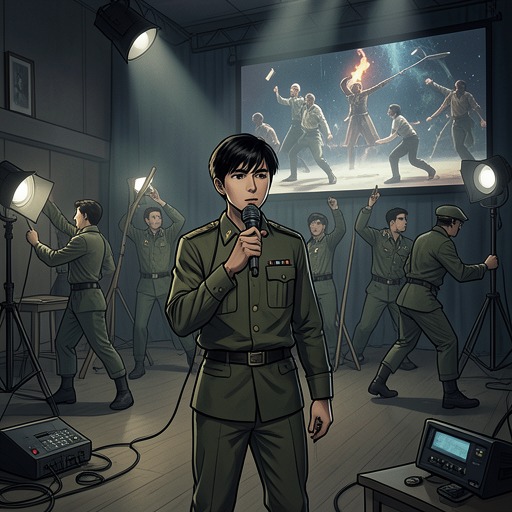
BTS Wings Tour Chile performance incident
O fenômeno Jungkook: O sucesso do BTS e a criação de um superstar mundialThe BTS Wings Tour Chile performance incident was a pivotal episode in Jungkook’s development as a performer: a concert that turned the image of the group’s seemingly invulnerable “Golden Maknae” into a stark encounter with bodily limits. In Santiago in March 2017, Jungkook performed through escalating illness, collapsed into backstage medical care, and still returned to the stage because his devotion to the fans outweighed his instinct to stop. The episode established the emotional logic behind his demanding professionalism: performance was not merely a job to complete, but a promise to an audience that had traveled to meet him.
Tour Context and Expectations
The incident took place during the first international stop of the BTS Wings Tour, the group’s second world tour, staged to promote the album Wings. Jungkook was nineteen, and the tour arrived at a moment when BTS had moved decisively beyond the uncertainty of its early career. “Blood Sweat & Tears” had become the group’s first single to reach number one on the Circle Chart, while its music video had broken the record for the fastest K-pop video to pass ten million YouTube views. The previous The Red Bullet Tour had begun with seven Asian cities in 2014 before expanding to twelve more locations, including New York City and Los Angeles, in 2015; Wings carried the pressure of that growth into a much larger international setting.
The group’s circumstances had also changed materially. In 2016, BTS won its first Daesang, receiving the institutional recognition it had pursued for three years. The first week of preorders for Wings exceeded 500,000 purchases, three times the total recorded for The Most Beautiful Moment in Life Pt.2 in 2015. The tour was designed to reflect that achievement, with a twenty-eight-song set including an encore and a solo number for every member. BTS scheduled two concerts in Chile and endured flights lasting thirty to thirty-two hours, including a stop in the United States, before reaching the first stage of the international itinerary.
The Santiago Concerts
The concerts were held at Movistar Arena, a venue in central Santiago with a capacity of 17,000 people. More than one hundred fans waited at the airport in organized lines, and some ran after the white van as the members departed. Jungkook, wearing a black hooded sweatshirt, practiced English in the back of the vehicle and later gave a peace sign to the camera documenting the journey. That evening, the members ate Korean barbecue, while Jungkook amused them by singing an exaggerated version of Jimin’s “Lie.” The mood was excited rather than ominous.
The first night proceeded according to plan, but the audience’s screams were so intense that they reached the dressing room and surprised the members. BTS responded by deciding to give ARMY a performance equal to that energy. Midway through the concert, Jungkook went backstage and threw himself onto a sofa, breathing heavily as sweat ran down his neck. He drank water while staff attended to him. RM, watching in shock, realized that the group’s celebrated youngest member was as human and vulnerable as anyone else. Jungkook, however, tried to protect his seemingly flawless reputation by pushing his body toward its limit.
The second night was substantially worse. Between sections of the show, Jungkook staggered from the stage while staff massaged him and tried to lower his temperature. At one point he sat shirtless with his eyes closed as someone stretched his neck back and forth; he appeared barely conscious even though the monitor in his ear was still sounding. Doctors held an oxygen cylinder over his mouth, supported the back of his head, and instructed him to breathe. The other members watched with fear and concern. Behind the curtain, in the darkness, Jungkook sat on the floor with his head lowered until it was time to return, presenting himself as though nothing had happened.
Returning to the Stage
Jungkook began his solo number, “Begin,” with a steady voice while executing turns and agile movements. The performance demanded more than vocal control: it required him to coordinate precise choreography while his body was already failing. When BTS moved into “Fire,” one of the group’s fastest and most physically punishing songs, Jungkook continued with what the narrative presents as extraordinary exertion.
A brief pause before the final dance break exposed the danger beneath the performance. Jungkook faltered and placed one hand on the floor to keep from falling. The moment was brief, but it punctured the image of effortless control: a rare visible mistake from a performer trying to conceal how ill he was. He then gathered enough strength to complete the final forty-five seconds of demanding choreography. The value at stake shifted from spectacle to physical survival, yet the public surface of the concert remained intact.
After the final thanks, Jungkook staggered into a backstage room and lay on a small exercise mat with his eyes closed. Doctors surrounded him and again placed an oxygen cylinder over his mouth; he appeared to drift toward and away from unconsciousness. SUGA went into the bathroom and cried in secret because he feared for Jungkook’s health. Staff placed an ice pack on Jungkook’s forehead and left two oxygen cylinders on the floor nearby, while Jimin remained at his side.
Jungkook began to respond when a staff member knelt to remove his socks. Even in that diminished state, he moved his feet slightly because he did not want to remain barefoot. The small gesture returns the episode from heroic abstraction to physical detail: the performer who had just forced himself through the last song was also a young man reacting to an ordinary discomfort. He eventually recovered enough to join the other members in the waiting room, where everyone was relieved to see that the youngest member was all right and astonished that he had managed to finish what they regarded as his best possible performance for the Chilean ARMY.
Motivation and Consequences
Jungkook later explained that he had been unwell in both body and mind, but had performed with one thought: he would be unable to see those fans for a long time. That explanation gives the incident its decisive meaning. The concert was not completed because illness had become irrelevant; it was completed because separation made withdrawal feel more painful than endurance. His professionalism therefore appears as an emotional exchange with the audience. The fans supplied love and expectation, and Jungkook attempted to repay them with the fullest performance he could provide, even when the cost was medically dangerous.
The episode also altered the way the group’s image could be understood. BTS had built its appeal through synchronized movement, shared effort, and intense communication with ARMY, but the Santiago backstage scenes revealed the labor concealed by that unity. The lightsticks, the organized crowd, and the collective screams represented the celebratory front of the concert; oxygen, ice, massage, exhaustion, and fear formed its hidden infrastructure. Jungkook’s return to the stage made devotion visible, but it also showed that the “Golden Maknae” was not superhuman. RM’s shock, SUGA’s private tears, and Jimin’s vigil placed the incident inside the group’s familial bond as well as its professional discipline.
Place in Jungkook’s Performance History
The Chile incident became an early template for the contradiction that continued to define Jungkook’s public career: an apparently natural performer whose ease was sustained by relentless work and a willingness to absorb discomfort privately. Years later, his live appearances would still be described through the same tension between lightness and labor. During his Good Morning America solo performance, a storm warning forced the production to abandon the planned rehearsal and move directly to the soundcheck recording, yet he performed three songs in nine minutes, including the first live performance of “Seven,” supported by a band and four dancers. The contrast is instructive. In Santiago, the hidden crisis was physical illness; in the later broadcast, the disruption was logistical. In both cases, Jungkook preserved the connection with the audience rather than allowing altered conditions to define the performance.
His vocal ability made that endurance especially demanding. His recorded range extends from G2 to Bb5 across three octaves, and his tenor is described as light, clear, sweet, and soft. His ability to blend chest and head voice, move naturally into falsetto, maintain stable pitch while dancing, and execute agile vocal runs allowed him to sustain a polished musical surface under intense physical pressure. The Chile concert therefore did not simply display determination; it exposed the cost of combining athletic choreography with the controlled breath support and vocal precision expected of a leading K-pop singer.
The performance’s lasting significance lies in the collision between collective joy and individual vulnerability. In the arena, ARMY experienced the concert as a shared emotional event, surrounded by thousands of Army Bombs and the synchronized energy of the crowd. Behind the curtain, that same event depended on a body struggling to remain upright. Jungkook’s decision to continue transformed the concert into a story of loyalty, but the medical aftermath prevented that loyalty from becoming an uncomplicated myth of limitless sacrifice. The incident endures because it shows both sides at once: the devotion that made Jungkook return, and the human fragility that made the return so frightening.