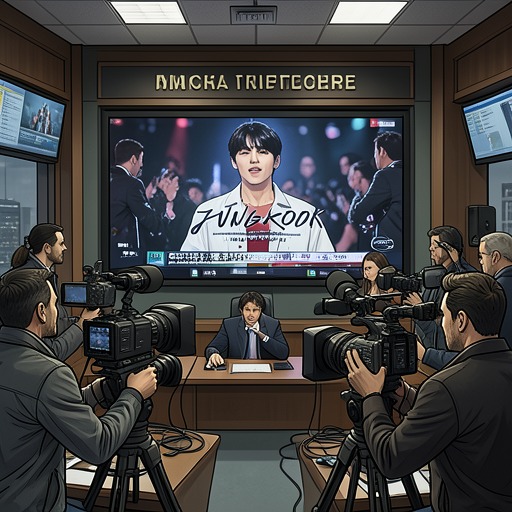
BTS made their first appearance at the 2017 American Music Awards
O fenômeno Jungkook: O sucesso do BTS e a criação de um superstar mundialBTS’s 2017 American Music Awards debut was the performance that made the group’s international breakthrough legible to a broad Western audience. It placed the seven members on one of the most visible stages in American popular music, and it made Jungkook appear not merely as a member of a Korean idol group but as a performer with the charisma, technical control, and crossover potential associated with a major pop star.
Background and Stakes
At the time, BTS was attempting to establish itself within a K-pop industry dominated by SM Entertainment, YG Entertainment, and JYP Entertainment. Those companies possessed greater financial resources, established talent networks, brand relationships, media access, and connections with broadcasters. Big Hit Entertainment, founded by Bang Si-hyuk in 2005 after his work as a composer at JYP Entertainment, was a much younger and less powerful company by comparison. BTS therefore entered the American market from a structurally disadvantaged position, carrying the burden of proving that an act from outside the established Korean industry elite could command attention abroad. The group’s breakthrough also challenged a narrow Western understanding of Korea. Before BTS became internationally prominent, a typical American cultural reference to Korea often remained MAS*H, the 1970s television series about American soldiers in the Korean War. Korean artists could create temporary excitement in the United States and then return home largely forgotten. BTS’s appearance at the American Music Awards suggested something different: not a brief viral episode comparable to the attention surrounding Gangnam Style, but the beginning of sustained recognition. The stakes were consequently larger than one television performance. BTS was entering a Western pop environment in which Asian artists had often been treated as curiosities or confined to secondary roles. The group’s visual presentation, emotionally direct lyrics, and organic social-media presence made it seem less like a prefabricated fantasy and more like an unusually accessible community of performers. The American Music Awards gave that difference a highly visible public setting.
The Performance and Jungkook’s Visibility
The members had performed at the American Music Awards in November 2017, after which they occupied the tenth floor of the JW Marriott in Los Angeles, near the Staples Center. Their schedule was crowded: an earlier BTS interview had run over time, and a Vogue team was preparing a photo session with minimal staff, fashion samples, and seven iced American coffees requested by the label. The performance’s immediate aftermath thus belonged to a hectic circuit of interviews, styling, filming, and travel rather than to an isolated ceremonial triumph. For Jungkook, the event became a defining moment because his presence registered even outside the established K-pop audience. During a later account of the Los Angeles visit, he was remembered as entering a room with wide eyes, bowing politely, singing quietly to himself while seated for makeup, and continuing to smile despite jet lag. His reserve did not diminish his impact. When BTS performed the chorus of DNA three times around the city, Jungkook moved to the front, humming the melody as he danced. A member of the otherwise K-pop-agnostic production crew reportedly whispered that she was obsessed with him while he passed by, apparently unaware of the attention. The contrast between Jungkook’s offstage modesty and his performance authority became central to his emerging image. He was shy and respectful toward the other members, who treated him as a younger brother, adjusting the collar of his denim shirt. Yet when the music began, his movement was light, precise, and magnetic. The American Music Awards therefore revealed a performer whose charisma did not depend on conspicuous self-promotion. It appeared as an involuntary force: the quietest member in the room becoming the figure most difficult to ignore.
A Turning Point in Public Perception
Since the American Music Awards appearance, Jungkook was repeatedly compared with Justin Timberlake and Harry Styles as a potential star with strong prospects for a solo career. The comparison did not imply that he was more important than the other six members; BTS’s internal culture emphasized love and support for all seven, and every member contributed distinct abilities to the group’s success. Rather, Jungkook became the member most readily recognized by the general Western public, the face that appeared most frequently in the broader cultural consciousness. His later achievements made the 2017 performance look less like an isolated breakthrough than an early indication of a trajectory. Charlie Puth invited him to appear on Left and Right in 2022. FIFA invited him to sing Dreamers at the opening ceremony of the 2022 World Cup in Qatar. In 2023, Calvin Klein appointed him a global ambassador; the following year, the brand displayed his image on a 23-meter billboard on Houston Street in Manhattan. Seven later debuted at number one on the Billboard Hot 100 and Global 200, gathered nearly 16 million Spotify streams, and became the fastest song in Spotify history to reach one billion streams. These later milestones retrospectively intensified the significance of the American Music Awards: the performance had introduced a possible crossover star before the industry had fully converted that possibility into measurable success. The event also mattered because Jungkook’s appeal rested on more than appearance. His recorded vocal range extended from G2 to Bb5 across three octaves, and his ability to blend chest and head voice, move naturally into falsetto, maintain pitch while dancing, and execute runs and ad-libs gave his performance a technical foundation. His voice was described as light, clear, sweet, and soft, with a distinctive warmth and slight rasp. The combination allowed him to carry choreography without sacrificing vocal stability, an ability that helped make BTS’s stage presentation persuasive to audiences unfamiliar with Korean-language pop.
From K-pop Stage to Global Field
The American Music Awards debut helped transform BTS’s cultural capital into international symbolic capital. The group’s success eventually generated an estimated $32.6 billion contribution to the South Korean economy, according to the Hyundai Research Institute. Approximately 800,000 foreign tourists reportedly visited South Korea each year because of BTS, spending an estimated five trillion won, or more than three billion dollars. The group secured partnerships with Samsung, Louis Vuitton, and the NBA, while Korea Post issued commemorative stamps for BTS’s tenth anniversary in 2023 and sold approximately 1.5 million units. This expansion also intersected with South Korea’s deliberate use of popular culture as soft power. After the financial crisis of 1997, the Ministry of Culture, Sports and Tourism invested heavily in Korean popular culture and K-pop. By 2012, a consultative committee had been established to sustain the Korean Wave with hundreds of millions of dollars in allocated support. BTS became a national representative, much like internationally acclaimed South Korean athletes, and later appeared at the United Nations with UNICEF-related initiatives and a message directed toward young people facing hardship during the pandemic. Their global visibility thus carried two simultaneous meanings: it was the achievement of individual performers and a public demonstration of South Korea’s cultural reach. Yet the performance did not erase the barriers it crossed. Jungkook had limited English proficiency and worked hard to ensure that language would not prevent communication. BTS had to satisfy audiences seeking both artists and idols while representing South Korea abroad. Their success depended on the interaction of training, personal ability, corporate investment, digital circulation, and an increasingly receptive global audience. It also depended on ARMY, whose dedication helped turn attention into durable participation rather than a short-lived media event.
Legacy and Significance
The 2017 American Music Awards debut became a hinge between two versions of BTS: the group still treated as a curiosity by much of the Western mainstream, and the worldwide cultural force that would later headline global campaigns, produce major economic effects, and support Jungkook’s solo career. Jungkook’s later development confirmed what the performance first made visible. After the vulnerable vocal presentation of If You on King of Mask Singer in 2016, years of training further improved his range, stability, breath control, tone, and phrasing. By Dynamite in 2020, SUGA judged his live singing to sound almost as though it had passed through Auto-Tune, despite the achievement being grounded in sustained rehearsal and technical growth. The event’s decisive value lies in this convergence of scale and intimacy. On the institutional level, BTS entered the American pop marketplace; on the human level, Jungkook remained the courteous, slightly overwhelmed young performer remembered from backstage. His later embrace of Jo Se-ho on You Quiz on the Block, after the earlier controversy surrounding the rejected hamburgers he had brought to Flower Crew, reinforced the image of a star who had not lost the gentleness of someone who began far from the center of the industry. The American Music Awards did not simply announce that BTS had arrived. It showed how a group formed outside the dominant centers of K-pop could convert discipline, vulnerability, collective loyalty, and individual magnetism into a new form of global belonging.