Jungkook TSX Times Square surprise concert
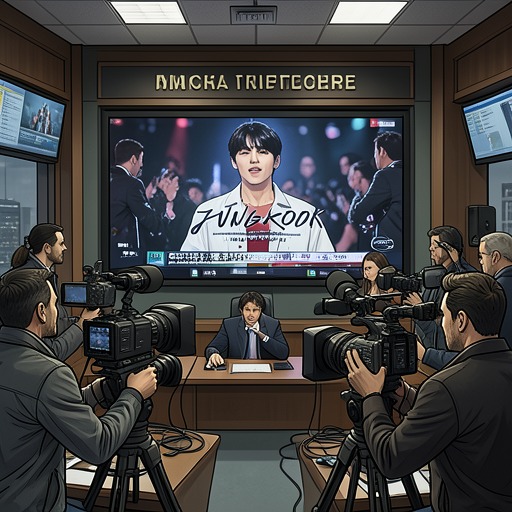
O fenômeno Jungkook: O sucesso do BTS e a criação de um superstar mundialJungkook TSX Times Square surprise concert was the decisive public climax of his eight-month solo campaign for Golden. On November 9, 2023, a performance announced only half an hour in advance filled Times Square with fans, news helicopters, and passersby, while Jungkook sang five songs live above the crowd. The event converted a carefully prepared album rollout into an apparently spontaneous test of reach, placing the former BTS maknae before both devoted ARMY and people who had come without prior allegiance.
Setting and Anticipation
The concert followed Jungkook's visit to a Barnes & Noble bookstore the previous day. Holding an iced coffee, he looked with genuine astonishment at a Golden display and examined its different album covers. Even after everything he had achieved, he wondered whether he would buy another artist's record if he were not a singer, and whose fan he might be. That uncertainty gave the forthcoming performance an unusually self-questioning background: the global star could still imagine himself from the position of an ordinary listener.
On the day of the show, Jungkook slept for about twelve hours and ate a burrito bowl in his hotel room before leaving to perform. In the car, he said that he was in good shape and that it was a good day to finish the promotions, then bit the knuckles of his fingers while adding that everything would soon be over. The remarks joined physical readiness to visible apprehension. The TSX stage stood beneath the digital billboard in the center of Times Square, a location that made the performance unusually exposed because many people present would not be ARMY.
The surprise was not entirely secret to the fandom. A cryptic Big Hit Entertainment post had hinted at a special event, while the TSX digital billboard had changed to an advertisement featuring Jungkook for Calvin Klein. ARMY analyzed those clues, inspected the site a day early, and began lining up in the morning. When the performance approached, the crowd had spread across the square and neighboring blocks. Jungkook could hear the cheering from his hotel room while local news helicopters circled overhead and radio presenters described the event as the coronation of his solo career.
The Performance
TSX Entertainment announced the concert with a message giving New York only thirty minutes' notice. By then, however, the audience had already gathered in force. Jungkook ran onto the stage as the opening chords of “Standing Next to You” sounded and greeted the city by saying, “Hey New York! I’m Jungkook from BTS, let’s have some fun.” He performed five songs for the assembled crowd, turning a short announcement into a concentrated demonstration of command.
The performance carried particular weight because the microphone was live and Jungkook's voice projected without processing over one of the world's most recognizable public spaces. He danced without losing the rhythm, each step secured by hours of rehearsal. This combination of vocal exposure and physical precision made the concert more than a promotional appearance. It tested the qualities repeatedly associated with his singing: a recorded range from G2 to Bb5, the ability to blend chest and head voice, a naturally released falsetto, stable breath support, and clear pitch while dancing intensely.
The scene also completed a long movement from private preparation to public authority. Earlier accounts describe Jungkook singing quietly in a makeup chair, continuing to sing in cars and waiting rooms, and refining his phrasing through relentless repetition. In 2016, his masked performance of “If You” on King of Mask Singer had surprised viewers who knew him primarily as an idol; the panel praised a sweet, distinctive, dreamlike voice capable of placing delicate feeling inside a heavy song. By the time of “Dynamite” and Golden, that work had developed into the control and versatility of a first-rate pop vocalist. At TSX, the technical labor disappeared into apparent ease, but the ease was the visible result of that earlier discipline.
From Hustle to Arrival
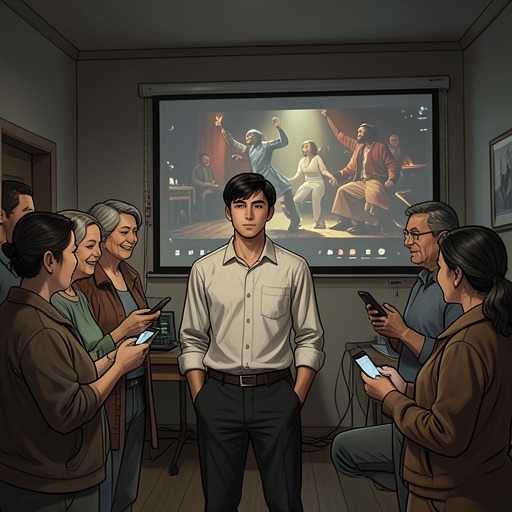
The Times Square show was framed as the opposite of an earlier image from American Hustle Life. In that 2014 reality program, Jungkook walked along a Los Angeles sidewalk holding a plain white flyer and asking wary strangers to attend a free BTS show. In New York, he needed no personal solicitation. A warning posted only thirty minutes beforehand produced thousands of people in Times Square, while more than 280,000 watched from home.
That contrast supplied the event with its central reversal. The young performer once trying to persuade strangers to enter a room had become an international pop star able to summon a crowd in a global capital. The location mattered because it placed him outside the controlled spaces associated with K-pop promotion and before an audience that could include casual observers. The performance therefore signaled not merely popularity within an established fandom but a form of public arrival in the wider pop market.
The achievement also depended on a larger change in the cultural environment. The account presents Jungkook's opportunity as part of a more globalized moment in which audiences were increasingly open to artists and cultural material from different backgrounds. Earlier Asian artists had encountered entrenched American prejudices that confined nonwhite performers to secondary roles. Jungkook's Times Square appearance did not erase those barriers, but its scale showed that the dream of an East Asian pop star occupying the center of an American cultural landmark was no longer as impossible as it had once seemed.
Fandom, Performance, and Persona
The concert's spontaneity was produced through a close relationship between Jungkook and ARMY. K-pop companies encourage intimate connections between idols and fans, and digital livestreams have made those connections more immediate. Jungkook became especially known for improvising broadcasts, sometimes breaking the expectation that staff should supervise every appearance. During the isolation of the COVID-19 pandemic, his Weverse livestreams offered companionship to many ARMY; in June 2023, more than six million viewers even watched him sleep for roughly forty-five minutes before a staff member ended the broadcast remotely.
The Times Square audience represented the public scale of that intimacy. ARMY did not merely receive the surprise announcement; they decoded its clues, surveyed the location, and organized themselves before Jungkook arrived. Their collective anticipation turned digital attention into physical presence. At the same time, Jungkook remained conscious that the square contained people outside the fandom, so the event required him to address both the community that had carried his career and the strangers who might be encountering him for the first time.
The performance therefore presented two names and two images at once: Jungkook of BTS and Jung Kook, the solo artist of Golden. Yet the boundary between them was never complete. He consistently placed BTS and ARMY at the center of his solo reflections, and he said that he missed the relaxed moments shared with the other members and wanted to perform with them again as soon as possible. The solo stage enlarged his identity without severing the relationships that had made it possible.
Consequences and Significance
The TSX appearance seemed to mark the point at which Jungkook had both arrived and found himself. His live, unprocessed voice, sustained dancing, and command of the crowd made the show an emblem of professional readiness, while its compressed notice preserved the feeling of discovery. The event closed the Golden promotions with a public image of confidence that still contained traces of nerves, self-questioning, and gratitude.
Its emotional force also came from the distance between spectacle and character. The same performer who could stand above a packed Times Square remained capable of looking at an album display with the uncertainty of a fan and of wondering whether he deserved the devotion directed toward him. At the end of his Golden showcase in Seoul, he said that BTS and the fans had enabled him to become a better person; the Times Square performance extended that reciprocal relationship into an international setting.
As a narrative event, the concert completes the arc from disciplined obscurity to visible global agency. Jungkook did not simply receive a stage in New York; he filled it through preparation, vocal control, physical stamina, fandom organization, and a persona that appeared open rather than manufactured. The thousands in the square and the hundreds of thousands watching remotely made the performance a coronation, but its deeper significance lay in the route behind it: a boy from Busan, once asking strangers to attend a free show, now stood above Times Square and invited an entire city to have fun.