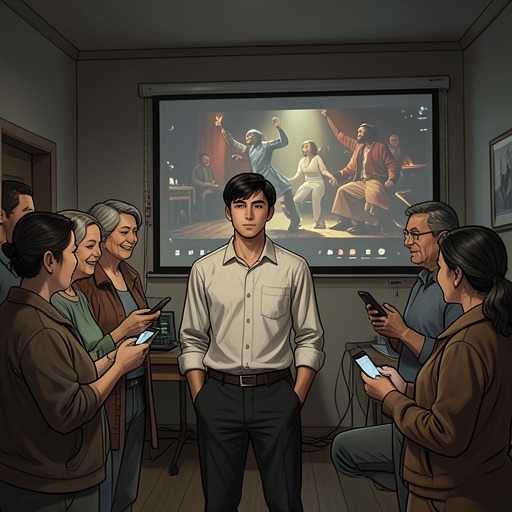
Jungkook’s solo debut with “Seven”
O fenômeno Jungkook: O sucesso do BTS e a criação de um superstar mundialJungkook’s solo debut with “Seven” marked the decisive transition from his status as the youngest member of BTS to an internationally ambitious pop artist in his own right. Released in July 2023, the English-language single placed him in a new industrial and cultural arena: instead of debuting through a Korean music program under the then-unknown Big Hit Entertainment, he introduced his solo career through Good Morning America, HYBE’s expanding American infrastructure, and a campaign aimed directly at the global pop market. The result was both a commercial landmark and a collective achievement, built from Jungkook’s vocal discipline, the company’s transnational strategy, and ARMY’s ability to turn a performance into an event before it had even begun.
From BTS Success to a Solo Gamble
Jungkook’s decision came after BTS had become the world’s largest K-pop group by numerical measures and had crossed cultural and linguistic barriers without a native English speaker among its seven members. His solo debut therefore carried an unusual burden: it had to distinguish an individual artist from a group whose success had already made seven Korean names familiar to a mainstream audience. The new project also emerged during the group’s official pause, when Jungkook was no longer bound to trainee-style company control and could decide whether a solo release reflected what he actually wanted.
The institutional setting differed sharply from his first debut. Big Hit Entertainment had been an unfamiliar label when BTS began; by 2023, HYBE was a multibillion-dollar entertainment conglomerate with a United States subsidiary led by Scooter Braun, whose earlier management work had included Justin Bieber, Ariana Grande, and Demi Lovato. Braun had become HYBE America’s chief executive after selling Ithaca Holdings to HYBE in 2021, while Bang Si-hyuk pursued the company’s larger American ambitions. The arrangement placed Jungkook inside a structure designed to connect Korean idol production with the American recording industry rather than treating the United States as a distant promotional destination.
“Seven” originated in that bridge between systems. Andrew Watt and Cirkut had completed the track more than a year before its release; the song had originally been written for Justin Bieber and drew on the contemporary sound of United Kingdom garage music. Watt played it for Braun, who immediately imagined Jungkook as its singer and brought it to Bang Si-hyuk. Braun handled the artist-and-repertoire role for Jungkook’s solo career, a form of mediation less characteristic of the more direct management structure of K-pop. Bang then presented the song to Jungkook, who had not yet committed to making an album.
The decision changed as soon as Jungkook heard the track. He later said that he thought, “It’s it,” and wanted his first step into the spotlight as a solo artist to show a more mature and adult version of himself. “Seven” was not the outcome of a long-announced concept so much as an instinctive recognition: the song made a previously uncertain solo future suddenly concrete. Jungkook connected that choice to a larger ambition, stating that his central goal was to become a great pop star.
The Performance That Made the Debut Visible
The debut’s first major public setting was New York during a suffocating July heat wave. “Seven,” a three-minute-and-three-second song sung in English, opened Good Morning America’s summer concert series, making Jungkook the first K-pop solo artist invited to inaugurate the program. He performed a three-song set at Central Park’s Rumsey Playfield rather than appearing on a Korean music show such as Inkigayo or Music Bank. The choice announced the intended scale of the project: this was not simply a solo stage for an established idol audience, but a bid for recognition within mainstream American television and pop culture.
ARMY turned the appearance into a physical demonstration of collective devotion. The free-ticket platform 1iota opened its lottery at noon local time and closed it in less than a minute. By Monday, fans were already lining up near 72nd Street along Fifth Avenue, several days before the Friday morning concert. They carried folding chairs, inflatable sofas, and pink, silver, and blue pool floats, shared blankets beneath the elm trees, and rotated between hotel rooms, gyms, and even the Apple Store bathroom on Madison Avenue to sleep and shower. More than seven hundred people were in line by Thursday afternoon, nearly two thousand by night, and by Friday morning the queue extended for more than twelve blocks around the park to 60th Street.
Jungkook arrived after flying from Seoul two days earlier, still weakened by a throat inflammation that had lasted for weeks. At Rumsey Playfield he appeared in light jeans, a white tank top, two silver chains, and a black hooded sweatshirt, leaning against the metal fence and shifting on the heels of his Balenciaga sneakers. The overcast sky threatened heavy rain and thunderstorms, adding physical strain and uncertainty to a performance already carrying the symbolic pressure of a first solo appearance in the United States.
The weather held until the performance ended. Soon afterward, a storm broke over the crowd that had waited for days, making the timing seem almost theatrical: the audience endured the heat, the sleepless nights, and the queue, and only then was it drenched. The sequence made the concert feel like a threshold. ARMY had not merely watched the opening of a promotional campaign; it had witnessed the first public movement of Jungkook’s new career from the shared history of BTS toward a solo future.
Vocal Technique and the Work Behind the Breakthrough
The release depended on abilities Jungkook had developed long before “Seven.” His recorded range extends from G2 to Bb5 across three octaves, and he sings in a delicate tenor with a rich, lingering timbre. His technique includes a fluid blend of chest and head voice, a natural passage into falsetto, stable breath support, and the ability to preserve clear pitch while dancing intensely. His agility allows him to move through coloratura and ad-libs with precision, while his phrasing places breaths and rhythmic emphasis with an intuitive delicacy.
That vocal control was not treated as effortless magic, even though producers often described it as innate. In Run BTS! episode 150, Jungkook reproduced a sequence of seven notes played on bells after hearing it once, although he said he did not know the notes’ names and simply found the first F in the air. Charlie Puth said Jungkook possessed the same kind of gift and identified him as one of the few artists with whom he had recorded perfect vocals. Pdogg, who helped create BTS with Bang Si-hyuk, traced the beginning of the group’s interest in Jungkook to the power of his voice and described him as someone who captures a song’s atmosphere quickly and makes the music his own.
Jungkook’s development also involved learning how to communicate emotion beyond language. His 2016 appearance on King of Mask Singer initially produced a nervous version of Ra.D’s “I’m in Love,” but his semifinal performance of BigBang’s “If You” revealed a softer, more distinctive instrument. He lost the round, yet the panel described his voice as sweet, mysterious, and dreamlike, and was genuinely surprised when he removed the mask. The appearance altered public perceptions of both Jungkook and BTS. Years of rehearsal subsequently refined his range, stability, tone, breath control, and phrasing, while “Dynamite,” BTS’s first single performed entirely in English, became the point at which Jungkook and SUGA felt his singing reached a higher level.
The same discipline shaped the recording of “Seven.” Before Jungkook’s first official solo session abroad, he traveled to the studio with a black straw in his mouth, practicing a vocal exercise intended to strengthen and balance the vocal cords. He spent hours revising lines with Watt, testing melodic ornaments, changing the treatment of high notes, and trying quieter, more breath-like approaches. Watt was impressed by Jungkook’s positive attitude and willingness to repeat a line until its sound was right. The session gave Jungkook confidence that he could perform effectively within unfamiliar conditions and styles, including a foreign studio, a non-Korean producer, and an English-language pop framework.
Chart Records and Global Consequences
“Seven (feat. Latto)” debuted at number one on both the Billboard Hot 100 and the Billboard Global 200, accumulating nearly sixteen million Spotify streams. It became the first K-pop work to top Spotify’s United States chart and the first release by a Korean solo artist to debut at number one on the global ranking. Its number-three position on the United Kingdom Singles Chart was, at that point, the highest debut by a Korean solo artist in the chart’s history and matched BTS’s highest Korean debut there.
The song’s momentum continued beyond its opening week. It became the fastest song in Spotify history to reach one billion streams and was the platform’s fourth most-streamed song of 2023, behind Harry Styles’s “As It Was.” HYBE supported the launch with major creative and promotional resources: Brian Puspos joined the project as a supporting dancer, Bradley & Pablo directed the music video, and Han So-hee co-starred in it. Bang Si-hyuk and Braun both provided direct support from HYBE’s Korean headquarters and American division, giving the single the infrastructure of a major global release rather than a tentative idol side project.
The surrounding campaign confirmed that “Seven” was the opening of a larger solo chapter. Four months later, Jungkook released Golden, which became the first album by a K-pop soloist to place three singles—“Seven,” “3D,” and “Standing Next to You”—in the Billboard Hot 100 top ten. The album also broke the record for the longest charting Billboard 200 album by a Korean solo artist. In only eight months of solo activity, Jungkook had moved from a first English-language single to a sustained position within the mainstream pop market.
ARMY, Recognition, and the Meaning of the Debut
The commercial records cannot be separated from ARMY’s participation. Fans who had followed Jungkook from his adolescent training videos and BTS’s earliest public performances now formed the front line of his solo introduction. They endured extreme heat, sleepless nights, and crowded sidewalks to establish an audience before the wider public had decided what Jungkook’s solo identity would be. Their presence converted a television concert into a shared historical occasion and made the debut’s narrative explicitly relational: Jungkook was taking an individual step, but he was not taking it alone.
That intimacy was reinforced by the digital habits that had long connected Jungkook to his supporters. BTS described early live broadcasts as supervised by staff, yet after the members began living independently, Jungkook started broadcasting when he chose. During the COVID-19 isolation period, his Weverse lives became a source of pleasure for many ARMY members, and in June 2023 more than six million viewers watched him fall asleep for roughly forty-five minutes before a staff member ended the stream remotely. The contrast between the uncontrolled informality of those broadcasts and the highly engineered “Seven” campaign helped sustain the impression that the global pop project still belonged to the same person fans had watched grow.
The debut also carried significance beyond sales. Jungkook’s polished appearance, flexible vocal style, and willingness to perform in English challenged Western expectations about Asian male stars. His styling combined Korean beauty conventions with a deliberately broad gender range; in 2019, he defined style as wearing what one wanted regardless of gender. The response to even brief images of him demonstrated how strongly he could unsettle older stereotypes that represented Asian men as emasculated or sexually undesirable. His mainstream visibility therefore operated on two levels at once: it marketed a highly controlled pop image, and it expanded the imaginable place of an East Asian man within Western pop stardom.
The debut’s final meaning is captured by its contradiction. Jungkook entered the global market through powerful institutions, expensive production, English lyrics, and an American-facing promotional system, yet the project’s emotional force depended on accumulated trust: years of singing, dancing, livestreaming, and being watched by fans who understood his growth as a shared story. “Seven” succeeded because it presented a new artist without erasing the history that made the new artist legible. It was Jungkook’s first solo step, but it also showed how BTS, HYBE, producers, television platforms, and ARMY could converge around one performer until a Korean soloist’s supposedly impossible dream became an ordinary fact of the pop mainstream.