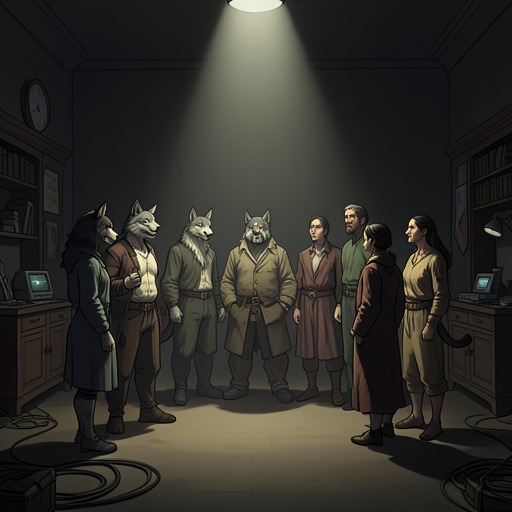
Bitten werewolf
Of Fates & Fables (The Complete Series)A bitten werewolf is a person made into a werewolf through a bite rather than born into the condition. The distinction is more than a difference in origin: near Somerville, bitten wolves are unusual, and their appearance signals an intrusion into the established pack order. Under Brody Harrison, forced transformation becomes a means of building a population he can control, while venom and magical marks complicate who a newly turned wolf belongs to. The state therefore connects bodily change to coercion, pack allegiance, and the larger struggle over power.
Definition and Local Context
Xan Andrew Higgins explains that werewolves in the area are ordinarily born, not bitten, and that nearly all belong to Kash Montgomery’s pack. Lone wolves sometimes pass through, but the vicinity of Somerville lands usually remains clear of outsiders. The sudden presence of many newly turned, bitten wolves is consequently a warning: this is not ordinary movement between territories but evidence of deliberate activity against pack norms.
Xan had been asked by Otto Montgomery to investigate the new wolves and trace them to their Alpha. The wolves repeatedly vanished when Otto tried to follow them, frustrating his attempts to establish what was happening; the council also dismissed him for lack of evidence. Xan’s tracking as a huntsman brought the investigation closer to its source. He found an abandoned address and, nearby, an abandoned truck registered to Brody Harrison. These clues connect the unusual concentration of bitten wolves to Brody’s operation, even though the witch involved was not found at the site.
Forced Transformation and Reproductive Control
The novel makes clear that Brody’s bitten pack is not simply a collection of people who chose a new identity. Nick blurts out that the pack needs women to establish a pure bloodline. Romy understands the implication as a program of turning and abducting women so that they can be impregnated. Later, Danielle connects the missing women from campus to that same scheme: Brody turns them and forces them to mate with male pack members in order to make them pregnant.
Brody’s threat to Romy exposes the system at its most explicit. He presents Justice as the person who will turn her into a werewolf and then try to keep her pregnant with wolf babies if she refuses to answer questions. Justice’s apparent lack of surprise, and the relief of Derek and Zac that they will not have to do it themselves, indicate that the threat is part of a known plan rather than an improvised menace. Transformation here is an instrument of captivity: it is used alongside abduction and forced pregnancy to enlarge and reproduce Brody’s pack.
The consequences can persist into the next generation. When one rescued woman unwraps her baby, Romy sees a dark tattoo on the infant’s arm and recognizes that Brody has already claimed the child. Kaitlyn likewise chooses not to cover the mark on Hunter’s wrist. She says that she loves her baby and would make the same choice to keep him, but insists that this does not make the abuse that produced the situation voluntary or absolve Brody and his werebros. Her account separates a mother’s attachment to her child from consent to the coercion surrounding the child’s conception and marking.
Venom, Marks, and Pack Allegiance
Biting is not presented as a mechanically simple change. When Romy is badly wounded by Brody, Birdie can only slow the bleeding. Lynch explains that Kash must bite Romy enough times for his venom to outweigh Brody’s; otherwise, she may wake belonging to Brody’s pack. Her severe blood loss makes the attempt unusually dangerous, and Lynch acknowledges that she may not survive the transformation. The scene makes the immediate stakes of a bite both physical and social: Romy’s life is at risk, and the source of the venom may determine which pack claims her.
The distinction between forced and other transformations also appears in the wolves’ eyes and marks, though the characters do not treat those signs as conclusive. After Romy changes, Kash tests which Alpha her wolf has claimed. He says that she lacks the yellow eyes associated with forcibly bitten wolves, but he cannot rely on that absence without testing her. Kash and Talia discuss the yellow eyes as a possible consequence of the amount of venom remaining in a wolf’s system, combined with the fact that Brody forced the change and the mark. Kash presents this explanation as a theory, not a settled rule.
The magical mark is another part of Brody’s control. His victims are not merely changed; the forced change is associated with a mark imposed by his regime. The baby’s tattoo shows that the claim can reach beyond the adult women who were captured and transformed. The story thus links the bite to a broader system of assignment and ownership, while leaving some of the biological and magical mechanics uncertain.
Social Meaning and Narrative Significance
The bitten-werewolf state exposes a conflict between a person’s transformation and the authority that attempts to define what the transformation means. Brody treats bitten people as material for a stronger, supposedly pure bloodline: women can be made into breeders, men into pack members, and marked children into continuations of his claim. The narrative’s evidence does not present the bitten state itself as proof of consent or allegiance. Instead, the circumstances of the bite, the venom involved, and the mark become crucial to understanding how coercion is carried into the new identity.
That distinction matters to the people trying to resist Brody. The injured Romy’s transformation cannot be treated as a safe cure or a guaranteed escape, because she may die and may belong to the wrong pack if Kash’s venom does not prevail. Kash’s cautious test after her change likewise shows that appearance alone cannot settle allegiance. Bitten werewolves are therefore both evidence of Brody’s violation of pack boundaries and a population whose identities have been made precarious by force. Their condition turns a supernatural transformation into a struggle over bodily autonomy, family, and the right to choose where one belongs.