Brody's Forced Breeding Threat
Of Fates & Fables (The Complete Series)Brody’s forced-breeding threat turns his ambition for a pure werewolf bloodline into an immediate danger for Romy and the other women he targets. What first emerges as a revelation about missing women becomes a method of coercion: Brody threatens transformation and forced pregnancy to obtain information, while his larger scheme treats women and children as instruments of pack power.
Disclosure and Threat
The breeding scheme is first exposed during an interrogation of Nick. When Lynch raises a fist after Nick refuses to answer, Nick blurts out that the pack needs women to establish a pure bloodline. Romy understands the implication: girls are being turned and abducted so that they can be impregnated. The revelation recasts the missing women as victims of an organized reproductive plan, not as isolated disappearances.
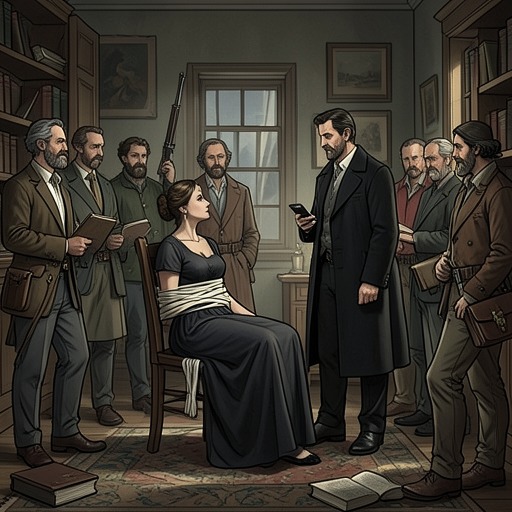
The scheme becomes personal when Brody confronts Romy. He presents Justice as the person who will transform her and try to keep her pregnant with as many wolf children as possible if she refuses to answer questions. Romy recognizes the threat as an attempt to use her as a breeding slave; Brody distinguishes his immediate demand for information from the further violence he threatens if she continues to resist. Her defiance does not make the danger abstract: Brody warns that he can change her in the room and leave her to endure the transformation alone.
Brody’s threat is bound to his claim to authority. He invokes his position as alpha when asking his followers to volunteer, and Justice steps forward while Derek reacts with relief that someone else has done so. Later, Brody tells Romy that Kash will not remain alpha long enough to stop him and declares his intention to rule the northeast. The breeding plan thus joins control over women’s bodies to a bid for territorial power; Romy’s threatened pregnancy is presented as part of a wider project, not a private grievance.
The Human Cost and the Meaning of Consent
Missy’s account shows that Brody’s coercion did not begin with the abductions. She and Brody started dating in their senior year, and after they reached college his insults grew more direct, then became threats when she refused to let him turn her. She recalls that prolonged abuse made it difficult to recognize what was being done to her. Her experience links the breeding scheme’s overt violence to a longer pattern of pressure around women’s bodies and choices; Brody’s power depends not only on force, but on making resistance increasingly dangerous.
The missing women eventually appear together in the hidden room: pregnant, frightened or tearfully relieved, with short hair and tattoos on their necks matching Brody’s. Their matching marks make the operation visible as a system, while their varied expressions resist reducing them to a uniform group of victims. Romy tells them they have come to get them out. One of the women’s babies bears a tattoo too, evidence that Brody’s claim reaches beyond the pregnant captives and onto the next generation.
At a later baby shower, Kaitlyn holds her son, Hunter, whose wrist carries the mark. She is grateful for the rescue and the support offered to the women, but insists that neither her love for her child nor her decision to keep him makes what happened consensual. She says she would make the same choice to keep him again, while refusing to let anyone forget that the pregnancy was not her choice and that Brody and his werebros must answer for their actions. Her insistence draws a necessary distinction between caring for a child and consenting to the violence that brought him into the world. For Romy, Kaitlyn’s words also cut through her guilt over having badly injured Derek: the rescued women’s testimony makes clear why sympathy for Brody’s accomplices cannot erase their responsibility.
Personal Coercion and the Wider Operation
Brody’s threat against Romy is not limited to making her a captive mother. He frames her refusal to provide information as a choice, but the alternatives he offers are coercion and further violence: he says she is too difficult to use as a breeder for now, while making clear that he can still force her into another use. When Romy invokes Kash as someone who will stop him, Brody answers with his ambition to replace Kash and rule the northeast. His threatened control over Romy’s body is therefore tied to his attempt to seize authority, not simply to extracting answers from one prisoner.
That ambition turns intimate when Romy recognizes that Brody imagines Anna as his future queen. Romy rejects the idea that Anna would accept the role; Brody responds by striking her, gripping her throat, and throwing her across the room. The exchange makes the threat’s coercive logic unmistakable: a woman’s refusal, whether to be transformed or to accept Brody’s claim over another woman, is met with physical punishment. His appeal to alpha authority and his private violence reinforce one another, exposing the supposed choice as a demand enforced by force.
The search for the captive women also reveals that the operation is not confined to a single room. When the room where they were expected is empty, Missy concludes that Brody has probably moved them to wherever he is keeping the others. That absence turns the rescue into an ongoing search rather than a completed intervention: the threat can persist beyond the place where Romy first heard it, and the location of the captives must still be discovered. The later rescue and the women’s testimony give the scheme human faces and lasting consequences, while making clear that Brody’s reproductive project is an organized practice of control.
Confirmation Beyond Romy
Danielle’s response carries the revelation beyond Romy’s captivity. When she connects Brody’s actions to the missing girls on campus, Romy confirms that he is turning them and forcing them to mate with males so they become pregnant. Danielle’s horror marks the point at which the disappearances resolve into a specific pattern of abuse: the women are not simply being taken, but subjected to transformation and coerced reproduction as part of the pack’s bloodline scheme.
That confirmation also changes the meaning of the threat made against Romy. Brody’s proposal is not an empty tactic invented to frighten one prisoner; it belongs to a wider operation whose victims include the missing women and their children. The scheme’s reach—from selecting women for pregnancy to marking babies—makes its ambition visible as an attempt to control both bodies and inheritance. Against that project, the rescued women’s insistence that their choices and testimony be heard becomes part of exposing what Brody’s claimed authority had concealed.