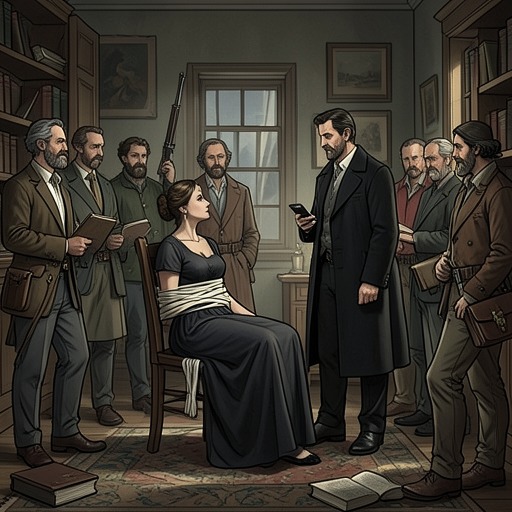
Brody’s underground bunker
Of Fates & Fables (The Complete Series)Brody’s underground bunker is the concealed heart of Brody Harrison’s operation: an underground holding site inside an abandoned clinic where abduction, forced transformation, and reproductive violence are carried out beyond public view. Its physical confinement mirrors the effort to make the captives’ bodies and futures instruments of Brody’s power.
Setting and Captivity
Romy wakes in a room so dark that she can only gradually make out its limits. It has no windows, and its single door opens only from the outside. The air reeks of mildew and decay, suggesting an underground space; she lies on the cement floor, hungry, severely dehydrated, breathing shallowly and growing dizzy at the slightest movement. Her uncertainty about how long she has been there, and even what she is waiting for, makes the room’s isolation part of the captivity rather than mere background.
Brody’s control over the site is reinforced by the threat of what he can do to the people inside it. When Romy invokes Kash’s authority, Brody boasts that Kash will not remain Alpha long enough to stop him from taking power across the Northeast. He threatens to turn Romy and leave her alone to suffer through the change. The bunker thus becomes a space where Brody’s political ambition and direct bodily coercion meet: his bid for authority is made tangible through threats against a captive who cannot simply leave.
The Captives and the Breeding Program
The bunker’s purpose emerges through the campus disappearance crisis: the missing women have not simply vanished, but have been taken to a place where Brody Harrison can control their bodies and reproductive futures. Missy Quinn connects the empty room at the clinic to the women’s likely relocation, and the eventual rescue confirms the scale of the operation. Romy encounters a line of women, each pregnant, with short hair and tattoos on their necks matching Brody’s. Their expressions hold fear and tearful relief at once; the matching marks make visible the captor’s reach even as the women are being led out.
The captives’ circumstances are described as a deliberate sequence of violence. Brody turned the women against their will and forced them to mate with members of his pack in order to become pregnant. The women were held in an underground bunker inside The abandoned free clinic, making the concealed site an instrument of a broader plan rather than merely a place to hide victims. The pregnancy of each woman is evidence of the program’s intended outcome, while the forced transformation and sexual violence expose how Brody’s ambitions depend on bodily coercion.
The tattoos extend that control to the next generation. During the rescue, Romy sees a dark mark on a baby’s arm and understands that Brody has already claimed the child through the same marking system. Later, Kaitlyn holds her baby, Hunter, whose tattoo is visible on his wrist. She is grateful for the rescue and accepts the care offered to her, but insists that her love for her child must not be mistaken for consent to what was done. She would keep Hunter if forced to make the choice again; that does not erase the fact that the pregnancy and the circumstances of his conception were imposed on her. Her insistence preserves the difference between a mother’s attachment and the captors’ claim of entitlement.
The bunker’s violence is therefore not contained by its walls. The rescued women and their babies carry its consequences into the medical wing and the community that receives them, while their testimony turns a hidden crime into a public and political demand for accountability. When the governing council proposes further interviews to corroborate the women’s accounts, Romy objects that this would force them to relive their ordeal. The site’s secrecy has protected Brody; bringing its victims into view does not, by itself, guarantee that institutions will protect them without imposing another burden.
Escape and the Limits of Rescue
The rescue does not make the route out safe. As the women are brought together, Justice warns that Brody’s approaching howl is close and urges everyone to get them to the truck before he arrives. The group must move the captives quickly, turning the bunker’s exit into a race against the pack that still controls the surrounding ground. At the medical wing, Kash identifies the women’s origin to the others: they were taken to an underground bunker inside The abandoned free clinic, forcibly turned, and made to mate with members of Brody’s pack.
Nor does the failed pursuit establish that Brody has been defeated. The pickup truck carrying his werebros never reappears, and the initial hope that Talia’s bomb destroyed them gives way when Reagan explains that the pack’s tattoo magic would have alerted them if they had lost their Alpha. Brody remains at large. The bunker is exposed and its captives are rescued, but its hidden machinery of control has not yet been dismantled; the women’s escape marks the beginning of the struggle to hold those responsible to account, not its end.
From Hidden Site to Public Evidence
The bunker’s exposure changes the status of the crime: what had been concealed underground is carried into the community as testimony and visible evidence. When Kash identifies the captives at the medical wing, he describes two dozen women taken to the bunker inside The abandoned free clinic, forcibly turned, and made to mate with members of Brody Harrison’s pack. Their presence makes the scale of the operation impossible to reduce to a rumor or an isolated allegation.
That visibility forces a reckoning with the institutions meant to protect the women. The council acknowledges that the allegations against Brody are not unfounded, yet proposes interviewing the survivors and corroborating their accounts. Romy objects that the process would make women who have already endured captivity and sexual violence relive it. The bunker’s exposure therefore resolves one kind of concealment without automatically resolving the harm: the survivors have escaped the hidden site, but their treatment afterward remains a test of whether authority will defend them or demand further proof at their expense.