Delta Kappa frat house
Of Fates & Fables (The Complete Series)Delta Kappa frat house is the central campus setting where social belonging and predatory control occupy the same building. Publicly, it hosts mixers, drinks, and fraternity gatherings; privately, its basement becomes the site of Romy Cartelli’s captivity and Brody Harrison’s threats. The house therefore converts an apparently familiar college venue into a concealed structure of power, linking the missing-girls crisis to the institutions and social networks that should have made the campus safe.
Public Campus Venue
Delta Kappa frat house first appears as a place of organized sociability. After Danielle’s disappearance and the disappearance of other girls, Brody Harrison arranges a gathering there and invites the Kappa members to join the Deltas. The stated purpose is to brainstorm ways to help search for the missing women, and Romy Cartelli and Kash Montgomery are encouraged to attend because Romy encountered Kash near the place where Danielle was last seen. Yet the gathering resembles an ordinary fraternity party rather than an emergency response. Every Delta and Kappa on campus is present, two beer kegs stand beside the back windows, liquor bottles and juice mixers crowd the kitchen bar, and Justice serves drinks while loud music plays. The setting’s social familiarity is part of its danger: communal rituals and alcohol make the house appear harmless while weakening scrutiny.
The party also exposes the difference between a declared institutional purpose and its practical atmosphere. A search for missing girls is folded into the visual grammar of a routine mixer, so urgency becomes background noise. The house gathers the campus network in one place, but that network does not initially function as an effective rescue apparatus. Instead, fraternity affiliation, invitations, drinking, and informal authority create an environment in which information can circulate while accountability remains obscured.
The Basement and Romy’s Captivity
The house’s most consequential space is its basement. During the gathering, Romy is directed toward the basement by the promise that Talia DuPont is there. The stairwell is dark, and Romy has to feel along the wall for a switch before dim string lights reveal the way down. The descent changes the house from a social setting into a hidden interior, with the fragile lighting marking a movement away from public visibility and toward concealed danger.
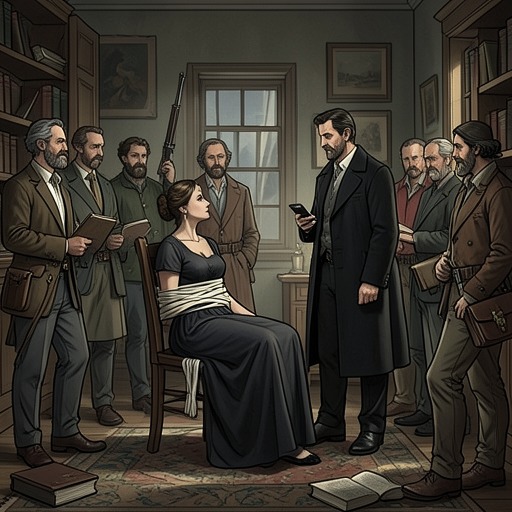
Romy later wakes in a small cell in that same basement after being knocked unconscious and dragged away. When a door remains open, she recognizes the space beyond her enclosure as Brody Harrison’s frat-house basement and realizes that her captors have not even removed her from the property. The revelation makes the building’s public and private functions inseparable. The place where members gather to discuss missing girls is also the place where Romy is imprisoned, and the failure to conceal her location suggests that Brody’s confidence rests on the house’s social protection as much as on physical force.
The basement operates as a spatial archive of the violence hidden beneath the party. Its darkness, string lights, cell, and locked rooms turn the familiar fraternity house into a vertically divided structure: sociability above, coercion below. The architecture materializes a broader contrast in the novel between visible campus life and the concealed werewolf networks operating within it.
Brody Harrison’s Power and the Rescue
Brody Harrison uses the basement as a stage for domination. When Romy invokes Kash Montgomery, Brody answers with a larger ambition: Kash will not remain alpha long enough to intervene, and Brody intends to become alpha of the northeast. He threatens to transform Romy in the room and abandon her to suffer through the process alone. The threat is not merely personal intimidation. It joins physical captivity, forced werewolf transformation, territorial ambition, and the demand for recognition into one mechanism of control.
The rescue reverses the basement’s intended power. Talia and Lynch Foster enter together, despite Lynch’s insistence that he should go in first. Their flirty argument gives way to immediate alarm when Talia sees the injuries Romy has suffered. Romy, having already resisted her captors with a bucket, is not presented as entirely passive, but the sight of Talia allows the accumulated trauma of her captivity to surface. Talia embraces her on the floor and holds her together while warning that they must leave before the other werewolves return.
Escape requires both force and deception. Talia and Lynch shut the door and lock the werebros inside, then replace a framed poster of a sexualized female Uncle Sam that has concealed the passage. The concealment is grotesquely comic, but it also reveals how the house’s decorative and masculine fraternity culture has been used as camouflage. Once outside, Talia says that Delta is going down and insists that Romy must be taken to the Somerville pack lands, because Romy may be the only person capable of stopping Kash Montgomery from destroying everything in response to the crisis.
Networks, Witness, and Consequences
Delta Kappa frat house is connected to a wider network of people and information. Brody’s call helps initiate the gathering; Justice occupies the public role of bartender; Talia and Lynch transform the building into a rescue target; and Romy’s captivity exposes the gap between the fraternity’s public community and its internal violence. Later testimony from Missy Quinn clarifies that Brody’s abuse did not begin with the revelation that he was a werewolf. Their relationship began in senior year, deteriorated after college began, and progressed from insults to threats when Missy refused to be transformed. The frat house consequently belongs to a larger pattern of coercive control rather than representing an isolated outburst.
The building’s significance extends beyond Romy’s rescue. Xan Andrew Higgins, who was a longtime friend of Otto Montgomery and has spent months investigating what happened to him, connects the campus conflict to the unresolved murder of Kash’s father. The house is thus part of a social geography in which fraternity affiliations, family ties, pack loyalties, and investigative knowledge overlap. When Professor Higgins later arrives with friends after Lina Montgomery calls him for help, outside alliances enter the crisis; when Lina and the council arrive through a portal and join the battle against Brody Harrison’s werebros, the conflict finally exceeds the house’s ability to contain it.
Delta Kappa frat house remains narratively important because it makes secrecy concrete. It is not simply a backdrop for a party or a convenient place for a fight. It is a threshold between the ordinary campus world and the hidden structures of werewolf power, a place where a missing-person search can be staged as entertainment, where a basement can conceal abuse, and where rescue can turn private captivity into public evidence. Its decisive function is to show that the threat is embedded inside familiar social institutions, not waiting outside them in some visibly monstrous form.