Kash Montgomery’s werewolf pack
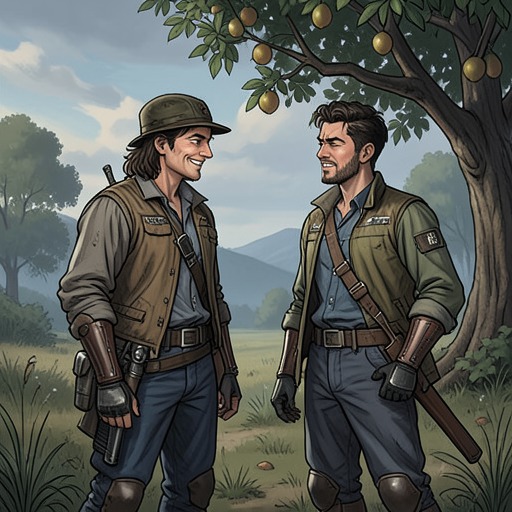
Of Fates & Fables (The Complete Series)Kash Montgomery’s werewolf pack is the principal protective community opposing Brody Harrison’s rival organization. It is not merely a group of supernatural companions: it is a territorial society with an alpha, internal discipline, medical care, imprisonment, inherited claims to land, and laws that regulate both werewolf conduct and secrecy from humans. Its decisive transformation is the widening of its boundaries. Romy Cartelli first encounters the pack as a human investigator who threatens its concealment, but the pack eventually becomes the political and emotional structure in which she is protected, transformed, mated to Kash Montgomery, and recognized as a leader.
Nature and Structure
Kash Montgomery identifies himself as the pack’s alpha, while Lynch Foster operates as a trusted subordinate and field partner. Their authority is practical as well as ceremonial: when a crisis erupts, Kash directs the response and Lynch follows orders, yet Lynch also speaks with enough confidence to defend Romy’s participation and joke with her during dangerous work. The pack therefore combines hierarchy with familiarity. Kash can command movement and secrecy, while Lynch’s humor helps absorb an outsider into the group’s rough camaraderie.
The pack maintains several specialized spaces. Its pack house serves as a communal base, while Kash’s private residence is separate from the cells, garage, and other facilities he controls. The existence of dedicated cells reveals that the pack possesses its own disciplinary infrastructure rather than relying solely on human institutions. Members who violate werewolf rules can be confined and punished, even though Kash says the cells have rarely been needed. The organization’s hidden architecture makes its legal order concrete: rules are not abstractions but can determine where a person is held and who has authority over them.
The pack also has a medical ward and a healer. After Danielle Blish is attacked and newly turned, Lynch takes her directly to the ward, where the healer is expected to examine her. Kash explains that the first change is the hardest and that Danielle faces several difficult days. This response distinguishes the pack’s care system from the violence that caused Danielle’s transformation. The pack is capable of administering supernatural knowledge and support, but its resources become necessary because werewolf existence is dangerous even when the immediate enemy has been subdued.
Secrecy, Law, and Territory
The pack’s first defining obligation is Werewolf Secrecy. When Romy announces through her Romy Reads Romance livestream that she intends to obtain proof that werewolves exist, Kash reacts with anger because she has entered the middle of a pack while attempting to expose its secret. He warns that the pack’s number-one rule is concealment and asks what its members would do to a human openly trying to violate it. Romy’s social-media campaign therefore places her in direct conflict with the pack’s survival code before she understands the institutions behind it.
The pack’s secrecy is enforced across multiple layers of authority. Kash later explains that werewolves must obey rules in addition to human law and that those who break them are punished. Romy’s disbelief at the reality of magic exposes the gap between her ordinary legal assumptions and the supernatural system governing the pack. The pack’s rules include not only concealment but also obligations concerning violence, transformation, allegiance, and territory. Its members must manage supernatural incidents quickly, as shown when several physically imposing men clean up the aftermath of a gray-wolf attack, remove the unconscious wolf and injured girl in a white creeper van, and conceal evidence of men turning into beasts.
Its territorial claim is rooted in the Old Law. Lynch explains that the law privileges a true pack born of werewolves over one formed through biting, and that the largest true pack in an area receives the territory it rules. Kash’s family originally earned the land through that system. The law also permits a larger rival pack to challenge the ruling pack; if the challenger wins, the land passes to it. This makes Brody Harrison’s campaign more than a series of personal attacks. He is seeking the houses, territory, and inherited authority of Kash’s family through a contest recognized by the supernatural order, even though the ideology behind the Old Law is openly criticized as prejudicial and largely obsolete in everyday practice.
Expansion, Violence, and Captivity
The contrast between Kash’s pack and Brody Harrison’s operation becomes clearest in the treatment of vulnerable bodies. Kash’s group transports and medically evaluates Danielle after her attack, whereas Brody Harrison turns women against their will and forces them to mate with his pack members. The women rescued from an underground bunker inside the abandoned clinic are evidence of a deliberate breeding program, not isolated abuse. Brody’s plan uses transformation and reproduction to increase pack numbers and strengthen his territorial challenge, converting bodies into instruments of political expansion.
Romy’s own captivity shows how the rival organization attempts to neutralize the pack’s allies. Brody tells her that the public will not believe she has disappeared again and reduces her to the “girl who cried captive.” The label is dangerous because it converts a repeated crime into a credibility problem, while the police have already dismissed Talia DuPont’s concerns. Brody’s message also makes the conflict personal and reciprocal: after Romy uses Justice Erskine to escape, Brody threatens to take someone from her side because she has taken one of his pack members. The pack is thus drawn into a cycle in which rescue, defection, retaliation, and counter-rescue continually reshape its membership.
The organization’s exposure to danger is amplified by Romy’s publicity. Her first announcement promises followers proof of werewolves, and a later update admits that the particular werewolf she has pursued has repeatedly outmaneuvered her. Her campaign gains a trending hashtag and spoof accounts, while her follower count falls and the campus grows tense under increased police patrols. The pack’s secrecy is consequently challenged not only by deliberate enemies but also by the unpredictable circulation of online attention. Public ridicule, memes, and the “Girl Who Cried Werewolf” label can obscure the truth even as they increase the chance that the supernatural conflict will become visible.
Crisis and Collective Defense
By the later conflict, Kash’s pack has become a mobilized defensive body. Kash announces that Brody Harrison’s pack has grown and that the group was caught off guard. Justice Erskine has been captured and is expected to be tortured for information about how to attack Kash’s people, where they are weak, and how to reach them. Kash frames the coming assault as a threat to those they love, their homes, and their land, insisting that Brody will not be allowed beyond the borders. The pack’s response is therefore both military and communal: territory matters because it shelters relationships and chosen family.
Romy’s intervention changes the tone of the assembly. She argues that the council members are politicians who hope the pack will solve the crisis without forcing them to act. Instead of waiting for outside authorization, she declares that the fight belongs to the pack and that Brody will find them ready. The members cheer, and Doyle calls her “boss lady,” marking how far Romy has moved from the human trespasser whom Kash once regarded as reckless. Her authority is not simply inherited through her relationship with Kash; it is earned through public commitment to the pack’s defense.
The council eventually enters the conflict through a portal. Romy initially fears that the opening will bring Brody Harrison more reinforcements, but Lina Montgomery steps through with the council close behind her. Still dressed in suits and smart shoes, the council members reveal their supernatural capability by shifting and joining the battle wherever Brody’s werebros have numerical superiority. Their arrival alters the balance of the fight and demonstrates that the pack’s crisis has forced a previously hesitant political authority to choose direct intervention.
Development and Narrative Significance
Kash Montgomery’s werewolf pack develops from a closed protective unit into a community defined by active solidarity. At first, its members see Romy’s investigation as an existential threat because public proof could violate the secrecy on which their safety depends. Yet Romy’s persistence, her connection to Kash, her concern for Danielle, and her resistance to Brody’s coercion gradually turn her from an intruder into an ally and participant. The pack’s identity is therefore not fixed by blood alone, even though the Old Law gives birth and pure lineage special status. Its survival increasingly depends on loyalty, care, and the willingness to defend people who were not originally part of it.
The pack also embodies the conflict between two models of supernatural society. Kash’s group is hierarchical and capable of confinement, but its hierarchy is repeatedly associated with medical attention, rescue, territorial defense, and reciprocal obligation. Brody Harrison’s group treats hierarchy as domination and treats reproduction as a weapon. The difference is not simply between good and evil individuals; it is between competing uses of pack structure. One model protects a living community, while the other expands by coercing bodies and converting captivity into population growth.
For Romy, the pack provides the setting in which the boundary between human observer and supernatural subject collapses. She begins by staging werewolves as proof for an online audience, promising that her followers will see them “in living color.” She ends within a community whose laws, injuries, secrets, transformations, and territorial claims can no longer be treated as content for a livestream. The pack’s significance lies in that reversal: what first appears to Romy as the object of a romance-reader’s investigation becomes the difficult, dangerous, and chosen social world to which she commits herself.