Missy Quinn's testimony
Of Fates & Fables (The Complete Series)Missy Quinn's testimony is the turning point at which Brody Harrison's violence stops being only a series of frightening personal encounters and becomes a traceable criminal operation. Speaking to Romy Cartelli and Talia DuPont from the precarious safety of her apartment, Missy explains how Brody's abuse developed, identifies the hidden room where she discovered his werewolf activities, and points to an abandoned free clinic that may be holding the missing women. Her account does not merely confirm that Brody is dangerous; it supplies the location and pattern that make intervention possible.
Circumstances and Witness
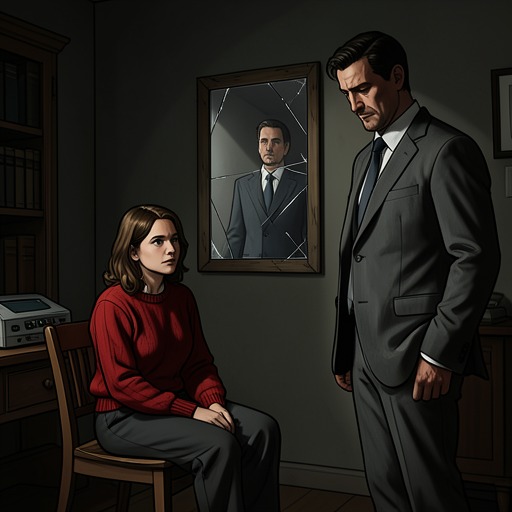
Missy receives Romy Cartelli, Talia DuPont, and Anna in a living room whose comfortable furniture contrasts with the history she is about to disclose. Her first question is how they found her, suggesting that she already understands the danger surrounding Brody Harrison and is alert to the possibility that contact with outsiders could reopen the past. When Talia explains that another Kappa girl supplied her name, Missy immediately asks whether Brody hurt Romy, placing Romy's injuries within a pattern she recognizes rather than treating them as an isolated incident.
Missy's position as a witness is complicated by institutional disbelief. She had previously tried to report what she saw, but the campus police did not accept a werewolf explanation, and Brody's fraternity brothers helped conceal the evidence. Her testimony therefore has to cross two barriers at once: the private intimidation imposed by Brody and the public assumption that supernatural violence cannot be real. The scene presents disclosure as an act of risk, but also as the beginning of practical knowledge.
Relationship and Coercive Control
Missy tells Talia DuPont that she and Brody Harrison began dating during their senior year. At that time, she did not know what he was, and when Talia asks whether she means a werewolf, Missy rejects the supernatural label as the most important description. Her immediate characterization of Brody as a cruel partner makes clear that his conduct as a human relationship figure preceded, and cannot be excused by, his werewolf identity.
After they reached college, Brody became progressively meaner and more direct in his insults. The insults then turned into threats when Missy refused to let him transform her. Her account traces a recognizable escalation from degradation to intimidation and bodily coercion: Brody wanted to control not only her choices but also her physical identity. Missy's reflection that prolonged abuse can make a person unable to see what is happening to them gives the testimony psychological depth. It explains why leaving was not a single uncomplicated decision and counters the self-blame that often accompanies coercive relationships.
Missy also distinguishes Brody's pleasure in power from any reluctant participation in werewolf life. She believes that he loves being a werewolf, along with the strength and brutality it gives him. That judgment aligns with Romy Cartelli's experience of Brody's threats and helps establish that the supernatural system is a tool he embraces for domination. Missy's testimony thus refuses to romanticize his power or treat his violence as an accidental consequence of transformation.
Discovery of the Hidden Room
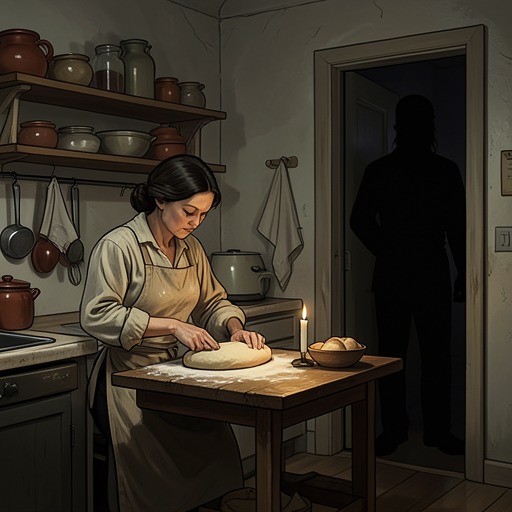
Missy's decisive physical evidence begins with an apparently ordinary domestic detail. After her parents sent boxes when they sold their house, her brother secretly supplied jars of moonshine, which remained in the building. The moonshine becomes one of the last objects Romy remembers seeing before Brody's attack and kidnapping, linking Missy's memory to Romy's bodily trauma without making their experiences identical.
Missy explains that she found the door to a secret room standing open. Inside were four men confined in a tiny space, each at a different stage of werewolf transformation. When one of them came toward her, she fled and did not stop until she reached campus police. The detail of four men in various stages of change converts rumor into a concrete image of confinement, experimentation, or organized transformation, while the room's cramped dimensions suggest that the people inside were being held rather than freely participating.
The report failed because Brody Harrison quickly closed off the room and hid it behind wall art. His fraternity brothers covered for him, and the campus police found neither the room nor the men. The concealment reveals a system sustained not only by Brody's threats but also by social protection and the limits of official imagination. Missy's failed report becomes important precisely because it records an earlier warning that institutions dismissed.
The Clinic Lead and Its Consequences
Missy connects the empty secret room to the larger disappearance crisis. She reasons that Brody probably moved the men to the place where he was keeping the missing women. When Romy Cartelli asks whether Brody has a second home or remote property, Missy initially says that he does not, then remembers a more promising connection: Brody's mother had a friend who ran a free clinic about an hour outside town. The woman was Brody's godmother, the clinic closed about a year earlier, and Brody's family may still own the building.
The abandoned clinic immediately fits details from Romy's captivity. Brody had threatened to take Romy to a clinic, and she had assumed that he used the word to describe a place where he impregnated girls. Missy's information forces Romy to reinterpret that earlier threat as a possible reference to a real location. Talia DuPont recognizes the building as an ideal site for a breeding operation, while Missy's horrified question shows that even someone who knows Brody intimately has difficulty accepting the full scale of what he may be doing.
Romy Cartelli's conclusion that the clinic must be the missing site turns testimony into an objective for rescue. Missy refuses to be drawn further into the investigation, explaining that she has worked hard to move beyond what happened to her and cannot allow herself to be pulled back into it. That refusal does not weaken her testimony. Instead, it establishes a boundary between giving necessary evidence and surrendering her life once again to Brody's violence.
Aftermath and Narrative Significance
The testimony gives Romy Cartelli, Talia DuPont, and their allies a concrete lead where suspicion had previously circulated without a destination. It helps connect Brody Harrison's abusive relationship with Missy, the hidden room of transforming men, the disappearance of campus women, and the suspected forced-breeding program. In narrative terms, Missy's memory supplies the missing bridge between personal testimony and collective action.
The episode also gains force from its contrast with the public treatment of Romy. During Romy's captivity, Brody's people exploit the fact that she had disappeared before, allowing the public to dismiss her as the girl who cried captive. Her social-media campaign is mocked through a spoof account, memes, and the spreading Girl Who Cried Werewolf hashtag, while her follower count collapses. Missy's evidence answers that culture of disbelief with specific testimony: a relationship history, a hidden room, four changing men, a failed police report, and a family-owned clinic.
Missy's account further clarifies the difference between protection and control. Kash Montgomery worries about Romy Cartelli's safety and tells her that danger prevents him from focusing, while Brody Harrison uses threats, imprisonment, forced transformation, and fear to claim authority over women. Later, Kaitlyn's insistence that rescuers must not forget the coercion behind her pregnancy echoes Missy's testimony: survival and recovery do not erase the absence of choice. Together, these voices make the investigation a struggle not only to defeat Brody but also to restore credibility, agency, and the right of affected women to define what was done to them.