Nick
Of Fates & Fables (The Complete Series)Nick is a newly turned werewolf and Danielle Blish’s former boyfriend whose capture links a seemingly isolated attack to Brody Harrison’s larger plan for bloodline control. Bruised, chained, and reduced to a terrified witness in the prisoner cells, Nick reveals that the campus disappearances are not random acts of violence: women are being targeted as reproductive resources for a pure werewolf lineage. His interrogation ends in death when the magical restrictions imposed by an alpha prevent him from speaking freely, making his body the final evidence of the system he served.
Identity and Introduction
Nick first appears as a prisoner held in human form, wearing only ratty cotton shorts and bearing bruises and blood. The narration cannot determine whether all of his injuries come from his earlier meeting with Kash Montgomery on campus or from what happened after his arrival at the prisoner cells. That uncertainty establishes him as both an aggressor and a captive: he has participated in violence, yet he has also been physically subdued and placed under someone else’s control.
His position is immediately tied to Danielle Blish. During the interrogation, Lynch Foster asks Nick why he bit her, and later Romy Cartelli explains that Nick and Conner Malone turned Danielle on the night she disappeared. Additional questioning identifies Danielle as Nick’s former girlfriend. She had been a Kappa before the others, and her prior social connection to Nick becomes one reason Romy believes Danielle may be able to help investigate what happened. Nick is therefore not an anonymous werewolf attacker; he is connected to the missing-person crisis through both an intimate relationship and a deliberate act of transformation.
Interrogation and Revelation
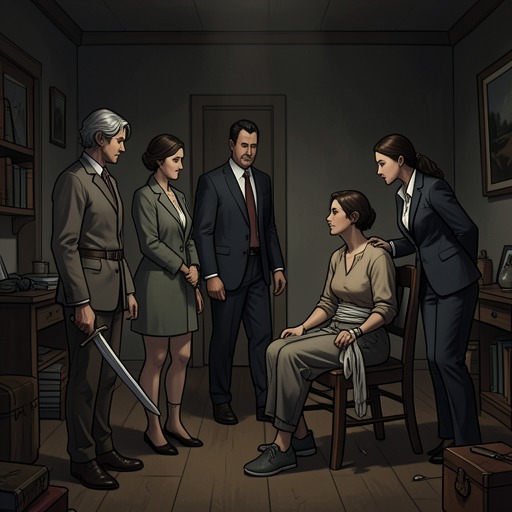
Kash Montgomery and Lynch Foster confront Nick in the prisoner cells. Lynch moves to one side while Kash moves to the other, pulling Romy with him, but Romy falters when she sees the chained man. Lynch then approaches Nick and strikes him in the gut before demanding his name and asking why he attacked Danielle. The physical interrogation reflects the desperation of the investigation, but Nick’s responses quickly shift the scene from ordinary retaliation to the discovery of a hidden command structure.
Nick admits that he was ordered to turn Danielle. His statement confirms that the attack was not solely his own decision and that the transformation of a campus woman served another person’s objectives. When Lynch realizes that an authority commanded the act, Nick reveals the central motive before he can be struck again: “We need women,” he says, identifying the goal as the creation of “A bloodline for the pack. A pure line.” The words expose the breeding program’s governing ideology. Women are treated as the means of producing a controlled population, while purity is presented as a justification for abduction, forced turning, and reproductive coercion.
Nick’s testimony also places him within a hierarchy. He recognizes Kash as Kash Montgomery, the Alpha of the Somerville pack, and Kash identifies Nick as a recent werewolf, estimating that his transformation occurred five or six months earlier. The exchange establishes a contrast between Kash’s legitimate pack leadership and the hidden alpha authority that commands Nick. Nick has enough knowledge to identify Kash’s rank, but he remains unable to identify the person who controls him.
Alpha Compulsion and Death
Nick tries to explain why he cannot provide the name or repeat the command. He says that he wants to tell them but is not permitted to, and that he cannot say the words regardless of how severely he is beaten. He describes the restriction as “some kind of alpha trick.” His panic convinces Romy that the silence is involuntary rather than a simple attempt to protect himself. The scene thus reveals that the breeding operation relies not only on physical captivity but also on magical obedience embedded in the bodies and speech of its agents.
The compulsion is not merely a threat of punishment. When Nick’s attempt to answer reaches its limit, his wails stop abruptly. His body becomes dead weight; his eyes roll back, blood streams from his nose and mouth, and he convulses against the chains before foam covers his mouth and he falls still. Nick’s death confirms that the controlling power can kill or destroy a subordinate who crosses the boundary of forbidden speech. The interrogation therefore produces knowledge at the cost of the witness himself: Nick exposes the existence and purpose of the conspiracy, but the mechanism protecting its leadership eliminates him before he can identify its source.
Relationships and Moral Position
Nick’s relationship with Danielle gives his actions a particularly disturbing intimacy. He did not attack an unknown victim; according to the investigation, he turned a former girlfriend during the night she disappeared. That connection makes his role difficult to reduce to either victimhood or villainy. He helped carry out the operation, yet his terrified refusal and involuntary death show that he was also bound within it. The evidence presents him as a compromised intermediary whose agency has been narrowed by alpha control.
His connection to Conner Malone further places him in a network of cooperating agents. Romy’s account groups Nick and Conner together as the werewolves responsible for Danielle’s turning, while the later investigation treats Danielle’s former relationship with Nick as a possible route toward understanding the campus attacks. Nick’s actions consequently have effects beyond his own fate: they help establish the pattern of targeting women, connect the disappearances to organized recruitment, and support the conclusion that Brody’s operation is designed around population expansion rather than isolated predation.
Nick’s encounter with Kash also marks a collision between competing forms of authority. Kash’s touch identifies Nick’s recent transformation and his rank within the broader werewolf order, while Nick’s recognition of Kash as Somerville’s Alpha underscores the difference between the pack Kash leads and the coercive structure that has recruited Nick. Nick’s body carries the signs of transformation, command, and punishment at once.
Narrative Function and Significance
Nick’s brief presence has disproportionate narrative importance because he converts suspicion into a political and biological conspiracy. Before his interrogation, the attacks can be understood as individual violence connected to missing students. His admission that women are needed for a pure line reveals a system that classifies bodies according to species, bloodline, and reproductive usefulness. The later sight of tattoos on captive women and babies gives his statement material consequences: the breeding ideology is not abstract, but inscribed onto the bodies it controls.
He also helps establish the novel’s recurring conflict over labels and credibility. Romy later confronts the fear that, if she escapes, the public will regard her as “the girl who cried captive,” just as the “The Girl Who Cried Werewolf” campaign attracts a spoof account and hostile memes on Instagram and Twitter. Nick’s own testimony exists under the opposite problem: he knows the truth but is magically prevented from communicating it. Public disbelief and supernatural silencing are parallel forms of enforced helplessness. Both turn a victim or witness into an unreliable figure in the eyes of others, even when the underlying events are real.
Nick’s death also demonstrates the cost of confronting the hidden order without understanding its rules. The revelation that magic is real expands the conflict beyond physical attacks, and Nick becomes the first clear proof that alpha command can operate through speech and bodily destruction. His final convulsions leave the investigators with the conspiracy’s purpose but not its full chain of command, preserving the danger while sharpening their objective. In that sense, Nick is less a completed redemption arc than a tragic threshold figure: a former boyfriend, a newly turned werewolf, a perpetrator of Danielle’s forced transformation, and a controlled witness whose death exposes the machinery behind the violence.