Otto’s note
Of Fates & Fables (The Complete Series)Otto’s note is a short but decisive piece of evidence in the investigation into Otto Montgomery’s death. Its three clipped instructions—“Valkyrie. 10 p.m. Come alone.”—identify a place, a time, and a demand for secrecy, turning an unknown appointment into a traceable encounter. The note matters not because it explains the murder by itself, but because it gives Romy and Kash Montgomery the first tangible route toward the person Otto intended to meet.
Appearance and Discovery
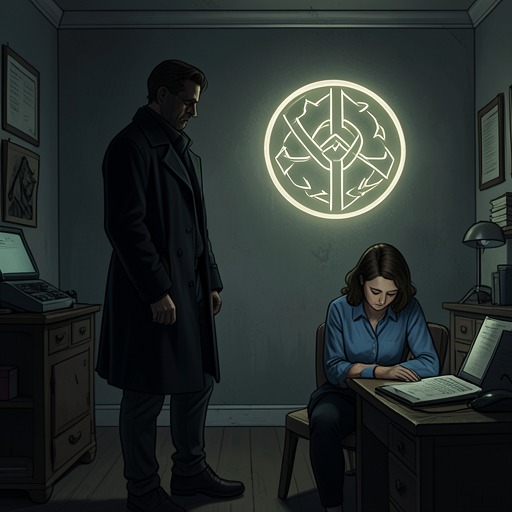
The note is encountered as part of a pile of papers on the corner of a desk. Romy notices it while Kash is angrily warning her about the danger of running away after he rescued her from a werewolf. The handwriting feels familiar to her, yet its presence in the room seems inexplicable. That dissonance makes the paper more than an incidental scrap: it interrupts the immediate conflict and redirects attention toward an older, unresolved crime.
Romy picks up the top slip and reads its message aloud: “Valkyrie. 10 p.m. Come alone.” The note contains no explanation, signature, or account of what was expected at the meeting. Its stark compression intensifies rather than resolves the mystery. A named destination and a precise hour imply planning, while the command to come alone suggests that the meeting depended on isolation and concealment.
Connection to Otto Montgomery’s Death
Kash identifies the paper as a note his father was carrying when he found him. He is certain that it is not Otto’s handwriting; instead, he believes it was written by the person Otto was meant to meet. This distinction gives the object an investigative function. The note does not merely record Otto’s plans from his own perspective. It preserves the outward sign of another person’s summons, leaving the writer’s identity and purpose at the center of the inquiry.
The note also exposes the limits of Kash’s knowledge. He cannot say who wrote it or whom Otto intended to meet, and that uncertainty helps explain his urgency and anger. The paper offers a direction without offering closure: it proves that Otto had a secret appointment, but it does not establish whether the meeting was a trap, an attempt at cooperation, or part of a larger conflict.
The Meeting with Xan Andrew Higgins
The handwriting becomes decisive when Romy and Kash bring the note to Xan Andrew Higgins. Xan immediately recognizes it as his own writing. Before that recognition is fully processed, Kash places the slip on the table and tells Xan that they know he was the last person to see Otto alive. Romy presents the accusation more carefully, explaining that they found the note in Otto’s office, recognized Xan’s handwriting, and need to know why the two men met and what Xan might have seen.
Xan confirms that he met Otto before Otto was killed, and adds that the meeting was not an isolated occurrence: he had met with Otto several times. The note therefore changes the shape of the investigation. It connects a single written summons to an ongoing relationship rather than a one-time coincidence. Xan denies killing Otto and describes Otto as his best friend, explaining that their friendship began in college when they met at a bonfire near the Charles River. Their bond crossed the boundaries separating their kinds, and they spent four years causing trouble together before adult responsibilities divided their paths.
Narrative Function and Significance
As an object, Otto’s note carries the story’s investigative suspense through withholding. It gives the reader concrete information—Valkyrie, ten o’clock, solitude—while withholding the writer’s name, the meeting’s purpose, and the events that followed. Each recovered fact narrows the field of possibility without eliminating danger. The paper’s brevity makes it a durable source of uncertainty: every word is legible, but the circumstances around those words remain contested.
The note also converts memory and suspicion into physical evidence. Kash’s grief and pursuit of the truth are emotionally charged, while Xan’s account of his friendship with Otto is vulnerable to doubt because Xan was the last known person to see him alive. The paper stands between them as an object that neither anger nor reassurance can erase. It allows Romy to mediate the confrontation, shifting the exchange from accusation toward testimony while preserving the central question of who arranged Otto’s final meeting and why.
Its importance ultimately lies in its double movement. First, it opens the path to Xan Andrew Higgins by exposing his handwriting. Then, once Xan admits repeated meetings with Otto, it opens a wider history of friendship, divided supernatural communities, and concealed responsibilities. Otto’s note does not solve the murder; it makes the murder narratively and materially investigable, giving the survivors a precise clue around which the truth can begin to gather.