Pure Werewolf Bloodline
Of Fates & Fables (The Complete Series)Pure Werewolf Bloodline is the belief, voiced by Nick during his interrogation, that a pack needs women to produce a pure lineage. In practice, the doctrine becomes the rationale for Brody’s campaign of abduction, forced conversion, and forced pregnancy. Its meaning is measured not by an established account of what makes a bloodline pure, but by what the pack does to women and children in its name: turn them, compel them to bear offspring, and mark the bodies it claims as its own.
The Doctrine Becomes a Plan
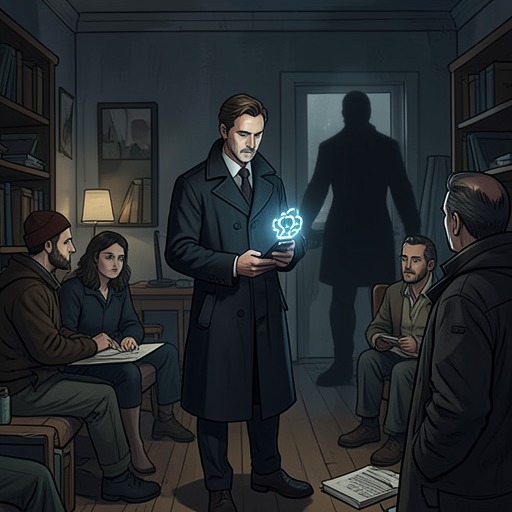
The ideology first emerges when Lynch asks Nick whether his Alpha ordered him to attack a girl. Nick corrects him: the order was to bite her. Lynch recognizes that this means turning her, a revelation that breaks from the expected pattern of questioning. Before Lynch can strike, Nick blurts out that the pack needs women for a pure line. Romy understands the implication as a breeding operation: girls are being turned and taken away so they can be impregnated. The revelation connects an individual order to an organized objective, transforming the missing women from a series of disappearances into targets in a deliberate scheme.
Brody later makes the same purpose explicit in his threat to Romy. He presents Justice as the person who will turn her and then keep her pregnant, making conversion and repeated pregnancy instruments of the pack’s plan. Derek and Zac are not surprised by the threat, suggesting that the scheme is already familiar within Brody’s circle. The language of lineage therefore masks a practice that depends on coercion at every stage: capture, transformation, reproductive control, and the production of children claimed for the pack.
Abduction, Pregnancy, and Inherited Claims
The missing women are not merely absent from campus. When the group investigates an empty room, Talia recognizes that Brody may have moved the captives to another location. The search eventually brings Romy and Talia face to face with a succession of pregnant women. Each has short hair and a tattoo on her neck matching Brody’s, visible evidence that their captivity has been organized around the same system of control. Their fear and tearful relief make the consequences of the plan immediate: what Nick described as a bloodline is being produced through confined, vulnerable bodies.
The claim extends to the babies. One woman reveals a dark tattoo on her infant’s arm, and Romy realizes that Brody has already marked the child as his. Later, Kaitlyn holds Hunter, whose small wrist bears a tattoo as well. The mark makes the ideology’s reach visible beyond pregnancy: the pack asserts possession over children from the moment they are born. The story does not establish that these marks prove biological purity; instead, they show how Brody’s group turns lineage into a claim enforced on bodies.
Resistance and the Cost of Being Disbelieved
The scheme operates alongside a struggle over who will be believed. As Romy’s campaign attracts a spoof account and hostile attention online, her credibility is already under pressure. Brody exploits that vulnerability when he tells her that the public will treat her as the girl who cried captive because she has disappeared before. Talia’s report to the police has also been dismissed. Social ridicule and institutional disbelief thus help conceal the very violence the bloodline project depends on keeping out of sight.
The plan’s control is not absolute. After Justice helps Romy escape, Brody sends her a message blaming her for taking one of his pack and threatening to take someone from hers. The threat frames people as possessions, but it also shows that escape and solidarity can provoke retaliation against the captors’ authority. Romy later explains the missing girls’ fate to Danielle, who responds with horror; the scheme becomes knowledge that can be shared rather than a secret imposed by Brody.
Kaitlyn’s words provide the clearest rejection of the ideology’s attempt to turn survival into consent. She says that she would never give up Hunter and would make the same choice to keep him, while insisting that the pregnancy was not her choice and that Brody and his werewolves must answer for what they did. Her position separates love for a child from approval of the violence that brought the child into the world. In doing so, she refuses the pack’s effort to make forced reproduction appear legitimate through the existence of a family bond.
Significance
Pure Werewolf Bloodline is presented less as a coherent account of heredity than as a political justification for controlling reproduction and pack membership. Brody’s operation converts a claim about collective continuity into a chain of violence directed at women and extended to their babies through tattoos and asserted ownership. The survivors’ testimony challenges that chain at its premise: a child’s existence, a mother’s attachment, or a mark on the skin cannot retroactively make coercion voluntary. The concept therefore exposes the distance between the language of preserving a lineage and the lived reality of those forced to produce it.