Romy's Kidnapping and Captivity
Of Fates & Fables (The Complete Series)Romy's Kidnapping and Captivity is the point at which Brody's private ambitions become a direct assault on Romy's freedom and bodily autonomy. Abducted from a cellar and held without contact with the outside world, she learns that Brody is a werewolf and that his violence is tied to a wider plan: to make her, and other women, serve his effort to build a pack and seize power.
The Ambush and Confinement
Romy is in a cellar when a scraping shoe among the shelves and junk warns her that someone else is there. She recognizes the danger too late. A bat swings from the edge of her vision, and its blunt end strikes her head. A familiar face appears briefly through the pain before she loses consciousness; the attacker also takes her phone. The scene turns a moment of uncertainty into an abduction, stripping away both her ability to identify her assailant and her means of calling for help.
When Romy next becomes lucid, hunger and thirst have become her first measures of time. She is alone in absolute darkness, on a cement floor in a room with no apparent windows and a door that opens only from the outside. The air smells of mildew and decay, leading her to suspect that she is underground. She is so dehydrated and weak that even slight movement brings dizziness, and she cannot tell whether hours or days have passed. Her isolation is made more frightening by the absence of sounds beyond the walls: she does not know who has taken her, where she is, or whether anyone knows she is missing.
The confinement also forces Romy to manage her own body as a dwindling resource. When she first wakes, she screams until the effort makes her vomit and black out again. Now exhaustion blunts her panic; she tries to cry without shedding tears because she cannot afford to lose more liquid. That practical calculation gives the captivity its immediate physical stakes: fear is present, but thirst and weakness govern what she can do.
Brody's Motive and Threats
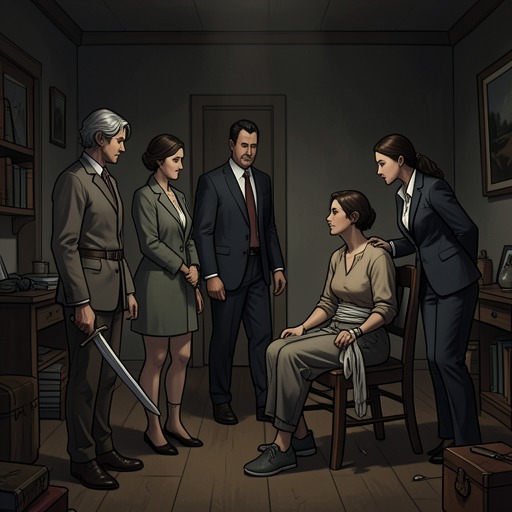
Brody eventually appears as her captor. Romy initially hopes that the situation might be a fraternity prank or a badly planned sorority initiation, but Brody's sneer ends that possibility. Derek, Zac, and Justice are with him. Justice is especially painful for Romy to see because she had regarded him as a friend; she turns the sting of his presence into resolve to demand answers. Brody says that Romy has something he wants and that he intends to obtain it regardless of the cost, while leaving the precise object of his desire unclear at first.
Romy challenges him by pointing to the consequences of abducting Anna's best friend: Anna could reject him once she learned what he had done. The taunt provokes Brody into a violent transformation. His bones crack as he drops to all fours; his clothes tear as pale grey fur covers him, his hands and feet become clawed paws, and his teeth lengthen. The display confirms that Brody is a werewolf, making the danger in the room more than a human captor's threat and exposing the supernatural identity he has kept from Romy.
The Breeding Plan and the Struggle for Control
Brody’s explanation turns the captivity from a personal kidnapping into part of a larger campaign. He says Romy has something he wants, but his demands soon make clear that he is seeking information as well as leverage. His group already knows about a plan to turn women into werewolves and force them to become pregnant. Brody presents Romy with a choice: answer his questions, or Justice will transform her and try to keep her pregnant with as many wolf babies as possible. The others’ lack of surprise makes plain that this is not an improvised threat; the breeding scheme has been discussed among them before.
Romy refuses to cooperate, and Brody escalates from threats of taking her somewhere to be subjected to what awaits there to direct physical abuse. When she tells him Kash will defeat him, Brody declares that Kash will not remain Alpha long enough to interfere: he intends to become Alpha of the northeast and win the respect he believes he deserves. He threatens to transform Romy himself and leave her to endure the change alone. His ambition and his coercion are inseparable: control over Romy’s body is one expression of the authority he means to claim.
Romy also recognizes the danger to Anna in Brody’s ambitions. When she tells him Anna will never be his queen, he slaps her, grips her throat, and throws her across the room. Derek’s intervention is not a defense of Romy; he cautions Brody not to injure her so badly that Justice would no longer want her. Brody answers that Justice will obey any order he gives. The exchange reveals how the captive is treated within the group—as an object to be kept usable—and how Brody’s authority depends on compelled obedience as well as violence.
Brody’s questions expose another strand of his purpose. He demands to know how Romy entered Kash’s compound and why she is posting on social media, but she does not understand what he means or how she could have done what he describes. Her confusion leaves the issue unresolved in the scene; what is clear is that Brody is trying to trace a breach or an attempted signal, and that the captivity is also an effort to control what Romy knows and can communicate.
Aftermath and the Wider Captivity
When Romy is safe enough to receive care, the effects of the captivity remain present in her injuries and in the choices she needs to regain. Kash asks whether she would rather have Talia or Anna help her change; Romy explains that she wants out of the clothes but cannot lift her arms over her head. His relief at her answer follows an unspoken concern about what might have happened to her. The exchange does not erase the violence: it shows care beginning with a question and Romy being able to say what she does and does not need.
Birdie later examines the scrape on Romy’s neck left by Derek’s teeth. The injury is a near-transformation, a reminder that the threat Brody used against her was not merely rhetorical. Romy’s body has been subjected to blows, restraint, and the prospect of forced change; medical attention makes that immediate danger visible without making it the whole of her recovery.
The captivity also sits within a larger pattern that Romy helps expose. She tells Danielle that the missing women on campus were being turned and forced into pregnancies. Danielle responds not as a distant observer but as someone whose own life has been radically altered: she has had to leave school because she cannot control her shift, lost her scholarship, and abandoned her hope of entering medical school. The revelation connects Romy’s kidnapping to a campaign that takes not only bodily autonomy but also education and a future from its victims.
Missy Quinn’s account shows how Brody’s coercion extended into his intimate relationships. She says their relationship began in senior year, worsened after they reached college, and turned from insults to threats when she refused to let him transform her. Her recollection that abuse can become difficult to recognize while someone is living through it gives the broader violence a history of gradual escalation, rather than making it seem to begin only with the kidnapping and the overt threats in the cell.
At a later baby shower, Kaitlyn insists that gratitude for being rescued must not obscure the coercion that brought her and the other women there. She loves Hunter and would make the same choice to keep him, she explains, while refusing to let anyone mistake that choice for consent to what Brody and his followers did. Romy’s response is to feel her guilt over having injured Derek recede: the survivors’ testimony restores the moral focus to the perpetrators’ actions and to the women’s right to name what happened. In this way, the event’s aftermath moves beyond Romy’s escape from confinement; it becomes part of a collective effort to recover voice, choice, and accountability.
Aftermath and the Wider Captivity
The violence does not end when Romy is out of Brody’s hands. Recovering her agency begins with ordinary choices that captivity had taken away: when Kash asks whether she would prefer Talia or Anna to help her change, Romy explains that she wants out of her clothes but cannot raise her arms. Kash’s relief follows his unspoken concern about what might have happened to her, while Romy’s answer sets a clear boundary and names the practical limits imposed by her injuries. Later, Birdie examines the scrape on Romy’s neck left by Derek’s teeth. The mark makes the attempted transformation a physical fact, not merely one of Brody’s threats.
Romy’s experience also opens onto the fate of the missing campus women. When she explains the forced turning and pregnancies to Danielle, Danielle recognizes the scale of the crime—and speaks from the consequences she has already suffered. Unable to control her shifts, she has had to leave school; her scholarship is gone, along with her hope of attending medical school. The scheme therefore reaches beyond immediate bodily violence, disrupting education and futures as well as autonomy.
Missy Quinn’s testimony supplies a longer history of Brody’s coercion. She recalls that they began dating in senior year, that his behavior worsened after they reached college, and that insults became threats when she refused to let him turn her. Her account shows how abuse can escalate gradually and become difficult to identify from within the relationship. The kidnapping is thus part of a pattern of control, not an isolated eruption of brutality.
At a later baby shower, Kaitlyn insists that gratitude for rescue must not be mistaken for consent to what happened. She loves Hunter and says she would make the same choice to keep him, but she refuses to let anyone forget that the pregnancy and the circumstances surrounding it were imposed on her. Hearing her restores Romy’s moral clarity and eases her guilt over injuring Derek: the survivors’ own words keep responsibility with Brody and his followers. The captivity’s aftermath consequently becomes a struggle not only to recover from confinement, but to preserve the women’s right to describe their experiences, make choices, and demand accountability.