Romy's Social-Media Signal
Of Fates & Fables (The Complete Series)Romy's Social-Media Signal is the hidden rescue message that transforms Romy's online persona from a platform for romance commentary into an instrument of resistance. While held by Brody Harrison and his people, Romy uses a seemingly ordinary Instagram post to preserve evidence, signal that she is alive, and create the possibility that someone outside her captivity will recognize where she is and act. The signal belongs to a larger pattern in which Romy performs confidence for audiences who dismiss her while quietly converting publicity into protection.
Origins in Romy's Online Persona
Romy's social-media presence begins as deliberate performance. Through Romy Reads Romance, she speaks directly to followers, promotes books, uses recurring hashtags, and cultivates an audience accustomed to her enthusiasm for attractive men and fictional book boyfriends. Even before the hidden message, the camera is both a source of credibility and a shield: Romy records herself because her channel has become too strange to ignore, while understanding that many viewers may treat her claims as exaggeration, fan culture, or a publicity stunt.
That established persona gives the later signal its plausibility. Romy has already trained her audience to expect playful posts under labels such as Book Boyfriend Material and Man Crush Monday. The recurring Man Crush Monday theme normally features a photograph of a man Romy considers suitable book-boyfriend material, making it an ideal disguise for communication. The message does not arrive in an obviously urgent form; it is embedded in the kind of content her followers already associate with her.
Construction of the Coded Post
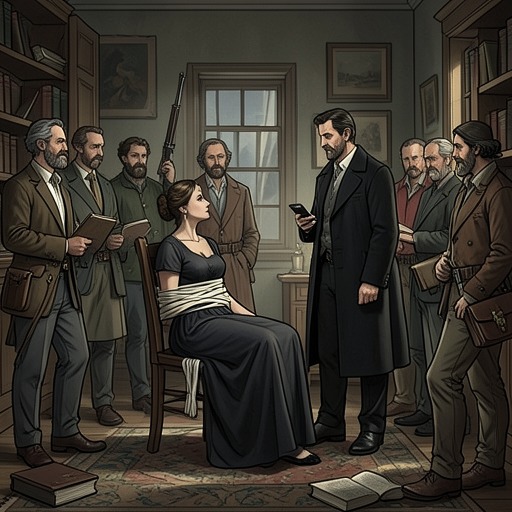
During her captivity, Romy asks Derek whether she may use a particular photograph on her phone. She explains the choice as a Man Crush Monday post, claiming that she usually spots a suitable subject around town and takes a quick photograph on Mondays. Derek accepts the explanation because it fits the harmless, somewhat nerdy image he has assigned to her. His confidence in that interpretation becomes the opening Romy needs.
Romy crops the photograph and adjusts its lighting so that the men from Delta can be seen clearly. The technical manipulation is crucial: the image remains acceptable as a social-media post, but it also preserves visual information about the people and setting connected to her confinement. She writes a teasing caption comparing the men with Sebastian Beckett and labeling them Book Boyfriend Material, then tags the authors and adds her usual book-related hashtags. The post therefore operates on two levels at once. To Derek, it is disposable fan content; to anyone examining it carefully, it is a record containing identifiable details.
Derek reads the caption, asks whether he will have to fend off attention from librarians, and ultimately taps the share icon himself. His participation gives the signal an especially sharp irony. The captor does not merely fail to stop the post; he helps publish it, believing that he is approving a piece of harmless self-presentation. Once the image appears at the top of Romy's feed, he powers off the phone and returns to the assumption that control has been restored.
Resistance Through Misrecognition
The signal depends on misrecognition. Brody Harrison has told Romy that no one is looking for her because she has disappeared before, and he relies on the social consequences of that history to make her seem unworthy of an alarm. Romy's response is not to accept his version of events but to create a trace that contradicts it. The post is a quiet answer to his claim that her friends will not know she needs to be found.
Her deception is also a form of impression management. Romy must appear casual enough to avoid punishment, ordinary enough to satisfy Derek, and recognizable enough to her followers that the post will not seem entirely out of character. The same public identity that allows her captors to underestimate her becomes the mechanism by which she can communicate. Her humor is not evidence that the danger is unreal; it is the surface under which the danger is made legible.
After the post goes live, Romy watches the captors leave and reflects that they believe they have won the round, while the post may give them a rude awakening. The consequence is deliberately left suspended at the moment of transmission. The signal is not a guaranteed rescue, but it changes captivity from a sealed space into a situation with an external witness and a possible route outward.
From Hidden Signal to Public Truth
The coded post is one expression of Romy's broader use of social media to contest disbelief. In an earlier live stream, she announces that werewolves exist and promises to enter a building to obtain proof. When the first attempt fails, she publicly reframes the setback, explaining that the werewolf has stolen her phone and repeatedly made the evidence slip away, but insisting that she will continue investigating the pack. Her broadcasts turn humiliation into narrative momentum, allowing her to retain control over how failure is interpreted.
Later, after learning the truth about the missing girls and Brody Harrison's breeding operation, Romy records a drunken video describing the kidnappings as a time capsule of proof. She recognizes that directly telling the public could expose her relationship with Kash Montgomery or make him appear guilty, so she preserves her account for a future in which the truth may finally become credible. This makes the hidden signal part of an archive as well as a distress call: Romy repeatedly records what others refuse to believe, trusting that evidence can outlast the moment in which it is dismissed.
The strategy eventually expands into deliberate public provocation. With Talia DuPont, Romy prepares an Instagram post suggesting that Jason Momoa is a werewolf and linking the joke to Book Boyfriend Material and The Girl Who Cried Werewolf. Talia recognizes that the post could go viral. Here, celebrity association and playful speculation help carry Romy's werewolf claim into a wider attention economy, showing how the language of fandom can be redirected toward exposure.
By the prologue, the label attached to Romy has been absorbed into her public identity. She acknowledges that people call her The Girl Who Cried Werewolf and says that the name now appears across her social-media handles, while insisting that the public version of the story is incomplete and that the account she is about to share is the truth. The hidden post thus anticipates the later transformation of private testimony into public authorship: what begins as a coded image inside a captivity narrative becomes part of the evidence and identity through which Romy tells the world what happened.