Rose
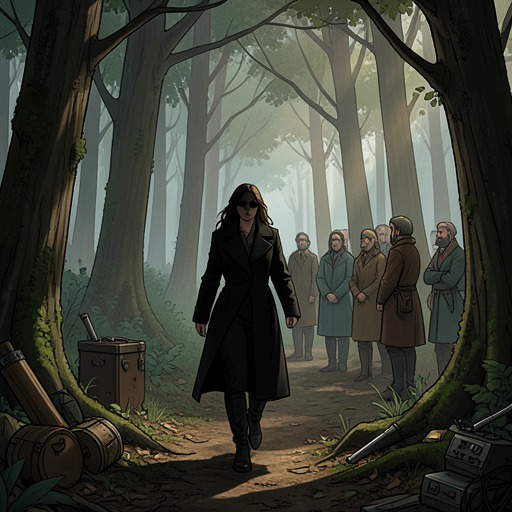
Of Fates & Fables (The Complete Series)Rose is a council member responsible for governing the werewolf world, but her first appearance presents authority as more ceremonial and political than protective. Alongside Charles and William, she arrives at Kash Montgomery’s home in an expensive suit and shoes, immediately resembling a corporate executive rather than a formidable werewolf leader. Her restrained, superior manner toward Romy Cartelli establishes her as an institutional gatekeeper whose social confidence exceeds her willingness to confront the violence unfolding within her society.
Identity and Introduction
Rose enters with Charles and William after the council’s representatives are admitted through the sunroom door. The trio’s dubious looks toward Lynch Foster make an immediate impression on Romy, who already dislikes them before their identities are explained. Kash introduces all three as members of the council that governs their kind, placing Rose within the formal ruling structure rather than among the local members of Kash Montgomery’s pack.
Her introduction is marked by social condescension. Rose shakes Romy’s hand limply, looks down her nose at her despite being the same height, and responds to Romy’s greeting with a dismissive murmur before stepping away. Kash’s introduction of Romy as his mate therefore produces a sharp contrast: Romy carries the personal and emotional stakes of the crisis, while Rose initially treats her as an outsider whose status does not command serious attention.
Connection to Lina Montgomery
Rose’s reserve changes as soon as she notices Lina Montgomery. She rushes to Lina, becomes immediately more animated, leans down to take her hand, and asks how she is. The difference between Rose’s treatment of Romy and her treatment of Lina reveals a hierarchy of recognition inside the council’s social world. Lina is not merely another person in the room; she is someone Rose already knows and respects, and that prior connection briefly overrides the formal distance Rose maintains with Romy.
Lina does not accept the warmth passively. She says that rejoining her son’s affairs has left her dismayed and directs her anger at the council members, accusing them of ignoring a matter that has harmed not only Kash’s pack but many others. Rose answers that the council takes Kash’s allegations seriously, but Lina’s reply—that it is odd that only these three appear to do so—creates an uncomfortable silence. Rose’s presence thus becomes part of a larger institutional failure: she can offer reassurance, yet Lina’s response suggests that the council has allowed the danger to continue without meaningful intervention.
Confronting Brody Harrison’s Victims
Rose’s understanding of Brody Harrison’s actions changes when Kash leads the council members into the living room and makes them face the pregnant women gathered there. The women’s pregnancies register one by one on the visitors’ faces. Rose’s eyes widen and her lips part in surprise and confusion, while Charles wrinkles his brow and William narrows his eyes. The scene forces the council to encounter the physical evidence of a breeding program rather than receive the allegations as an abstract political dispute between rival alphas.
Kash explains that Brody is attempting to create a pack born rather than bitten so that he can claim Kash’s lands. Charles concedes that the allegations are not unfounded, but says the council needs time to interview the women and corroborate their accounts. Rose does not lead the objection to this delay, but she stands beside the men as they propose an investigative process that would require survivors to revisit their experiences. Romy rejects that response, describing how Brody kidnapped the women, turned them into werewolves, and repeatedly raped them until they became pregnant. Her anger identifies the council’s procedural caution as another burden placed on victims whose bodies already bear the program’s consequences.
Rose reacts more visibly than the men when Romy challenges the council. She sniffs while Charles responds angrily to Romy’s disrespect, although she appears at least somewhat contrite. Her reaction is limited and does not immediately produce a promise of action, but it distinguishes her from Charles’s open defensiveness. The narrative leaves Rose suspended between sympathy and institutional loyalty: she can recognize the horror before her, yet she remains part of a governing body that has demanded further proof from those already harmed.
Authority, Delay, and Political Failure
Rose’s role becomes clearest when Kash warns the council that the conflict is no longer merely a private attempt to take his mate. He tells Charles, William, and Rose that a war is coming and that they will eventually have to choose a side. The warning places Rose within a political order whose neutrality is no longer sustainable. Her authority depends on appearing above factional conflict, but Brody’s breeding operation converts private violence into a threat to pack territory, bloodlines, and the stability of the werewolf world.
Later, Romy characterizes the council members as politicians who hope to ignore the situation long enough for Kash and his allies to solve it without them. Although Rose is not singled out as the sole architect of that delay, she is included in the institutional category Romy condemns. The council’s polished appearance, its demand for interviews, and its reluctance to act all become signs of a system attempting to preserve clean hands while others confront the danger directly.
Rose therefore embodies a compromised form of sovereignty. She belongs to the body that is supposed to protect werewolves, yet the women and babies gathered before her have been treated as resources in a program designed around bloodline, reproduction, and territorial expansion. The dark tattoos on the babies’ skin make that political logic visible: Brody has claimed even children before they can choose any affiliation. Rose’s shock at the pregnant women does not erase the fact that the council had to be confronted with their bodies before it acknowledged the scale of the crime.
Narrative Function and Significance
Rose functions as a humanizing but inadequate face of the werewolf council. Her enthusiasm toward Lina, her discomfort during the confrontation, and her partial contrition suggest that she is capable of recognizing suffering. At the same time, her dismissive treatment of Romy and her association with the council’s demand for further interviews show how institutional sympathy can coexist with exclusion and delay.
Through Rose, the story contrasts personal testimony with bureaucratic verification. Romy speaks from captivity and direct injury; the rescued women embody the continuing consequences of forced transformation and pregnancy; Rose represents the authority that wants their experiences translated into acceptable evidence before it commits itself. The contrast exposes a form of biological politics in which bloodline, reproduction, and the status of born versus bitten werewolves determine whose bodies matter to the ruling order.
Rose is not given a decisive individual transformation in the supplied scenes. Her significance lies instead in the pressure placed upon her position. She begins as a socially superior council representative, becomes visibly unsettled when confronted with Brody’s victims, and remains part of an institution that Kash and Romy accuse of political cowardice. The looming war makes that hesitation consequential: Rose and the council can no longer remain detached observers, because their refusal to act has already helped leave vulnerable women, children, and rival packs exposed to Brody’s ambition.