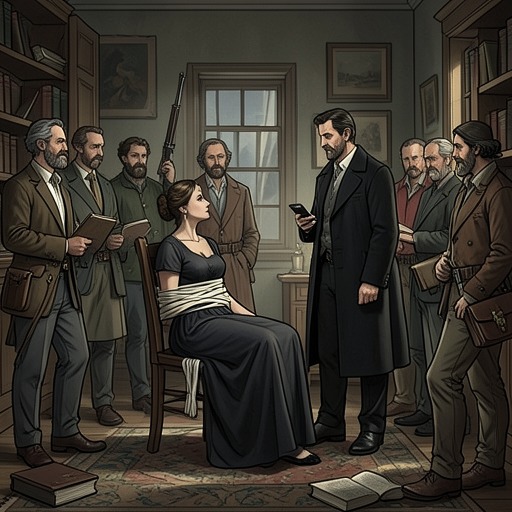
Talia's collapsible baton
Of Fates & Fables (The Complete Series)Talia's collapsible baton is both a concealed weapon and a material emblem of organized resistance. Small enough to hide in Talia's boot yet capable of expanding into a cruel-looking staff, it allows a rescue operation to move quickly from surprise to controlled violence. Its later revelation as a taser baton gives the object a second function: it is not merely an extension of Talia's skill, but a device that Romy can seize and adapt while escaping captivity.
Design and Concealment
Talia carries the baton as a compact stick hidden in her boot. When she flicks her wrist, it extends to full length, then folds back into itself when she slams its end against the ground. This transformation makes concealment part of its practical power. The weapon can pass unnoticed until the instant it is needed, allowing Talia to enter Brody's stronghold masked and apparently unarmed before exposing the tool's real purpose.
The baton is also defined by precision rather than indiscriminate force. Talia uses it with enough control to strike Justice across the cheek and render him silent when he begins to regain consciousness. During the escape from the house, she makes a further circuit of the wrecked room to ensure that the Delta men remain unconscious, and when Lynch warns that one is coming around, she hits that man on the temple before directing Romy outside. The baton therefore converts a chaotic rescue into a sequence of deliberate interruptions, keeping pursuit at bay long enough for the rescuers to leave.
The Delta Rescue
The baton first becomes central during Talia and Lynch's extraction of Romy. Talia has already used tear gas, which sends the Delta men scrambling and leaves much of the living room destroyed. She then uses the baton to complete the incapacitation of the men who remain in her way. The object works in concert with her disguise, the gas, Lynch's warning, and Romy's urgent flight through the backyard and down the path behind the house.
For Romy, the baton marks the physical difference between captivity and freedom. She has been confined in darkness, on a cement floor, in a windowless room whose door opens only from outside; hunger, dehydration, shallow breathing, and dizziness have reduced even stillness to an act of endurance. After Talia and Lynch get her out, the cool night air brings an immediate but fragile sense of release. The baton is part of the force that makes that first breath possible, even as Romy's paranoia keeps her alert to the possibility that Brody is still nearby.
Transfer of Agency
The baton changes hands during the escape. Justice begins pulling at the cuffs Talia has placed on him, recovering far faster than an ordinary human. Romy asks Talia for the weapon, and Talia removes it from her boot and passes it to her. The exchange is tactically necessary, but it also records a shift in Romy's position: she is no longer only the person being extracted. She becomes an active participant in securing the escape and managing the danger posed by Justice.
Romy discovers that the baton contains a taser function when her thumb brushes the button at its base. She powers it up and shocks Justice in the ribs. He stiffens and twitches until she releases the charge, while a howl splits the air and Talia takes the throttle. The baton thus expands Romy's available means at the precise moment when physical restraints may fail. Its hidden feature mirrors the broader pattern of her resistance: survival depends on noticing usable resources, learning how they work, and acting before an opponent can recover.
Violence, Defense, and Narrative Significance
The baton occupies the uncertain ground between weapon and rescue tool. Talia uses it without waiting for institutional authorization because the immediate stakes are bodily safety and escape. Its blows are forceful, but they are directed toward stopping captors and pursuers rather than displaying power for its own sake. In that sense, the object belongs to the book's recurring conflict over who has the right to use violence when official authorities delay or fail to protect victims.
Its significance also lies in its portability and reusability. The weapon is not a single-use symbol of Talia's toughness; it is a practical object that can be concealed, extended, folded, transferred, and repurposed. Talia's practiced handling establishes competence, while Romy's later use of the taser function turns the baton into a tool of shared resistance. The object gives material form to a change in the rescue narrative: agency is not kept by one rescuer but passed along to the person who must continue fighting for her own freedom.