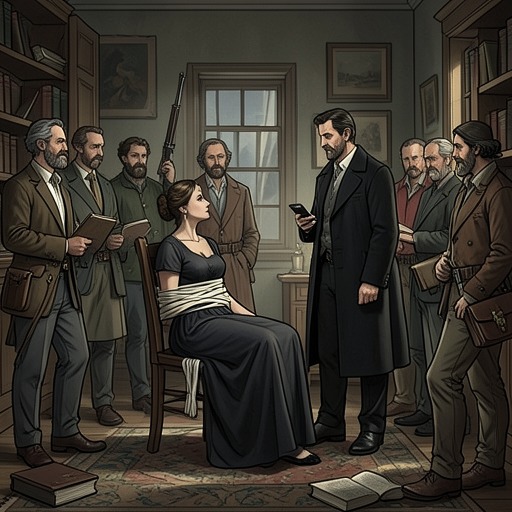
The prisoner cells
Of Fates & Fables (The Complete Series)The prisoner cells are the hidden detention rooms beneath Kash's house, a location that turns the novel's abstract struggle over safety, authority, and bodily freedom into an oppressive physical space. Reached through a concealed door and a descending stairwell, the cells first appear as a place of fear: Romy enters already traumatized by captivity and finds darkness, restraints, and the visible residue of violence. Yet the same rooms later become a contested site of investigation and controlled justice, where Kash's pack holds suspects, searches for abducted girls, and tries to rescue victims without reproducing Brody's methods.
Location and Atmosphere
The route to the prisoner cells runs through Kash's house and down a hallway toward a door that conceals their existence. Kash leads Romy, Talia, Anna, and Justice toward the entrance after ordering the household's welcome party to treat them as guests and to maintain a level-three perimeter lockdown. The movement from the inhabited house into the hidden lower level creates a sharp spatial contrast: above, the group is receiving protection; below, the architecture preserves the machinery of confinement.
The descent changes Romy's bodily response before she even sees the rooms. Anxiety rises as she goes down the stairwell, and the first sight of the cells tightens her chest. Inside one room, she finds a surprisingly large space filled with wicked-looking devices. A table carries brown stains that suggest blood, and the sight makes her shiver. Kash tightens his hand around hers, while Romy squeezes back and deliberately continues, determined to witness what has happened rather than allow panic to control her. The cells therefore function as a Gothic underground: their darkness and instruments materialize the buried violence that the safer rooms of Kash's house cannot contain.
Confinement and the Trauma of Captivity
The cells acquire much of their emotional force through their relationship to Romy's earlier imprisonment. After being knocked unconscious, Romy awakens in a separate room with no windows, a door that opens only from the outside, and air thick with mildew and decay. She suspects that she is underground. Hunger, extreme thirst, shallow breathing, dizziness, and the cement floor reduce her world to bodily endurance; she does not even know what she is waiting for. Although that room is not explicitly identified as Kash's prisoner cells, its sealed architecture establishes the sensory vocabulary through which Romy experiences captivity and explains why the descent into Kash's cells provokes such an immediate physical reaction.
That trauma continues after Romy reaches Kash's protection. When Justice enters with food, he finds her injured after an encounter with Brody, and her response is marked by pain and betrayal even though she knows Justice did not directly cause it. Later, when Justice helps her with her clothes, he stops when she objects and offers to ask Talia or Anna for assistance. Romy's inability to lift her arms and her wish to burn the clothing show how captivity remains present in her body, not merely in memory. The prisoner cells thus carry a double meaning: they are a place where captives are physically contained, but they also reactivate the bodily knowledge of being watched, handled, threatened, and denied control.
Interrogation of Conner
The cells become the setting for Kash's attempt to locate the other missing girls. Conner is found injured, with one eye nearly swollen shut, and he accuses Kash of promising to release him after recovering Romy. Kash rejects the narrow bargain because he now understands that Romy is only one of several girls who must be found. He offers Conner a way out if Conner reveals their location, but Conner spits toward him and refuses to cooperate.
The exchange clarifies the difference between Kash's stated purpose and Brody's coercive system. Kash uses the cells and the threat of continued detention to obtain information, but his stated objective is recovery: he is trying to find the other abducted girls, not merely to punish the man before him. The room remains morally dangerous because the evidence of violence is everywhere, yet Kash's questions connect confinement to an urgent rescue operation. Conner's resistance also confirms that the kidnapping network is larger than Romy's individual captivity and that information about the missing women is being deliberately withheld.
The interrogation does not end with a clean confession or a triumphant release. When Romy asks that Justice be spared further exposure to the cell's violence, Kash agrees to move Conner to the empty room across the hall. This decision gives the location an internal distinction: not every enclosed room carries the same degree of blood, fear, or punitive meaning. Kash then has Conner's body removed by Levi and two other men. Ten minutes later, Conner is gone, and Justice has been moved into the larger room across the hall, which lacks the lingering scent of blood and death. The relocation is both practical and symbolic, an attempt to separate a witness and possible ally from the physical atmosphere of execution.
Power, Protection, and Moral Contrast
The prisoner cells expose the unstable boundary between protection and control in the werewolf conflict. Brody's threat against Romy is explicitly reproductive and bodily: he threatens to have Justice turn her into a werewolf and force her into repeated pregnancies, while presenting the plan as an instrument for producing wolf babies. Brody's broader ambition is to eliminate Kash and become the Alpha of the northeast, so the cells are connected to a political project as well as personal cruelty. They are part of a world in which bodies can be confined, transformed, impregnated, and treated as resources for a leader's rise.
Kash's use of the cells is not innocent or comfortable, but it is framed through reciprocal concern and protective responsibility. Before the crisis, Romy tells him that he must be careful as well as demanding safety for her, and their agreement rests on mutual rather than one-sided protection. In the cells, Kash holds her hand when the instruments frighten her, accepts her request to move Justice, and asks her to rest afterward. These gestures do not erase the room's violence; instead, they create a contrast between coercive possession and a form of authority that can respond to a captive's boundary.
The rescued women later provide the clearest ethical counterpoint to the cells. Danielle explains that forced transformation destroyed her previous life: she had to leave school, lost her scholarship, and believed medical school was no longer possible. Missy recounts how Brody's insults became threats when she refused to let him turn her, describing the gradual erosion of her ability to recognize what was being done to her. Kaitlyn, holding her baby Hunter at a gathering for the rescued women, insists that keeping her child does not make the pregnancy her choice and that Brody and his werebros must answer for their actions. Her statement restores the language of consent and accountability that Brody's system attempted to erase.
Narrative Significance
The prisoner cells concentrate the novel's recurring concern with who has the right to control a body and what legitimate protection should look like. Their concealed entrance, underground position, stained table, and threatening devices make secrecy physical. The rooms are not merely a backdrop for Conner's interrogation; they are a material record of the danger that Romy and the other women have survived, and a testing ground for whether Kash's pack can exercise power without becoming another version of the predator it opposes.
For Romy, entering the cells is an act of controlled confrontation. She recognizes the panic rising in her, takes Kash's hand, and continues despite the room's visual evidence of suffering. That movement from immobilized waiting in darkness to deliberate witnessing marks a small recovery of agency. The cells remain frightening, but they no longer define her as helpless. Through the investigation of Conner, the care shown to Justice, and the later testimony of Danielle, Missy, and Kaitlyn, the location becomes part of a larger transition: captivity is exposed, its victims are heard, and the authority once used to dominate them is redirected toward rescue and accountability.