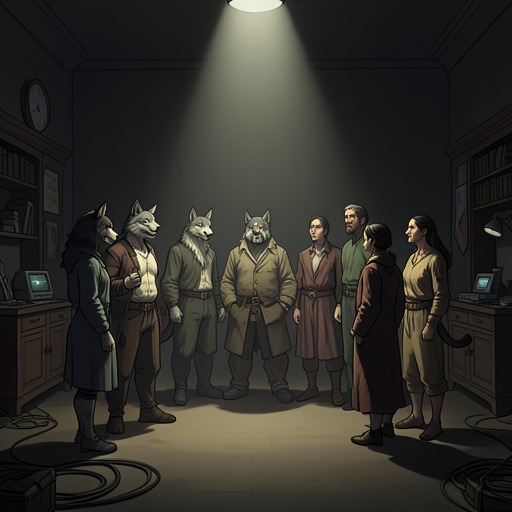
Werewolf transformation
Of Fates & Fables (The Complete Series)Werewolf transformation is the change from human to wolf that follows either birth into a shifter family or being bitten and turned. The novel presents it both as a normally private act associated with love and as a dangerous process that can be imposed through violence. Its consequences extend beyond the body: a newly turned person must survive a difficult first change, confront unfamiliar senses and abilities, and contend with the pack allegiance carried by the venom that caused the transformation.
Forms and Ordinary Conditions
The novel distinguishes between being born a werewolf and becoming one after a bite. Kash explains that shifters can be born to two shifter parents or be bitten and turned. This distinction matters in a story where bloodline and pack membership are politically charged, but the physical transition is not described as a simple expression of ancestry: a bite can make a human part of the supernatural world without making the process voluntary or safe.
Under ordinary circumstances, turning is not the frenzied spectacle Romy expects from books and films. Kash describes it as gentle and extremely private, normally undertaken when a shifter falls in love with a human. His account establishes an intimate model of transformation against which the novel’s later coercive bites can be measured. The difference is not merely one of pain: a loving choice preserves the human’s agency, while a violent bite can place that person within the attacker’s sphere of control.
The body’s first change is a separate ordeal within that larger transition. After Danielle is bitten, Kash warns that she will not die but will wake as a werewolf, and that she may wish otherwise in the immediate aftermath. He says the first change is always the hardest and expects Danielle to face several rough days. The transformation therefore does not end when venom has entered the body; it begins a difficult adjustment whose physical and emotional effects require care.
Danielle’s Attack and the Cost of Turning
Romy encounters Danielle lying pale on the ground, convulsing as a massive gray wolf stands over her and licks the wound on her shoulder. Kash prevents Romy from treating the scene as an ordinary human emergency: Danielle has been bitten, he explains, and human medical intervention cannot save her from the change now underway. She is not expected to die, but she is already on a path toward waking as a werewolf.
Danielle’s name makes the attack personal for Romy, who asks what will happen to her. Kash says Lynch will take her directly to the medical ward, where a healer must examine her before Romy can visit. The healer and the ward mark a distinct system of care for a body undergoing a supernatural transition. The need for that care also makes clear how abruptly a bite can separate the newly turned from ordinary human support: Romy cannot simply stay beside her friend or arrange treatment as she would after a conventional injury.
The change carries lasting social costs as well as a painful beginning. Danielle later says that she survived, but her former life was gone: she had to leave school because she could not control her shift, lost her scholarship, and saw her plan to attend medical school disappear. Her account refuses to treat transformation as an uncomplicated gift of strength. A new body may bring powers, but without control and support it can also disrupt education, livelihood, and a person’s imagined future.
Transformation as Coercion and Pack Politics
The novel sets this intimate model against a political program built around forced reproduction. During Nick’s interrogation, he blurts out that the pack needs women to create a pure bloodline. The statement exposes the ideology that turns women’s bodies into instruments of pack expansion. Transformation, in this setting, is not just a change of species: it can be a mechanism through which an aggressor seeks to claim, control, and reproduce through another person.
Brody makes that threat explicit when he tells Romy that Justice will turn her and then try to keep her pregnant. His threat fuses the bite with forced breeding, showing how the transformation is meant to initiate a broader regime of bodily control. Later, after Derek bites Romy, Brody claims she is becoming one of his. Romy counters that if Derek turned her, she would belong to Derek instead, and that this would contradict Brody’s Alpha orders. Her response shows that she understands the bite as carrying a contested affiliation, not merely producing a physical change.
That distinction becomes decisive when Romy is wounded by Brody and near death. Kash explains that Brody’s venom remains in her body; unless Kash adds enough of his own venom to outweigh it, she will wake belonging to Brody’s pack. In an ordinary turning, Kash says, this would not be so risky, but Romy has lost too much blood. The emergency makes the usual private process painful and dangerous: allegiance has become a race between competing venoms, and the injury leaves little room for a safe, gradual change.
Romy’s Emergency Turning
Kash tells Romy he must put more of his venom into her than Brody left behind, apologizing because the process will hurt. Lynch confirms the stakes: Birdie has been trying to stop the bleeding, but Romy’s survival depends on Kash biting her enough times for his venom to outweigh Brody’s. With Romy having lost so much blood, even the intervention intended to save her carries unusual risk. Kash acknowledges that this is not how turning normally happens and asks her to stay with him as he bites her wrist and licks the wound.
The bite is thus both injury and rescue. It cannot erase what Brody has done; it answers it by trying to prevent Romy from waking under his pack’s control. When the venom takes hold, the coals inside Romy flare again, and the story carries the transformation through her altered perception rather than treating it as a completed medical procedure. The intimate language of a normal turning has been displaced by urgency, pain, and the need to keep her alive and free of Brody’s claim.
Romy wakes to Talia’s shriek and initially tries to answer, only to hear a yipping bark. She discovers red fur covering her four-legged body and recalls the sequence that brought her there: the witch, Brody’s bite, and Kash sealing his venom inside her. Her first awareness of the new form is therefore a collision between memory and bodily evidence; she knows what happened, but her voice and shape no longer behave as human ones do.
First Changes, Senses, and Agency
Romy and Talia’s early adjustment makes transformation a practical challenge as well as a dramatic revelation. At the university campus, Romy gags at the overwhelming smells, and she recognizes that Talia’s wolf senses are similarly overloaded. Kash and Lynch nevertheless judge their adjustment better than that of other newly turned wolves. Their transition has been unusually seamless, a difference that helps explain why the women are trusted to act without the men staying at their sides.
That developing competence changes what the newly turned can do in the conflict. Romy has gained compulsion, which she sees as a new power that can protect her and her friends. The ability does not make the dangers disappear, but it alters their prospects: the women are no longer limited to waiting for rescue while others decide what happens next. Their plan is allowed to proceed with Justice as backup, and Romy understands her new capacity as a possible means of ending the crisis sooner.
The novel’s treatment of transformation consequently holds vulnerability and agency together. Danielle’s experience shows how an uncontrolled shift can cost someone her education and intended career; Romy’s experience shows the danger of a forced bite and the risks of countering one pack’s venom with another’s. Yet the new form also brings heightened senses and, for Romy, a protective power she can use. Transformation is neither a simple liberation nor a simple curse: its meaning depends on consent, care, control, and the struggle over who has the right to define a newly turned person’s future.